The architecture, latency & cost techniques, and eval practices for agents that make it easier to buy and sell online.

Over the past year, we've worked with teams across the commerce industry — retailers, marketplaces, travel, entertainment, and telecom providers — to build commerce agents using Claude.
These agents are in production, and enterprise customers have seen larger carts and more efficient seller operations when using them. They also share a simple architecture: Claude in an agent loop equipped with a set of skills, tools, and a strong eval suite.
This post is for the engineers and engineering leaders building these (or other consumer facing) agents. Part 1 covers the architecture, which you decide once. Part 2 covers latency and cost. Part 3 covers production: memory, safety, evals, and scaling the work across an organization.
We define a commerce agent as an agent that simplifies buying and selling across an online catalog.
Some agents face consumers: they search, compare, substitute, and assemble the order. That could be a retail cart, a travel itinerary, a mobile plan change, or seats held for a show. Some agents face the business: they answer questions about sales, run promotions and campaigns, and manage inventory and pricing.
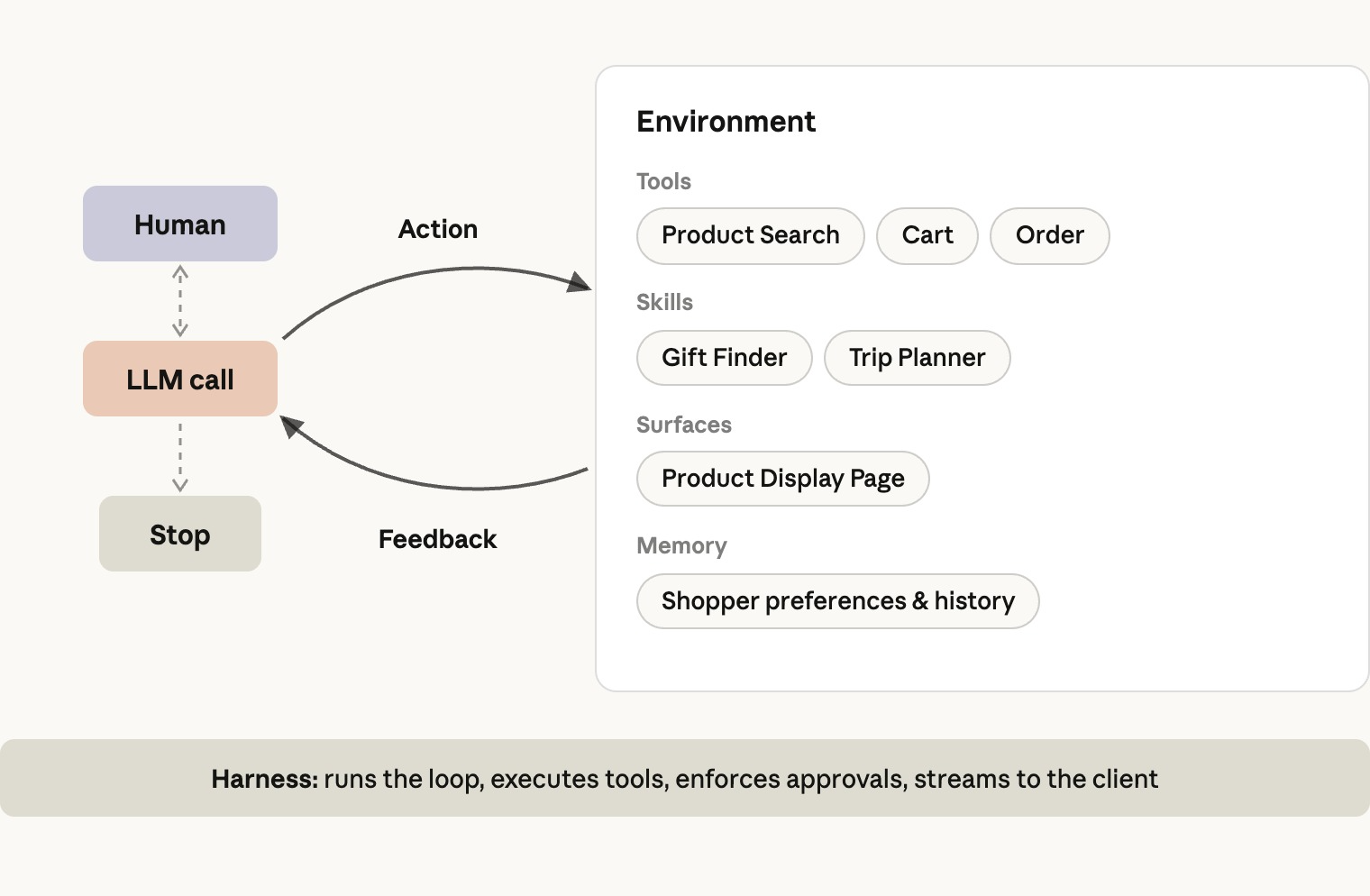
The core architecture is a model in a standard agent loop:https://www.anthropic.com/engineering/building-effective-agents: reasoning about a goal, exploring context, taking actions through tools, learning procedures through skills, asking clarifying questions, and observing the results until the goal is accomplished.
There is no intent router in front of it that segments the conversation and no set of domain specific agents behind it.
A commerce agent has to cover a wide range of capabilities across many categories and intents, which makes it tempting to create one subagent per domain.
In practice this proves suboptimal, because a commerce conversation is one tightly coupled session across multiple intents and turns, and requires considerable shared context.
In a subagent architecture, the orchestrator holds the cart or staged changes, the user's preferences, and the conversation history.
Every handoff to a subagent is a state-lossy operation, which often impacts the quality of the subagent’s response and, consequently, the overall response. On top of that, each handoff can cost several times the tokens and adds seconds of latency.
The domains also rarely separate cleanly. A returns flow might need the order history, the current cart, and the product catalog, meaning a subagent-per-domain approach either duplicates that access everywhere or hands off mid-task.
As models get smarter, they also handle longer context, more skills, and more tools, so the limits behind today's placement rules loosen with each model generation.
Instead, agent skills:https://platform.claude.com/docs/en/agents-and-tools/agent-skills/overview give you similar per-domain modularity and context control without the handoff tax, because the skill instructions load into the main agent that already holds the entire history.
In our comparisons across several enterprise deployments, a single agent with skills consistently has outperformed both the one-prompt-for-everything design and the subagent design on quality, and often at a lower cost and latency per task.
Where subagents do earn their place is when the orchestrator can call them as a tool for a narrow or self-contained task that would benefit from its own dedicated context window.
A common production example is a deep-research subagent, where the subagent searches and reads documents, writes and runs code, traverses data models, and hits dead ends. All the work happens inside one or more subagents, and only a compact answer comes back to the orchestrator.
The other exception is a domain that already has its own purpose-built agent. If your pharmacy or financial-services experience runs a dedicated agent with its own compliance surface, the right move can be a hand-off, where that agent takes over the task and works with the user directly through its own loop until the task is done.
The distinction is ownership of the conversation. A hand-off makes the domain agent the user's counterpart, while delegation keeps the orchestrator, bouncing the domain agent in and out within a single turn and degrading on every exchange.
The main factor when deciding whether to put a set of instructions within a system prompt or skill is how often the agent will need it. Loading a skill costs a model turn, so anything the agent needs on most turns generally goes in the system prompt.
This does, however, depend on how your traffic is distributed, and what agent behavior your evals show. A good starting point is that anything relevant to a third or more of your traffic, whether anticipated before launch or observed in production, goes in the system prompt, and the rest goes in skills.
If a skill is predictable from a signal you already have, such as the page the user arrived from, we recommend injecting it from the harness before the first model call and skipping the extra turn to load the skill.
Critical instructions, such as safety and legal rules, brand constraints, and key user facts such as allergies, always go in the system prompt.
For commerce agents, this means product search lives in the prompt, since nearly every session touches it, and skills carry the long tail of features.
In our reference implementation:https://github.com/anthropics/commerce-agents, the shopping agent's prompt holds grounding, cart and checkout semantics, and presentation rules, and the following skills cover the rest: search-discovery, purchase-research, planning-goals, customer-care, and memory-personalization.
The merchant agent splits the same way, with performance-insights, catalog-listings, inventory-operations, pricing-promotions, and marketing-campaigns as its skills, one per operational domain.
Our post on writing effective tools for agents:https://www.anthropic.com/engineering/writing-tools-for-agents covers tool design in general. Two points have mattered most in commerce:
Build agent tools on top of your core systems and logic.
A commerce company already has search and ranking, a cart, a preferences and profile store, an inventory system, promotion and campaign engines, sales analytics, and more, each encoding logic tuned over years and seeing signals the model never will.
The agent's tools should call those systems, not reimplement them, and the tool boundary is where their logic ends and the model's judgment takes over.
For example, when the agent calls search_products , the results should arrive already ranked; its job is to decide which results serve the user's goal, how many to show, and how to present them.
Return the fields the model reasons with and drop the rest. Image URLs on every search row are the usual offender.
As needed, reshape the raw response inside the tool, including appending a next step when it isn't obvious from the data.
This is especially relevant for error scenarios, where the model benefits from instructions instead of error codes. For example, add an error instruction "Include a product ID when querying availability," instead of a generic 403.
Most commerce agent responses are UI components rather than prose, whether a product carousel, an itinerary, a seat map, or a chart. That means the agent has to emit a schema rather than text.
Teams sometimes start by prompting the model to emit custom tags and parsing them on the client-side. This stops working as the surface grows, because:
The pattern that has held up is to make each UI component a tool. The model calls present_products , present_itinerary , or present_plan_comparison with typed arguments; your server validates and enriches the call and emits an event; and your client renders it.
As the components are tool calls, they're already in the messages array in native format, so you don’t need to re-parse when you reload an old conversation. An example presentation-tool contract is illustrated below and in the reference repo.:https://github.com/anthropics/commerce-agents
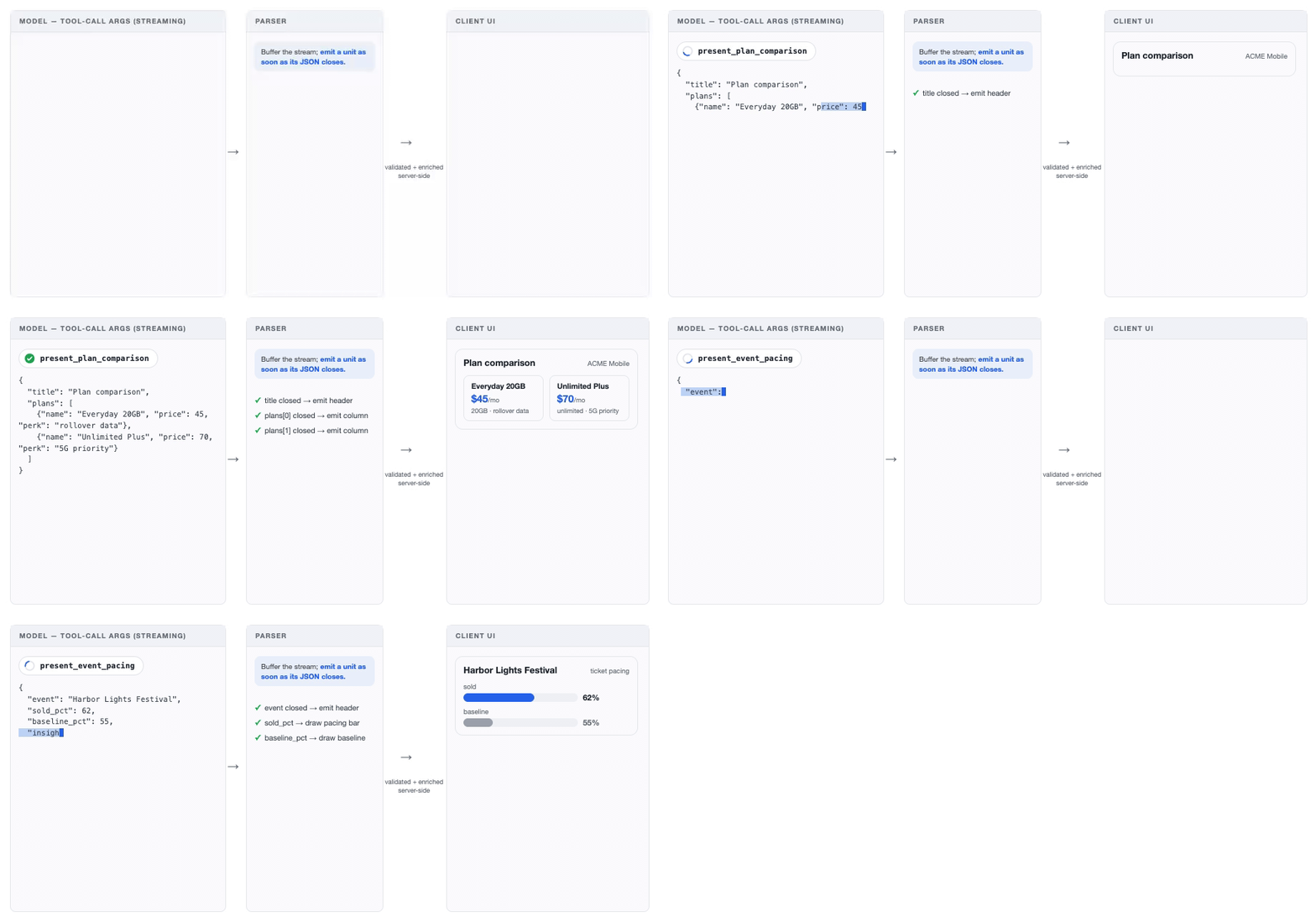
The tradeoff is streaming granularity. Each top-level argument of a tool call buffers on the server for validation, so the sub-components of a presentation tool arrive in steps even with streaming on. This impacts perceived latency.
To get a token-level stream, set eager_input_streaming: true on the tool definition, which skips the buffering and with it the server-side schema guarantee.
In our evals, schema violations are very rare on Claude Sonnet-class models and up, but wrap the call in a retry for the cases where one slips through.
Presentation tools also give the agent a record of what's on screen. When a customer says "the first hotel" or "the third one down on the left," the layout is in the messages array, in the arguments of the last presentation call.
For that to work, the arguments have to reflect the rendered layout, so structure them the way the UI is structured, as ordered rows and carousels rather than a flat list the client rearranges.
Latency matters in commerce, and consumer surfaces are the least forgiving. However, on agentic surfaces, what we have consistently seen move metrics like retention, engagement, and cart size is the quality of the outcome.
Whether the answer was relevant and the task actually completed was more critical to those metrics as compared to marginal latency gains.
So attack latency on two fronts. Minimize end-to-end latency through good engineering, and pair that with dropping perceived latency (since time spent watching an agent work reads as progress).
Every user has a latency budget, and the techniques below keep the agent inside it without spending intelligence to get there.
Task completion latency is the sum, over model turns, of time to last token plus tool processing. That gives you three levers to work towards: fewer turns, faster tools, and faster tokens. These levers sometimes compete, so the thing to minimize is the sum rather than any one of them.
Query complexity adds turns, and is generally out of your control. Model intelligence and relevant context help the agent get to task completion in fewer turns. Some of our key learnings in this area include:
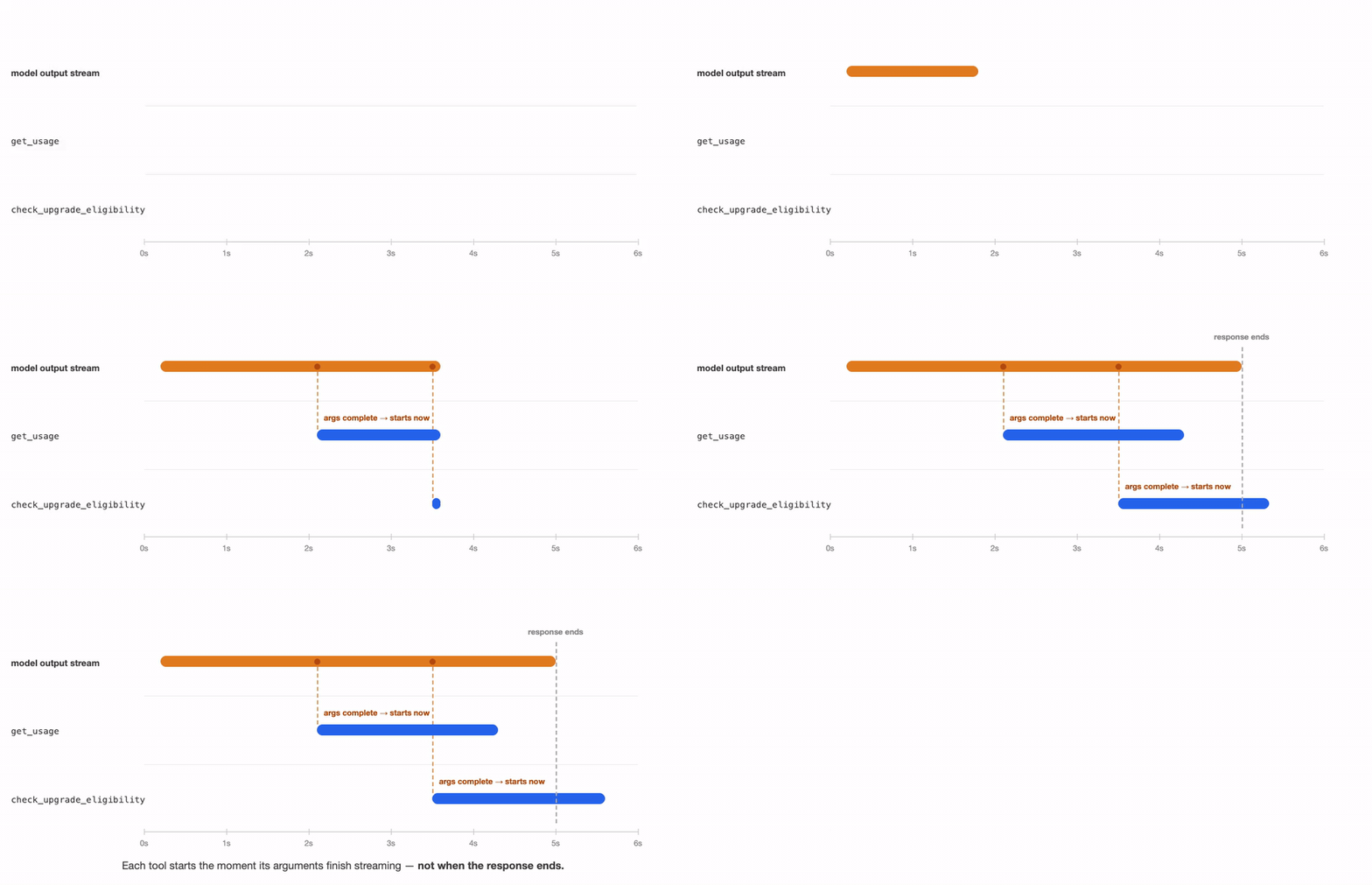
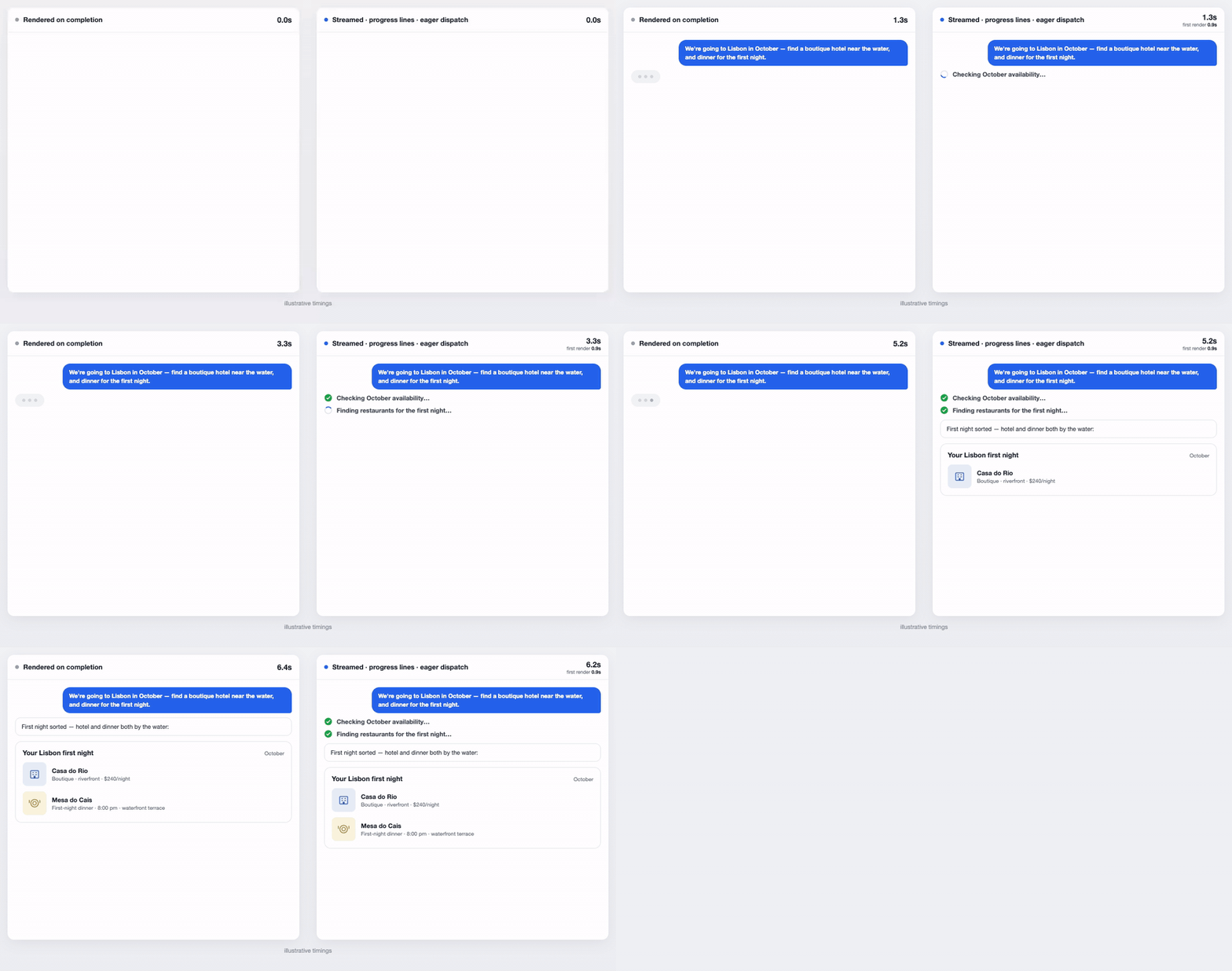
Perceived latency is the time a user feels until the screen does something. It’s especially critical in consumer-facing use cases where any transaction friction impacts checkout rates and revenue. Two techniques shorten it without touching the model:
Prompt caching is your largest cost reduction candidate and commerce traffic is well-suited for it. Cached input token reads cost a tenth of fresh ones, and while cache-writes carry a premium of roughly 1.25x, a cached prefix pays for itself on its second use. In customer facing applications where volume is large, you have a unique opportunity to hit very high cache levels using the cheapest, default 5 minute cache expiration.
The best commerce deployments we've seen run at 90–99% cache hit rates, and that is the range to design for from the start. Our experience has shown cached token reads are also around 1.5 to 2x faster at ~100k tokens, with relatively linear scaling the more tokens there are.
Caching is prefix-based. A request reads from cache up to the first byte that differs from a previous request, so what matters is not just what is in the context but the order it is in. Think of a request as three segments, ordered by how often they change:
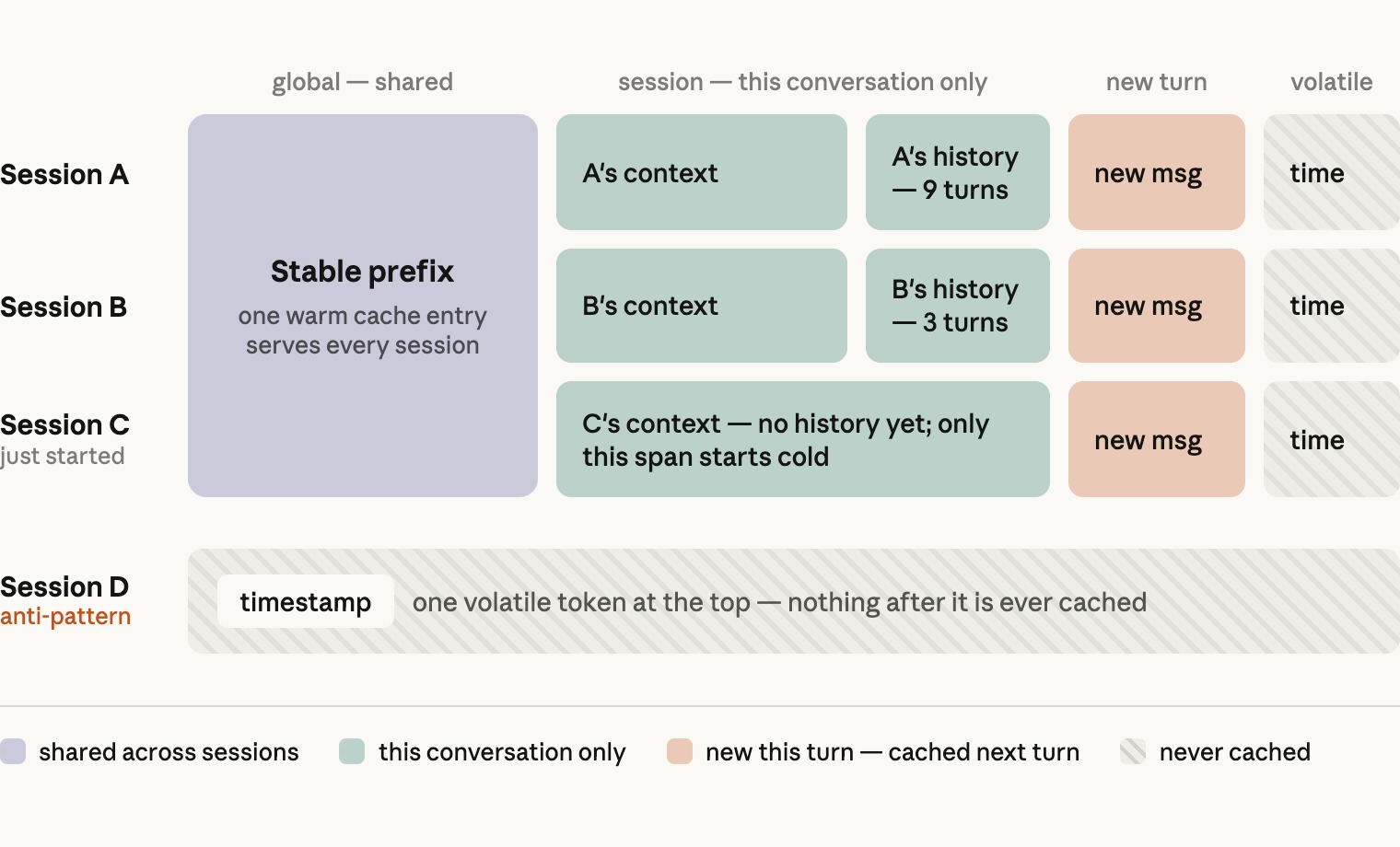
There are two implementation details to remember here. First, skills should be loaded as tool results rather than appended to the system prompt. The skill body then lands in the conversation prefix and is cached along with it.
Second, roll your breakpoints forward in each turn: a request allows a limited number of breakpoints, so move the newest one to the end of each user turn. Each round then reads the accumulated history, including long tool results such as search responses, from cache.
Model size and the effort setting:https://claude.com/blog/claude-model-and-effort-level-in-claude-code are the same tradeoff – intelligence against latency and cost – and you should choose both by measurement:
Measure cost per completed task rather than per model call, since a cheaper model that needs more turns, or fails more often, is not cheaper. When the result is close, and the cost fits your per-task economics and latency, choose intelligence. Quality is what drives adoption and retention, and allows for room to build for the next 6 months as models become better.
Lastly, we talk about what gets an agent through production: memory, safety, evals, and scaling the work across an organization.
The relationship and interactions you have with your customers matter. Memory is what lets an agent pick up where the last conversation left off instead of starting from nothing. A shopper who mentioned a nut allergy in March shouldn't have to repeat it in June, and a merchant who checks the same three campaigns every Monday shouldn't have to name them each time. Long-term memory, the facts that should survive across sessions, is a system you build and it has three parts: how facts are stored, how they are written, and how they are read.

 Scan to open this article