In January, Department of Homeland Security ( dhs ) officers killed at l east :https://www.theguardian.com/us-news/2026/jan/28/deaths-ice-2026- two people. In both cases, a federal agent grasped his gun, aimed it at a peaceful citizen, and shot them dead.
I learned that Google sells its Cloud services to the relevant agencies within dhs . :#google-supports-the-immigration-enforcement-supply-chain I thought that was wrong. Federal agents should not be able to kill citizens in the street. I set out to find the most effective way to push my company to stop serving these agencies. My divestment campaign quickly broadened into an attempt to prevent Google from signing an unethical military AI deal, as the Pentagon started pressuring AI providers into military AI deals with no restrictions against use for killer robots or mass surveillance. 1:#user-content-fn-surveil
I wanted AI ethics commitments to hold under pressure. In particular, I wanted Google DeepMind ( gdm ) to maintain its existing commitment against supporting killer rob ots. :#preparing-for-lunch-with-jeff-dean Over several months, I asked many people to act. I asked senior people—respected people—people with reputations silvered by their concern about AI ethics and safety. Nearly all declined.
Take Stuart Russell, a famous AI researcher who spent over a decade crusading against autonomous weapons. I worked at his lab for years. At a conference, on-stage, he agreed to push his organization to make a statement supporting AI providers against government coercion and promised a poll of the organization’s members. The statement and poll both vanished.
Or take Jeff Dean, who is Google’s Chief Scientist and the co-lead of Google’s Gemini AI project. In 2018, Jeff signed a pledge to never support the development or use of killer robots. I got Jeff to publicly and boldly co-sign an amicus brief (where outsiders weigh in to sway a lawsuit) backing Anthropic against the Pentagon. But I also asked him to use his immense leverage to stop Google from making its own unethical deal with the military, and I don’t think he did. He remains at Google despite his pledge.
I wrote a 25-page proposal containing contract language and oversight mechanisms. Military- and surveillance-law experts praised the proposal, which represented a principled counteroffer Google could have stood by. I sent the proposal to Demis Hassabis ( gdm ’s ceo ) who routed it to senior policy staff, only for the proposal to wilt unattended until Google signed a deal.
Senior management had insisted that Google wouldn’t sign. I disagreed with them, but they largely ignored my warnings. While I may have increased the Pentagon’s hesitation around the d eal, :#jeff-signs-an-amicus-brief-supporting-anthropic Google still signed a deal handing over their AI without restrictions against killer robots or mass AI spying. Google’s contract restrictions were even weaker than OpenAI’s.:https://fortune.com/2026/05/04/google-employee-backlash-pentagon-ai-contract-power-waned-since-project-maven/ At that point, I couldn’t stay at Google in good conscience, so I left.
This essay tells the story of why I left Google DeepMind. It is also the story of something larger: how powerful people and institutions failed, one after another, to keep their AI ethics promises in the face of pressure.
Throughout this essay, I never quote anyone’s private words without permission. Where private conversations matter, I characterize them minimally. I otherwise keep to my own actions, public information, and official communications. You can’t verify my characterizations, so weight them accordingly. This minimization has cut content which would have supported my arguments.
After Alex Pretti’s death, I was determined to take effective act ion. :https://turntrout.substack.com/p/a-winter-spent-by-the-pond To determine how to reduce harm from dhs , I researched Big Tech’s entanglement. Certainly, Microsoft and Amazon have larger involvement,:https://www.forbes.com/sites/the-wiretap/2026/01/27/immigration-record-spend-on-amazon-and-trump/ but I was surprised to learn of Google’s exposure.

The stereotypical activist action is to make a petition. But Google had already ignored a large petition on this is sue. :https://www.cnbc.com/2026/02/07/nearly-a-thousand-google-workers-sign-letter-urging-company-to-divest-from-ice-cbp.html Plus, Google’s executives likely hardened their company against stereotypical organizing tactics. Sit-ins, strikes, even a mass of Google engineers quitting: I deemed all of them ineffective (if I could even pull them off).
As I strategized, I judged that Google would not care about 100 random research engineers quitting. No, in the AI industry, talent is top-heavy and teams are driven by a few hard-to-replace stars. I didn’t need to coordinate 100 engineers. Perhaps I just needed to coordinate 10.
I’d followed the news and guessed that Sundar Pichai (Google’s ceo ) was more of a businessman than a “make me a big speech about ethics and I’ll change my mind” kind of guy. But if a few hard-to-replace people were ready to walk, that would matter for the business, so Sundar might listen.
That’s when I remembered reading Jeff Dean tweeting about how bad ice was, retweeting Anne Frank quotes. Maybe I didn’t even need 10 engineers, I just needed one .
Jeff is considered a saint at Google. He was Google’s 30 th employee, developed key algorithms, and is known as a man of principle. A common joke: it’s easier for Jeff Dean’s resume to list what he hasn’t achieved than what he has. He’s Google’s Chief Scientist and a co-lead of Google’s Gemini effort. A Jeff departure would be a disaster for the company.
But if Jeff cared so much and had so much leverage, why was Google in these ice contracts in the first place? Of course, you can’t be Chief Scientist and constantly get what you want by threatening to quit. But I still felt confused.
At first I thought about who could put me in touch with him. But (and this is a good general lesson) if you want to talk to someone about something, you can always just ask them !
I told Jeff that I respected him for speaking out, that I wanted Google to divest from the dhs supply chain. I asked if he shared these goals and, if so, how I could help.
He suggested it’d be reasonable for me to email a few guys. Their names: Sundar Pichai ( ceo of Google), Demis Hassabis ( ceo of Google DeepMind), and Thomas Kurian ( ceo of Google Cloud). I thought “sure, Jeff. No problem. I’ll just tell them what I think.”
I’m writing as a concerned employee at gdm . I recently messaged Jeff Dean regarding my concerns. He suggested that directly emailing the three of you was a reasonable next step.
I have no problem with Google working with lawful administrations of either US political party. My concern is not about politics, but rather about the events enabled by Google’s role in the dhs supply chain.
I think that ice has gone well beyond its legal mandate to remove illegal immigrants from the country in an orderly fashion. According to watchdogs, ice operations frequently deprive targets of due process. These operations regularly detain citi zens :https://www.cbsnews.com/minnesota/news/woman-american-citizen-describes-being-held-by-ice-for-two-days/ in facilities operating with minimal (or no) legal oversight.:https://www.americanimmigrationcouncil.org/press-release/report-trump-immigration-detention-2026/ Over 1,000 people are missing from one such location.:https://www.projectcensored.org/detainees-missing-ice-alligator-alcatraz/ At other locations, the aclu reports human rights abuses and a severe lack of safety for detainees.:https://www.aclu.org/news/immigrants-rights/detained-immigrants-detail-physical-abuse-and-inhumane-conditions-at-largest-immigration-detention-center-in-the-u-s
These are not standard, legitimate enforcement activities. These operations are troubling from a human rights perspective and also pose reputational risk to any vendors involved.
On 1/28/26, the dhs posted its 2025 AI Use Case Inventory,:https://www.dhs.gov/publication/ai-use-case-inventory-library which lists Google as one of several GenAI providers which “improve the operational efficiency” of dhs . I urge Google to immediately stop working with ice (and dhs more broadly), including via support for third-party integrators facilitating these specific operations. Whether through a direct (“prime”) contract or through intermediaries (like ITC Federal:https://itcfederal.com/news/itc-federal-achieves-ato-for-dhs-ice-cloud/), Cloud and Gemini must not power these operations.
History will judge the tech sector by its involvement in these events. I love working at Google, and I want to ensure Google is on the right side of that history.
They never replied. I returned to Jeff and asked for a lunch to discuss constructive opportunities for real change within Google. I told him: “any time, any place. I’ll drive down to Mountain View to meet with you.”
At this point, I thought this was where “plan A” would fail. To my surprise, he actually accepted, for a lunch a few weeks out.
The Pentagon wanted the frontier AI lab Anthropic to remove red lines from its existing contract: red lines against lethal autonomous weapons systems and AI spying / profiling. The ultimatum was essentially “give us your product or we will designate you a supply chain ri sk.” :https://www.nytimes.com/2026/02/24/us/politics/pentagon-anthropic.html The government wanted the AI for “all lawful use.”
There were two major problems with that kind of deal.
I’d been following the Anthropic–Pentagon standoff for weeks. That morning, I read about the ultimatum. I was attending a conference in Paris held by the International Association for Safe and Ethical AI ( iaseai ), which is a nonprofit:https://iaseai.org/about founded in 2024 to be “a unified voice” for safe and ethical AI. The world-famous AI scientist Stuart Russell chairs its steering committee. Its 2026 working groups:https://iaseai.org/working-groups include “Red Lines for Advanced AI,” focused on “autonomous weapons and escalation.” iaseai seemed built for a moment like this.
Iaseai ’s venue would be full of influential AI professionals who care about ethics. I thought: we can organize a response, as a field, in support of 1) Anthropic’s right to do business without threat of destruction and 2) actual standards for whether and how to integrate AI into lethal autonomous weapons systems and surveillance apparatuses.
Anthropic had two days to comply with the administration’s demands. Perhaps other companies would agree to these “all lawful use” terms before the deadline. The main question which weighed on me: can I stop Google from caving, from accepting an “all lawful use” deal? If Anthropic says “no” and Google also says “no,” now we’re getting somewhere. That seemed hard. I wanted to make it happen anyway. Google could cave at any moment, whether before the Friday deadline or after.
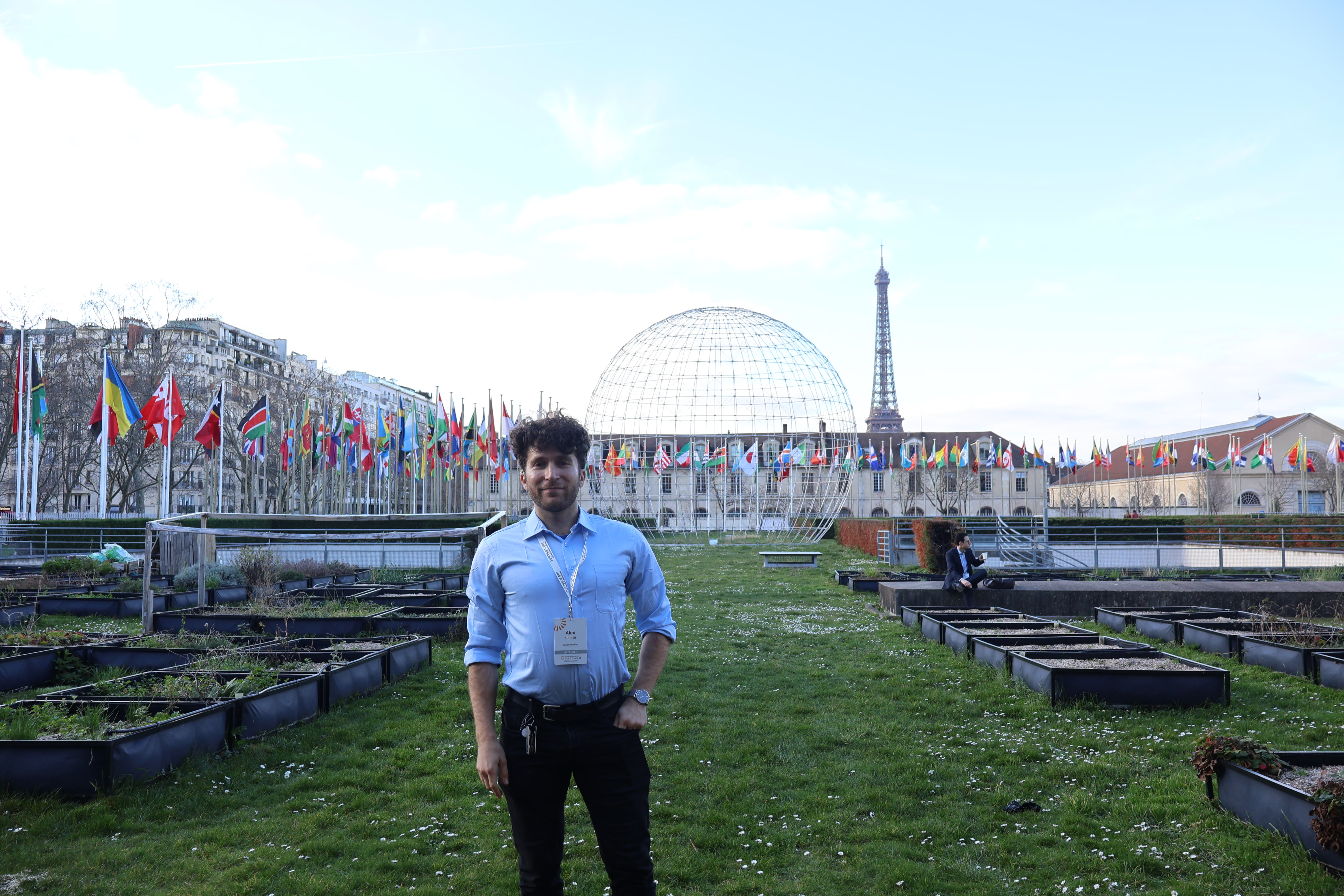
When I arrived at the iaseai venue, I expected some of the hundreds of AI professionals to be discussing the urgent ai ethics news which just dropped. Instead, no one besides me brought it up. People busied themselves with the usual abstractions: “how does public choice theory inform coordination problems?”.
Most importantly: the leading figure in the global campaign to ban lethal autonomous weapons,:https://awards.acm.org/award_winners/russell_3816360 with his site highlighting over two hundred prestigious talks on the subject .:https://people.eecs.berkeley.edu/~russell/research/LAWS.html He presented the Slaughter bots :https://www.youtube.com/watch?v=O-2tpwW0kmU vi deos :https://www.youtube.com/watch?v=9rDo1QxI260 to the United Nations. If anyone on this green planet Earth had a reason to call out an “all lawful use” military AI deal, it was the man who organized the field against slaughterbots .
I briskly gathered information. Hinton was speaking remotely, so I’d have to reach him indirectly, likely through Bengio or Stuart. I knew Stuart already and had a friend who could get me in touch. Bengio was the wildcard. I saw him leaving the venue, so I ran to catch him.
“Yoshua, would you be willing to make a statement supporting Anthropic’s right to do business and pushing against unregulated killer robots?”. I clarified that his voice could influence the many gdm professionals who respect him, professionals who might be mobilized to push against “caving” to the Pentagon’s demands. He told me to email him.
Soon after, his office told me they decided they weren’t going to make a statement. They didn’t explain why not. Since I didn’t know Bengio, I figured I should focus my attention on Stuart Russell and then let him handle it.
At lunchtime, I saw Stuart speaking with someone 1-on-1. With the encouragement of several attendees, I overcame a dash of social anxiety and interrupted his conversation as politely as I could.
“Stuart, this is an extremely important situation and your voice matters,” I told him. “Can you make a statement? Can you get the iaseai organization to make a statement, too? Can you move the people inside of these companies?”. He considered. He agreed. He would try to get Bengio and Hinton on board. He would convene an iaseai vote asap and announce it at the closing of the conference later that day. He didn’t hedge his willingness to fight.
“Now that’s what I’m talking about,” I thought. “Here’s a powerful guy who knows his power.”
AI company / DoD deals mattered . They marked the first public, high-profile intersection between modern generative AI and military use restrictions. Whatever compromises (or capitulations) the companies made would reverberate as precedent into the future. Iaseai attendees had a chance to take their contributions from “abstract work which might inform policymakers” to “directly influencing precedent.” Stuart was now going to mobilize them.
As promised, he spoke about the issues at closing. I recorded his remarks during the Q&A, which were originally available on iaseai ’s conference schedule:https://www.iaseai.org/schedule-2026?date=2026-02-26 but were later migrated and not reuploaded to iaseai ’s official YouTube chan nel. :https://www.youtube.com/@IASEAI
Should iaseai make a statement in support of Anthropic’s right not to have its software used in purposes that are outside the contracted areas that it agreed to have it used for?
The question said, “what about Google DeepMind, what about OpenAI”—are they also going to take the same stand as Anthropic? It seems like that’s up to them, but the right of a company to say “we don’t want to sell our product for that purpose”—and to be able to say that without threat of economic destruction. I’m not a lawyer, but it seems like that’s something that ought to be protected.
I was surprised. Stuart said “It seems like [taking the same stand] is up to them.” He didn’t encourage Google and OpenAI to avoid powering lethal autonomous weapons? Wasn’t that a defining cause for him over the last decade?
The next question from a conference attendee asked whether iaseai would take positions on current issues. As the session wrapped, iaseai ’s interim executive director Mark Nitzberg took the stage.
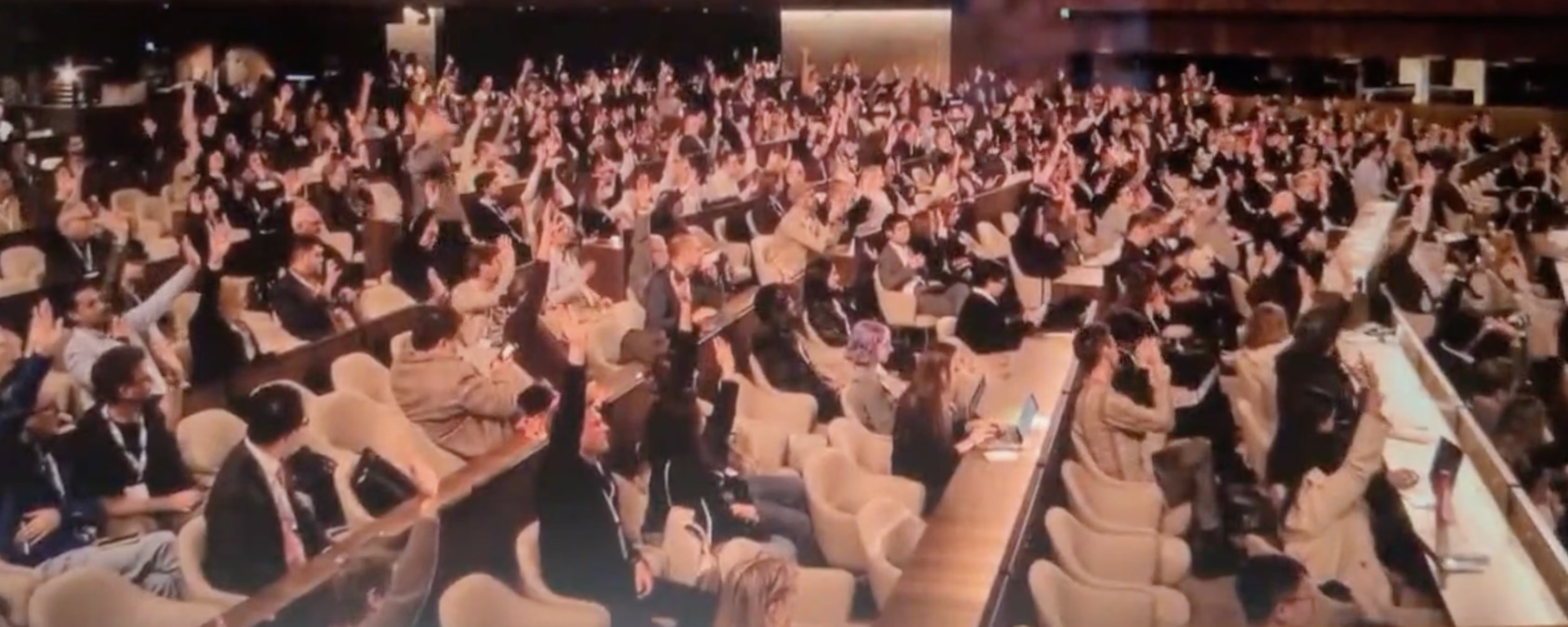
Many news outlets are discussing the extortion racket that the DoD is applying to Anthropic…
I think we will try to get an online poll if we have time to make this happen. So that we can publish a news release saying “92% (or whatever it turns out to be) of members of iaseai are in favour of the proposition that Anthropic should not be required to do what they don’t want to do.”
Stuart called the DoD’s actions an “extortion racket.” I appreciated the frankness, though frankness in the hall wasn’t the same as frankness in a statement the world would see. 5:#user-content-fn-coverage As I left, I signed up to be an iaseai member to participate in the poll. I thought it’d pass but wanted to make my voice heard. I paid the $75 membership fee.
Before the closing ceremony, Mark had texted me that the survey would close Thursday night. With 2/3 support, Stuart would sign a statement on iaseai ’s behalf, and without it, Stuart would sign a statement personally with the option for others to co-sign.
I left for an evening at the Louvre.
Thursday morning greeted me. I didn’t see how to vote in the poll. Strange. I texted Mark. He said iaseai would have to act after Anthropic’s Friday deadline.
I told Mark that the situation was urgent: Google and OpenAI could move at any point. I urged him to talk to Stuart about making his own statement, any statement. I appreciated that Mark was helping me figure out this situation. Later that day, Anthropic indicated they would stick to the red lines in their existing contract with DoD. :https://www.anthropic.com/news/statement-department-of-war
(Thursday was supposed to be the start of a romantic vacation in Iceland. I didn’t really want to be doing any of this.)
Friday morning. Stuart had not made any public statement. I asked Mark, “What is possibly more important than spending a few minutes composing an email to his favorite reporter?”. From my conversation with Mark, I learned that neither Stuart nor iaseai would act.
But here’s the thing. Mark committed publ icly :#stuart-closes-out-iaseai at closing that iaseai would hold a member poll. Mark encouraged people to pay dues and become members to participate. Then iaseai leadership silently cancelled the poll. 6:#user-content-fn-workshop No statement ever came.
Mark gave me an evolving list of reasons for his organization not making a statement:
I could appreciate the first reason: after all, Stuart had repeatedly disclaimed “time permitting” for making a statement before the deadline. But that last reason in particular didn’t make sense to me. Anthropic made a statement saying they won’t budge, so iaseai doesn’t need to make a statement supporting Anthropic?
The Pentagon set the Friday deadline for Anthropic, not for iaseai . The Anthropic autonomous weapons issue had been in the news for weeks:https://www.wsj.com/politics/national-security/pentagon-used-anthropics-claude-in-maduro-venezuela-raid-583aff17 prior. Anthropic’s lawsuit against the Pentagon:https://www.theverge.com/ai-artificial-intelligence/891514/anthropic-pentagon-lawsuit-amicus-brief-openai-google ran for weeks after. Google wouldn’t sign for two more months. Iaseai had plenty of time to act and plenty of ways to act, like filing an amicus brief, putting out a statement, or contacting senior decision-makers at Google.
OpenAI did announce a deal on Fri day. :https://openai.com/index/our-agreement-with-the-department-of-war/ OpenAI claimed its deal protected the same red lines against killer robots and mass surveillance that Anthropic had insisted upon. However, some analysts concluded that OpenAI’s contract language contains wide loopholes.:https://www.techpolicy.press/five-unresolved-issues-in-openais-deal-with-the-department-of-defense/
 Scan to open this article