Sakana AI 将这次合作框定为更大趋势的一部分。该公司认为,AI 的进展将越来越依赖于模型的评估、组合能力以及在实际工作流程中的整合情况。没有单一模型能在每个任务、语言、模态和企业环境中领先。这使得协调层成为开放 AI 下一个阶段的重要组成部分:https://the-decoder.com/new-review-paper-argues-code-is-how-ai-agents-think-and-act-not-just-what-they-produce/。广告 DEC_D_Incontent-2
Sakana AI 还以地缘政治的角度来定位这项合作。该初创公司将其贡献描述为一种日本的“集体智能”方法,旨在让全球开发者和公司能够访问不断增长的开放模型生态系统。当公司首次发布 Fugu 时,已指出依赖单一 AI 提供商的风险,并将可开放、可协调的模型作为应对监管或外交政策访问限制的对冲手段。
这家初创公司于 2023 年在东京成立:https://the-decoder.com/microsoft-and-google-dropouts-launch-ai-offerings-in-japan/,由前谷歌研究员 Llion Jones(Transformer 论文《Attention Is All You Need》的联合作者)和 David Ha 创办。从一开始,他们就在扩展策略的核心放置集体智能,而不是越来越大的单一模型。在发布 Fugu 之前,Sakana AI 已经设立了 RSI 实验室:https://the-decoder.com/sakana-ai-bets-ai-that-improves-itself-can-break-the-compute-arms-race-of-frontier-labs/,这是一个专注于递归自我改进的研究团队,旨在自动化 AI 开发过程本身。
保持 AI 动态的同步。清晰、有用,无废话。
关注 The Decoder 获取 AI 新闻、背景故事及专家分析。
The Decoder:https://the-decoder.com/
Tokyo-based startup Sakana AI is adding Nvidia's open Nemotron models to its Fugu orchestrator. The partnership is meant to prove that coordinated open models can keep up with frontier systems.
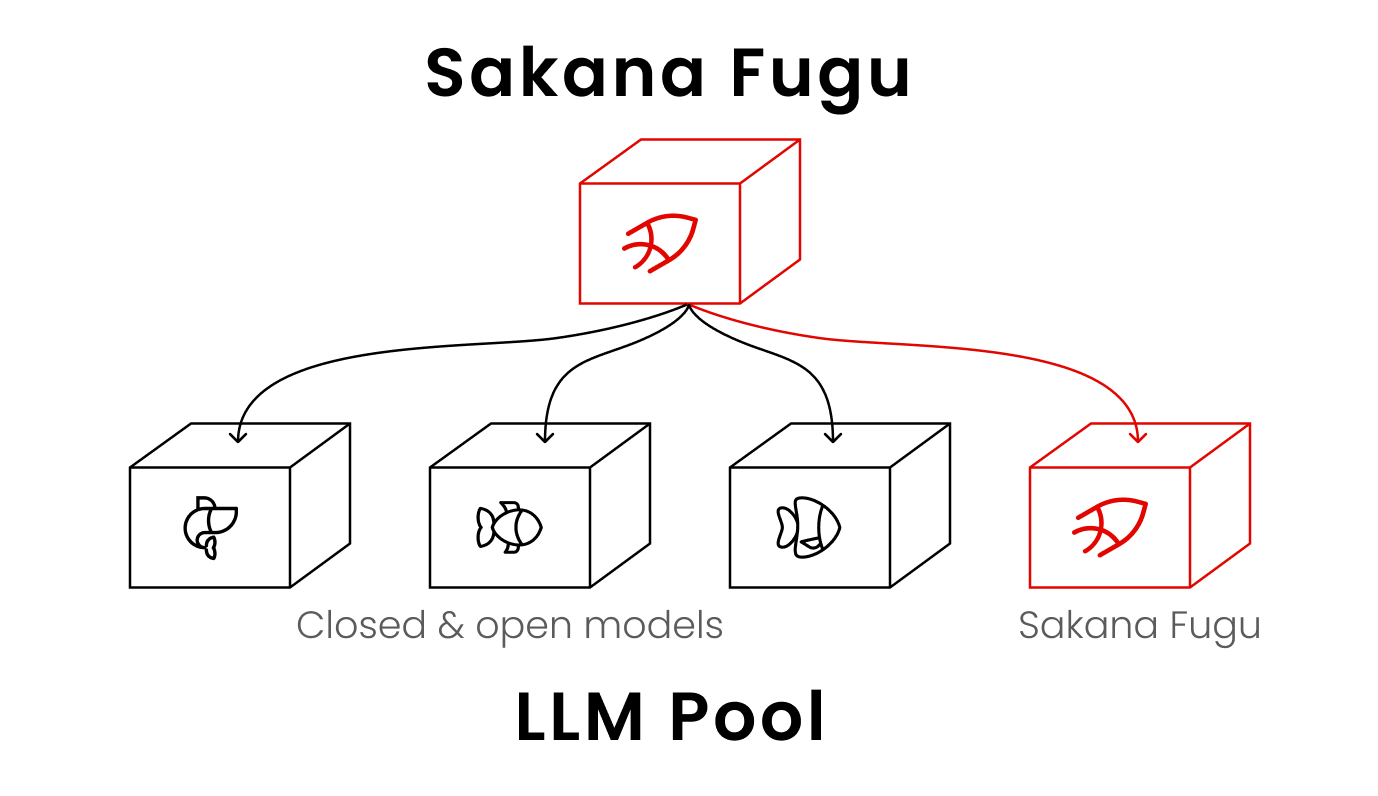
Sakana AI launched Fugu:https://the-decoder.com/sakana-ais-fugu-orchestrates-multiple-llms-to-match-anthropics-fable-and-mythos-benchmarks/ just recently. The system is itself a language model, trained to call other LLMs from an agent pool that includes instances of itself. Behind a single API, Fugu dynamically picks which models to combine for a given task, delegates subtasks, and synthesizes the results into one response.
The setup is modular. New models can be added at any time, so the system isn't tied to the strengths or outages of any single provider, according to Sakana AI. In its own benchmarks, the company claimed its stronger variant Fugu Ultra performed on par with Anthropic's Fable 5 and Mythos Preview:https://the-decoder.com/anthropic-releases-claude-fable-5-and-mythos-5-with-major-gains-in-coding-and-science/. Early independent tests were less enthusiastic, though, with criticism around speed and cost. Ad
Nvidia's Nemotron family consists of open-weight models and tools. Sakana AI points to their strengths in coding, tool calling, and instruction following. As specialist models, they're meant to complement the frontier models inside Fugu's orchestration layer, not replace them. Open models become more useful when they're orchestrated in agentic systems rather than deployed in isolation, the company says. Ad DEC_D_Incontent-1
Nvidia has been expanding the Nemotron lineup fast. With Nemotron 3 Ultra:https://the-decoder.com/nvidias-nemotron-3-ultra-becomes-the-smartest-open-us-model-but-china-still-leads/, a model with roughly 550 billion parameters and 55 billion active parameters, the company released what benchmark platform Artificial Analysis calls the most capable open US model to date. It ranks ahead of Gemma 4 31B:https://the-decoder.com/googles-gemma-4-is-now-available-with-apache-2-0-licensing-for-the-first-time/, gpt-oss-120b:https://the-decoder.com/openai-releases-its-first-open-weight-language-models-since-gpt-2-with-gpt-oss/, and Nvidia's own Nemotron 3 Super:https://the-decoder.com/nvidias-nemotron-3-swaps-pure-transformers-for-a-mamba-hybrid-to-run-ai-agents-efficiently/, but still trails Chinese models like Kimi K2.6:https://the-decoder.com/open-weight-kimi-k2-6-takes-on-gpt-5-4-and-claude-opus-4-6-with-agent-swarms/.
Nvidia also shipped Nemotron 3 Nano Omni:https://the-decoder.de/nvidia-veroeffentlicht-nemotron-3-nano-omni-samt-tiefem-einblick-in-das-training-multimodaler-ki/, a multimodal model that handles text, images, video, and audio, aimed at agentic use cases like document processing and computer-use agents. Together, the Nemotron family covers a broad range of capabilities that Fugu can draw from when picking agents. Ad
Sakana AI hasn't given a specific date for the integration, saying only that it will ship in an upcoming Fugu release. After that, the Sakana and Nemotron teams plan to monitor and optimize Nemotron's performance inside Fugu on an ongoing basis. Nvidia will provide technical guidance on Nemotron recipes and evaluation.
Sakana AI frames the partnership as part of a bigger trend. Progress in AI will increasingly depend on how well models can be evaluated, combined, and woven into real-world workflows, the company argues. No single model will lead in every task, language, modality, and enterprise environment. That makes the orchestration layer a critical piece:https://the-decoder.com/new-review-paper-argues-code-is-how-ai-agents-think-and-act-not-just-what-they-produce/ of the next phase of open AI. Ad DEC_D_Incontent-2
"The most capable AI won't come from any single model, but from many models working in concert," Sakana AI writes in its announcement:https://sakana.ai/nvidia-open-model-innovation/. In early evaluations, the orchestration-based approach showed strong performance alongside leading frontier systems. The announcement doesn't include any new benchmark numbers for the Nemotron combination, though. In practice, the deal means Sakana gets access to a wider pool of specialist models while Nvidia collects data on how Nemotron performs in multi-agent workflows. Ad
Sakana AI also positions the partnership in geopolitical terms. The startup describes its contribution as a Japanese "collective intelligence" approach designed to give developers and companies worldwide access to a growing ecosystem of open models. When it first unveiled Fugu, the company had already pointed to the risks of depending on a single AI provider and pitched open, orchestrable models as a hedge against regulatory or foreign-policy access restrictions.
The startup was founded in Tokyo:https://the-decoder.com/microsoft-and-google-dropouts-launch-ai-offerings-in-japan/ in 2023 by former Google researchers Llion Jones, co-author of the Transformer paper "Attention Is All You Need," and David Ha. From the start, they put collective intelligence rather than ever-larger single models at the center of their scaling strategy. Before Fugu, Sakana AI had set up the RSI Lab:https://the-decoder.com/sakana-ai-bets-ai-that-improves-itself-can-break-the-compute-arms-race-of-frontier-labs/, a research group focused on recursive self-improvement that aims to automate the AI development process itself.
Stay in the loop on AI. Clear, useful, no fluff.
Follow The Decoder for AI news, background stories and expert analyses.
 扫码直达文章详情