Anthropic 发布最强通用模型 Claude Fable 5,专为长时间、多步骤的复杂异步工作设计,可在 Claude Cowork 中自主执行深度研究、尽职调查等任务。...
产品更新Claude:Blog(网页)
今日 AI 情报摘要
Anthropic 发布最强通用模型 Claude Fable 5,专为长时间、多步骤的复杂异步工作设计,可在 Claude Cowork 中自主执行深度研究、尽职调查等任务。
该模型需手动选择,默认模型为 Claude Sonnet 5。
中文正文 · AI 翻译
Claude Fable 5 可以独立完成长期、复杂的工作。以下是在 Claude Cowork 中充分利用它的方法,从一个想法开始,直到完成整个工作。
Claude Fable 5 是 Anthropic 最强大的通用可用模型:https://www.anthropic.com/news/claude-fable-5-mythos-5,专为长期、复杂和异步工作而构建。Claude Fable 5 特别擅长独立执行多步骤工作流程(例如进行深度研究并将其整合到初稿备忘录中、在生成董事会演示文稿前进行尽职调查,或浏览文件夹以红线修改多个合同,仅举几例),在较长时间内不断测试和评估其结果。
最大化模型能力需要改变与模型的工作方式。随着模型不断改进,我们已优化了关于如何更好地利用 Claude 的建议,包括提示最佳实践:https://platform.claude.com/docs/en/build-with-claude/prompt-engineering/claude-prompting-best-practices、提供上下文以及构建技能:https://claude.com/resources/tutorials/teach-claude-your-way-of-working-using-skills,这些技能涵盖可重复的流程,如每周团队更新、销售电话准备或客户反馈分析。这些实践在 Claude Fable 5 中仍然重要,实际上,模型在应用这些方法时表现更佳。
Claude Fable 5 会在整个任务中应用你的上下文、偏好和技能:https://claude.com/blog/skills-explained,即便是需要数天完成的任务,而之前的模型可能在长时间内失去跟踪,需要提醒。与它合作就像与一位非常能干的同事一起工作:你解释情况,同意最终结果的标准,然后让你的同事去完成。你用于检查每一步的时间减少了,因此可以将更多时间用于决定工作内容。
我们为 Claude Fable 5 提供的提示指南:https://platform.claude.com/docs/en/build-with-claude/prompt-engineering/prompting-claude-fable-5 提供了详细的能力提升列表以及推荐的行为和提示调整。在本文中,我们将介绍其中一些如何应用于 Claude Cowork,这是 Anthropic 面向知识工作的代理 AI 系统。
Claude Cowork 是为创建完成的工作而构建的。给它一个目标,它会管理其余的工作,即使任务又大又复杂。一个大任务会被拆分为同时进行的多个部分,每个部分都有它自己的子代理,即 Claude 的一个独立实例,它处理工作的一部分并报告结果。Claude 通过这种方式快速处理大量信息。Claude 还通过在一开始设定计划来管理大型任务,并且可以在执行过程中对照计划检查自己的结果。
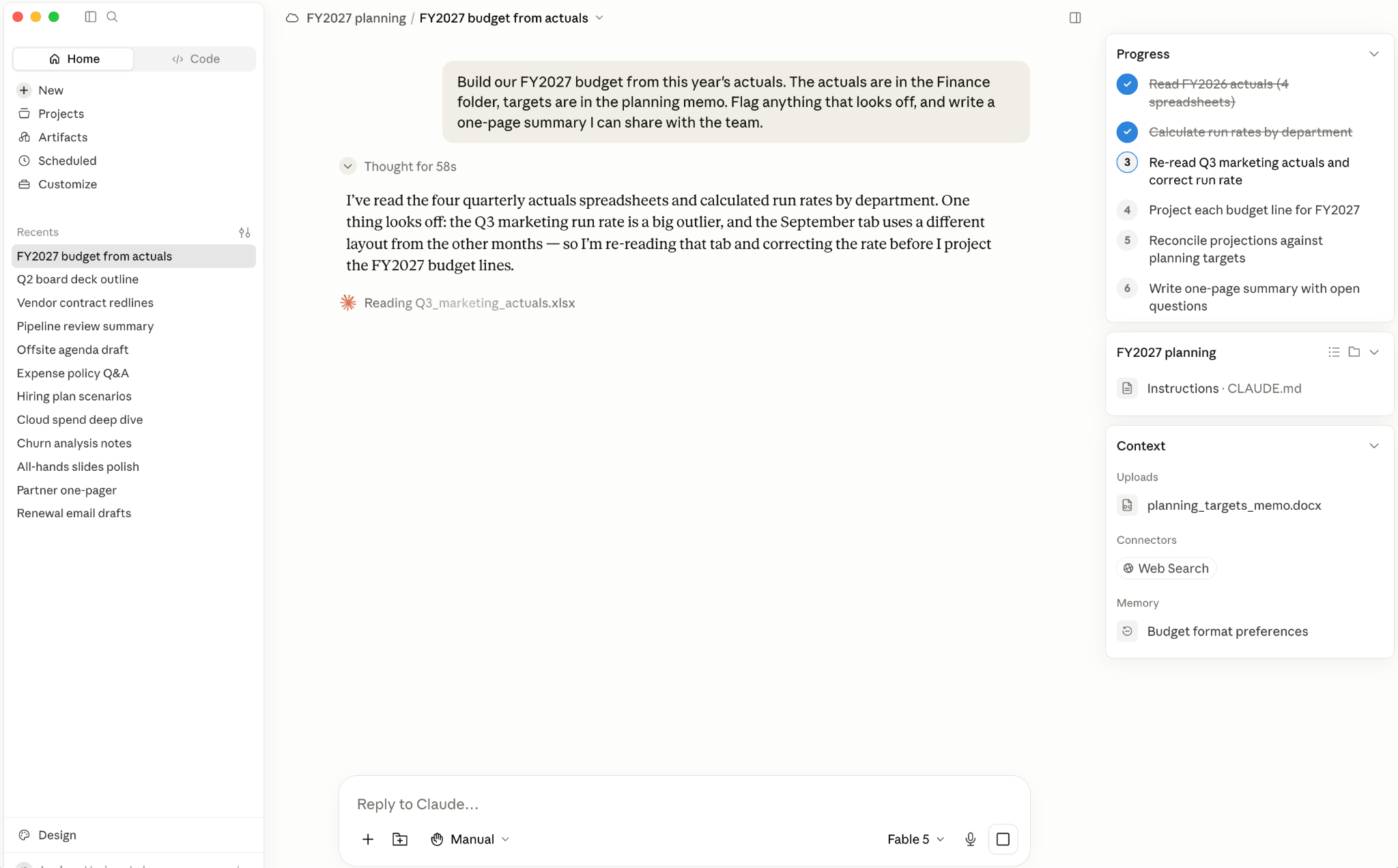
Claude Fable 5 在处理长且复杂任务方面远远领先于我们的其他模型:https://www.anthropic.com/news/claude-fable-5-mythos-5,而 Claude Cowork 的任务通常正是如此,需要几十个步骤,每一步都建立在前一步之上。比如这样一个项目:根据今年的实际情况来构建明年的预算。Claude 会访问并读取电子表格,提取运行率,预测每一行,与目标对比进行调和,并撰写总结。如果它在早期误读了一个运行率,这个错误将影响到之后的每一个预测。Claude Fable 5 会在开始前规划工作流程,并在执行过程中检查结果,因此它可以在任务运行时发现并纠正误读的数字。
Claude Fable 5 并不是 Claude Cowork 的默认模型;你需要手动选择。截至发布时,默认模型是 Claude Sonnet 5,它是处理日常任务、快速处理你自己也能完成的工作的合适选择。Claude Opus 是可靠的选择,适合已明确目标的深度工作,你知道最终结果是什么样的。Claude Fable 5 则适用于感觉最复杂或最模糊的项目,可能是之前的模型难以完成的工作。它会花更多时间思考,并消耗更多你的使用配额,但对于耗时或代价高昂、容易出错的工作,这可能是值得的。我们建议你将 Claude Fable 5 保留给最重要的工作,特别是那些需要使用多种工具并且需要一系列判断的任务。
你可以通过调节 Claude 的努力设置进一步优化你的选择。在较高的努力水平下,Claude Fable 5 会在开始工作前进行更多的计划,并在工作进行过程中更多地检查。对于你希望 Claude 从头到尾完成的复杂或多步骤项目,保持较高的努力水平。在较低的努力水平下,你会获得更快的响应,同时仍能利用 Claude Fable 5 的智能。考虑将其用于那些仍需前沿判断但不需要深入探索的任务,例如由许多简单步骤组成的自主运行任务,或 Claude 容易检查结果的工作。在我们的测试中,Claude Fable 5 在较低努力水平下的表现通常与早期模型在最高努力水平下的表现持平或更好。有关内部机制的更多详细内容,我们在 Claude Code 中解释了模型选择和努力水平的相互作用:https://claude.com/blog/claude-model-and-effort-level-in-claude-code。
同样值得注意的是,Claude Fable 5 配备了一组新的分类器:独立的 AI 系统,用于检测与网络安全或生物化学相关请求中的潜在误用。当触发这些分类器时,响应会自动由 Claude Opus 4.8 处理:https://support.claude.com/en/articles/15363606-why-claude-switched-models-in-your-conversation-with-fable-5,并在发生时通知用户。Opus 4.8 本身是一个非常强大的模型,从此聊天会继续使用 Opus;如果想恢复使用 Claude Fable 5,需要开启新的会话。我们保守地调整了这些安全措施,以便能够发布 Mythos 级模型:https://www.anthropic.com/news/claude-fable-5-mythos-5,既安全又快速地供一般使用,因此它们有时会捕捉到无害请求,包括 Claude Cowork 中仅涉及相关话题的短语。在我们优化这些安全措施时,正在努力减少这些误报。
当你开始一个任务时,你并不总是知道自己想要完成什么。最初的阶段,Claude Fable 5 可以成为一个强大的思维伙伴,而在 Claude Cowork 中,它会基于你的技能、工具和知识进行工作。
你可能习惯将任务拆分为多个部分,并为每一部分向 Claude 提示。Claude Fable 5 对中间提示的需求要少得多,因此你可以在 Claude Cowork 中委托完整的工作。
当过程对你很重要时,比如某个指标每次必须以完全相同的方式计算,你仍然应该自己写出步骤。但如果结果才是重点,只需描述目标,让 Claude 完成剩下的工作。逐步提示也可能限制它只能按你想到的步骤操作;而提供目标则给它寻找更优路径的空间。
在 Claude Cowork 中委托意味着将一个你通常会自己做的决策交给 Claude。你可以通过以下三种方式实现:
给 Claude Fable 5 更艰巨的工作,比你此前给 AI 的工作更多,甚至包括那些你认为不可能完成的工作。即使工作凌乱或不清晰,或者可能需要几小时或几天才能完成,也可以描述出来,看看模型是否能处理。选择一个你负责的成果,并说明你会如何评判,然后让 Claude 提出达到目标的步骤。这些工作中的部分可能会转化为自动运行的计划任务。Claude 可以将该流程保存为技能,并按计划执行,通过你已连接的工具完成任务。
Claude Fable 5 能够处理长篇工作的部分原因在于它知道如何制定并遵循计划。在 Claude Cowork 中,你可以在 Claude 工作时看到该计划:对话旁边的面板列出了它打算做的事情,然后是它正在读取和写入的文件,以及它正在使用的工具和技能。
当工作完成后,像审查同事的工作一样进行复查:打开 Claude 生成的文件并阅读它们。如果某些内容看起来不对,运行记录仍然保留在对话中。向上滚动查看 Claude 工作时列出的步骤,包括它读取的文件和使用的工具,并展开其思路以了解决策背后的推理。或者直接问:“这个数据来自哪里?”Claude 会指引你找到来源。
从你知道如何验证的工作开始,比如你团队下季度计划的初稿。如果你清楚优先事项,就能快速判断 Claude 的成果是否可靠。当结果证明可靠时,再委派更大的任务。
更强大的模型会提升你所建立的每个连接的价值,从你分享的文件夹到团队使用的工具。以下是我们向 Claude Fable 5 提供所需上下文以发挥最佳工作能力的建议:
随着前沿智能的持续进化,Claude Cowork 将变得越来越强大,能够处理更长时间的工作并开启更多知识工作用例。学习如何提示、管理上下文、检查 Claude 的工作以及委派任务,将帮助你充分利用 Claude Fable 5 及未来模型提供的一切优势。
本文由 Anthropic 教育团队的 Josefina Albert 撰写。
开始使用 Claude Cowork:https://support.claude.com/en/articles/13345190-get-started-with-claude-coworktoday。
嗨 Claude!你能把一个复杂的主题讲得简单明了吗?如果你需要我提供更多信息,请立即问我1-2个关键问题。如果你觉得我应该上传任何有助于你更好完成任务的文件,请告诉我。你可以使用你可以访问的工具,比如 Google Drive、网络搜索等——如果它们能帮助你更好地完成这个任务的话。不要使用分析工具。请保持你的回答友好、简短和对话式。请尽快执行任务——如果有一个可行的产物那就太好了。如果使用产物,考虑哪种类型的产物(互动的、可视化的、清单等)对这个特定任务最有帮助。谢谢你的帮助!
嗨 Claude!你能帮我理清这些想法吗?如果你需要我提供更多信息,请立即问我1-2个关键问题。如果你觉得我应该上传任何有助于你更好完成任务的文件,请告诉我。你可以使用你可以访问的工具,比如 Google Drive、网络搜索等——如果它们能帮助你更好地完成这个任务的话。不要使用分析工具。请保持你的回答友好、简短和对话式。请尽快执行任务——如果有一个可行的产物那就太好了。如果使用产物,考虑哪种类型的产物(互动的、可视化的、清单等)对这个特定任务最有帮助。谢谢你的帮助!
嗨 Claude!你能帮我准备考试或面试吗?如果你需要我提供更多信息,请立即问我1-2个关键问题。如果你觉得我应该上传任何有助于你更好完成任务的文件,请告诉我。你可以使用你可以访问的工具,比如 Google Drive、网络搜索等——如果它们能帮助你更好地完成这个任务的话。不要使用分析工具。请保持你的回答友好、简短和对话式。请尽快执行任务——如果有一个可行的产物那就太好了。如果使用产物,考虑哪种类型的产物(互动的、可视化的、清单等)对这个特定任务最有帮助。谢谢你的帮助!
Claude Fable 5 can carry long, complex work on its own. Here’s how to get the most out of it in Claude Cowork, starting with as little as an idea and getting to finished work.
Claude Fable 5 is Anthropic’s most capable generally available model:https://www.anthropic.com/news/claude-fable-5-mythos-5, built for long-running, complex and asynchronous work. Claude Fable 5 is particularly effective carrying out multi-step workflows (such as conducting deep research that it incorporates in a first-draft memo, performing due diligence before generating board presentations, or going through a folder to redline multiple contracts, to name a few) on its own for extended periods of time, testing and evaluating its results as it goes.
Maximizing the model’s capabilities requires a change in how you work with it. As models improve over time, we've refined our recommendations for getting more out of Claude, including prompting best practices:https://platform.claude.com/docs/en/build-with-claude/prompt-engineering/claude-prompting-best-practices, providing context, and building skills:https://claude.com/resources/tutorials/teach-claude-your-way-of-working-using-skills that capture repeatable processes like weekly team updates, sales call prep, or customer feedback analysis. Those practices still matter with Claude Fable 5, in fact, the model performs even better with them in place.
Claude Fable 5 applies your context, preferences, and skills:https://claude.com/blog/skills-explained across entire tasks, even those that take days to complete, while previous models may have lost track over long stretches and needed reminding. Working with it resembles working with a highly capable colleague: you explain the situation, agree on what a strong final result looks like, and let your colleague work. Less of your time goes to checking each step, so more of it can go to deciding what the work should be.
Our prompting guide for Claude Fable 5:https://platform.claude.com/docs/en/build-with-claude/prompt-engineering/prompting-claude-fable-5 provides a detailed list of capability improvements and recommended behavior and prompting changes. In this article, we cover how some of those apply to Claude Cowork, Anthropic’s agentic AI system for knowledge work.
Claude Cowork is built for creating finished work. Give it an objective, and it manages the rest, even when the task is large and complex. A big job gets broken into parts that run at the same time, each with its own subagent, a separate instance of Claude that takes one part of the job to complete and reports back. That is how Claude gets through large amounts of information quickly. Claude also manages large tasks by setting a plan at the start, and it can check its own results against it as it goes.
Claude Fable 5 has a wide lead over our other models on long, complex tasks:https://www.anthropic.com/news/claude-fable-5-mythos-5 and Claude Cowork tasks are often exactly that, with dozens of steps, each building on the last. Take a project like building next year’s budget based on this year’s actuals. Claude gets access to and reads the spreadsheets, pulls the run rates, projects each line, reconciles the projections against targets, and writes the summary. If it misreads a run rate early, the error will flow into each projection after it. Claude Fable 5 plans the workflow before starting and checks results as it goes, so it can catch the misread number while the job runs and correct it.
Claude Fable 5 isn’t the default model in Claude Cowork; you need to select it. As of the time of publication, the default is Claude Sonnet 5, and it is the right choice for everyday tasks you yourself would handle in quick passes. Claude Opus is a dependable choice for deep work with a clear shape, where you know what the end result looks like. Claude Fable 5 is for the projects that feel the most complex or ambiguous, and may have been out of reach for prior models. It spends more time thinking and more of your usage limits, but that may be worth it on work that’s time-consuming or costly to get wrong. We recommend that you reserve Claude Fable 5 for your most important work, especially jobs that use multiple tools and require a series of judgment calls.
You can further tune your choice with Claude’s effort setting. At higher effort, Claude Fable 5 plans more before it kicks off a job and checks in more throughout its run. Keep effort higher for complex or multi-step projects you expect Claude to complete from beginning to end. At lower effort, you’ll get a faster response, while still taking advantage of Claude Fable 5 intelligence. Consider using it for tasks that still need frontier judgement, but not deep explorations, such as agentic runs made of many easy steps or work where the result is easy for Claude to check. In our testing, Claude Fable 5 at lower effort often matched or exceeded the performance of earlier models at their highest effort levels. For a more detailed look under the hood, we explain how model choice and effort interact in Claude Code:https://claude.com/blog/claude-model-and-effort-level-in-claude-code.
It’s also worth noting that Claude Fable 5 comes with a new set of classifiers: separate AI systems that detect potential misuse in requests related to cybersecurity or to biology and chemistry. When they trigger, the response is automatically handled by Claude Opus 4.8:https://support.claude.com/en/articles/15363606-why-claude-switched-models-in-your-conversation-with-fable-5 instead, and users are informed whenever this occurs. Opus 4.8 is a highly capable model in its own right, and the chat stays on Opus from there; start a new one to get back to Claude Fable 5. We tuned these safeguards conservatively so we could release a Mythos-class model:https://www.anthropic.com/news/claude-fable-5-mythos-5 for general use both safely and quickly, so they'll sometimes catch harmless requests, including phrases in Claude Cowork that only touch on related topics. We're working to reduce these false positives as we refine the safeguards.
When you kick off a task, you don't always know what you're trying to accomplish. That early stretch is where Claude Fable 5 can be a powerful thought partner, and in Claude Cowork it works from your skills, tools, and knowledge.
For example, if you see a news announcement relevant to your industry or company, you can ask Claude: "Here's the announcement, tell me what changes for us, considering everything you know about my organization." You read the output and as you start to develop a strategy, Claude builds a plan to produce the assets that you need, starting in the same conversation in Claude Cowork where the brainstorming happened.
Brainstorming in Claude Cowork gives the model your real material to think with: it can read the files you've shared and use the tools you've connected while you talk, so it can offer relevant suggestions. It notices gaps in an idea while the idea is still easy to change, and it shows you directions you hadn't considered. And when the task begins in the same conversation, Claude Fable 5 already carries the goal you settled on, the constraints you named, and the decisions you made along the way.
For example, a data scientist at Anthropic came to Claude Cowork with an idea for a new analytics dashboard while the team was still figuring out what it should show. Because Claude Fable 5 could read the team's usage data during the conversation, it knew which problems take weeks to get noticed, and it ranked the metrics that would have caught them sooner. By the end of the conversation, the data scientist had a shortlist of metrics worth adding and a clickable prototype.
Here are two prompts that can help you evolve your idea into an output:
Context is the information Claude works from, and in Claude Cowork that means your prompt, whatever files and folders you’ve shared, and any tools you’ve connected, such as Asana, Hubspot, Jira, Slack, or others:http://claude.com/connectors.
When you give Claude Fable 5 a task in Claude Cowork, think of how you'd brief a colleague on a report. You wouldn't hand them a list of rules, but chances are you'd tell them who it's for, when it's needed, and what it has to accomplish, and trust them to make good decisions from there. Claude Fable 5 works the same way.
Constraints are still useful: "keep it under two pages and use plain language" is a fine instruction. But a constraint only tells Claude what not to do. Context tells it what the work is for, so it can make the right call in situations your constraints didn't anticipate.
Claude Fable 5 handles long, multi-step tasks well partly because of this context: when a question or decision point comes up while it works, it looks for the answer in the context you shared. It also uses that context to check its own work as it goes, so give it something concrete to judge against, such as an early draft of a report and the final version, and Claude will work out what your standards are based on what changed between the two.
Context also gives Claude an understanding of your situation, so it can infer or find details you never specified in the prompt. Sharing additional context lets Claude search through a wider base of knowledge than you could fit in a prompt.
One thing to note about chats with lots of context: in order to stay caught up, Claude reads the whole conversation again with every new message you send, so a long conversation may use more of your usage. It helps to start new tasks in a fresh conversation. Scheduled tasks count towards your limit too, so check yours occasionally and turn off any you no longer need.
You may be used to breaking a task into parts and prompting Claude for each one. Claude Fable 5 needs far fewer of those intermediate prompts, so you can delegate complete jobs in Claude Cowork.
You should still write out the steps yourself when the process matters to you, for example if a metric has to be calculated the exact same way each time. But if the outcome is what matters, describe the goal and let Claude do the rest. A step-by-step prompt can also limit it to the steps you thought of; a goal gives it room to find a better path.
Delegating in Claude Cowork means handing Claude a decision you would normally make yourself. Here are three ways you can do that:
Bring Claude Fable 5 harder work than you're used to giving AI, even work you assumed wasn't possible. Even if the work is messy or unclear, or could take hours or days to finish. Describe it and see whether the model can work at that level. Pick an outcome you're responsible for and say how you'd judge it, then let Claude propose the steps to get there. Some of this work may turn into a scheduled task that runs on its own. Claude can save the procedure as a skill and put it on a schedule, working through the tools you're already connected to.
Part of what lets Claude Fable 5 carry long work is that it knows how to set and follow a plan well. In Claude Cowork, you can see that plan while Claude works: the panel beside the conversation lists what it intends to do, then the files it's reading and writing and the tools and skills it's using.
That panel is your chance to catch problems and redirect early. A mistake you'd otherwise find in the finished output instead shows up as one wrong step in the plan. You can correct the plan in one sentence and Claude adjusts without starting over.
When the work is finished, review it the way you would a colleague's: open the files Claude produced and read them. If something appears off, the record of the run is still in the conversation. Scroll back through the steps Claude listed as it worked, including the files it read and the tools it used, and expand its thinking to see the reasoning behind a decision. Or ask directly: "Where did this figure come from?" and Claude will point you to the source.
Start with work you know how to verify, like the first draft of next quarter’s plan for your team. If you know the priorities well, you can quickly tell if Claude’s pass holds up. Delegate bigger jobs as the results prove reliable.
A more capable model raises the value of each connection you’ve made, from the folders you’ve shared to the tools your team works in. Here are our recommendations for giving Claude Fable 5 the context it needs to do its best work:
As frontier intelligence continues to evolve, Claude Cowork will become increasingly capable, enabling even longer running work and unlocking additional knowledge work use cases. Learning how to prompt, manage context, check Claude’s work, and delegate tasks will help you take advantage of all Claude Fable 5 and future models have to offer.
This article was written by Josefina Albert on Anthropic’s Education team.
Get started with Claude Cowork :https://support.claude.com/en/articles/13345190-get-started-with-claude-coworktoday.
Explore more product news and best practices for teams building with Claude.
Product updates, how-tos, community spotlights, and more. Delivered monthly to your inbox.
Hi Claude! Could you help me develop a unique voice for an audience? If you need more information from me, ask me 1-2 key questions right away. If you think I should upload any documents that would help you do a better job, let me know. You can use the tools you have access to— like Google Drive, web search, etc.—if they’ll help you better accomplish this task. Do not use analysis tool. Please keep your responses friendly, brief and conversational. Please execute the task as soon as you can—an artifact would be great if it makes sense. If using an artifact, consider what kind of artifact (interactive, visual, checklist, etc.) might be most helpful for this specific task. Thanks for your help!
Hi Claude! Could you improve my writing style? If you need more information from me, ask me 1-2 key questions right away. If you think I should upload any documents that would help you do a better job, let me know. You can use the tools you have access to— like Google Drive, web search, etc.—if they’ll help you better accomplish this task. Do not use analysis tool. Please keep your responses friendly, brief and conversational. Please execute the task as soon as you can—an artifact would be great if it makes sense. If using an artifact, consider what kind of artifact (interactive, visual, checklist, etc.) might be most helpful for this specific task. Thanks for your help!
Hi Claude! Could you brainstorm creative ideas? If you need more information from me, ask me 1-2 key questions right away. If you think I should upload any documents that would help you do a better job, let me know. You can use the tools you have access to— like Google Drive, web search, etc.—if they’ll help you better accomplish this task. Do not use analysis tool. Please keep your responses friendly, brief and conversational. Please execute the task as soon as you can—an artifact would be great if it makes sense. If using an artifact, consider what kind of artifact (interactive, visual, checklist, etc.) might be most helpful for this specific task. Thanks for your help!
Hi Claude! Could you explain a complex topic simply? If you need more information from me, ask me 1-2 key questions right away. If you think I should upload any documents that would help you do a better job, let me know. You can use the tools you have access to— like Google Drive, web search, etc.—if they’ll help you better accomplish this task. Do not use analysis tool. Please keep your responses friendly, brief and conversational. Please execute the task as soon as you can—an artifact would be great if it makes sense. If using an artifact, consider what kind of artifact (interactive, visual, checklist, etc.) might be most helpful for this specific task. Thanks for your help!
Hi Claude! Could you help me make sense of these ideas? If you need more information from me, ask me 1-2 key questions right away. If you think I should upload any documents that would help you do a better job, let me know. You can use the tools you have access to— like Google Drive, web search, etc.—if they’ll help you better accomplish this task. Do not use analysis tool. Please keep your responses friendly, brief and conversational. Please execute the task as soon as you can—an artifact would be great if it makes sense. If using an artifact, consider what kind of artifact (interactive, visual, checklist, etc.) might be most helpful for this specific task. Thanks for your help!
Hi Claude! Could you prepare for an exam or interview? If you need more information from me, ask me 1-2 key questions right away. If you think I should upload any documents that would help you do a better job, let me know. You can use the tools you have access to— like Google Drive, web search, etc.—if they’ll help you better accomplish this task. Do not use analysis tool. Please keep your responses friendly, brief and conversational. Please execute the task as soon as you can—an artifact would be great if it makes sense. If using an artifact, consider what kind of artifact (interactive, visual, checklist, etc.) might be most helpful for this specific task. Thanks for your help!
Hi Claude! Could you explain a programming concept? If you need more information from me, ask me 1-2 key questions right away. If you think I should upload any documents that would help you do a better job, let me know. You can use the tools you have access to— like Google Drive, web search, etc.—if they’ll help you better accomplish this task. Do not use analysis tool. Please keep your responses friendly, brief and conversational. Please execute the task as soon as you can—an artifact would be great if it makes sense. If using an artifact, consider what kind of artifact (interactive, visual, checklist, etc.) might be most helpful for this specific task. Thanks for your help!
Hi Claude! Could you look over my code and give me tips? If you need more information from me, ask me 1-2 key questions right away. If you think I should upload any documents that would help you do a better job, let me know. You can use the tools you have access to— like Google Drive, web search, etc.—if they’ll help you better accomplish this task. Do not use analysis tool. Please keep your responses friendly, brief and conversational. Please execute the task as soon as you can—an artifact would be great if it makes sense. If using an artifact, consider what kind of artifact (interactive, visual, checklist, etc.) might be most helpful for this specific task. Thanks for your help!
Hi Claude! Could you vibe code with me? If you need more information from me, ask me 1-2 key questions right away. If you think I should upload any documents that would help you do a better job, let me know. You can use the tools you have access to— like Google Drive, web search, etc.—if they’ll help you better accomplish this task. Do not use analysis tool. Please keep your responses friendly, brief and conversational. Please execute the task as soon as you can—an artifact would be great if it makes sense. If using an artifact, consider what kind of artifact (interactive, visual, checklist, etc.) might be most helpful for this specific task. Thanks for your help!
Hi Claude! Could you write grant proposals? If you need more information from me, ask me 1-2 key questions right away. If you think I should upload any documents that would help you do a better job, let me know. You can use the tools you have access to — like Google Drive, web search, etc. — if they’ll help you better accomplish this task. Do not use analysis tool. Please keep your responses friendly, brief and conversational. Please execute the task as soon as you can - an artifact would be great if it makes sense. If using an artifact, consider what kind of artifact (interactive, visual, checklist, etc.) might be most helpful for this specific task. Thanks for your help!
情报判断
Aioga 编辑摘要
Anthropic 将 Claude Fable 5 定位为其能力最强的通用可用模型,面向长时间、复杂且异步的工作。它可在 Claude Cowork 中处理深度研究、尽职调查和合同审阅等多步骤任务,但需要用户手动选择。
背景分析
Claude Cowork 面向知识工作,可先制定计划,再将大型任务拆分给多个子代理并行处理,同时按计划检查结果。原文称,提示词实践、上下文提供和可复用技能仍然重要,并能帮助 Claude Fable 5 更好地完成整个任务。
对 Claude Cowork 用户而言,模型选择将更依赖任务类型:默认的 Claude Sonnet 5 适合快速处理日常任务,Claude Opus 适合结果形态清晰的深度工作,而 Claude Fable 5 更适合复杂、模糊及需要多次判断的项目。 用户可先为重要任务明确目标、背景和最终成果标准,再配置相关偏好与可复用技能,并在 Claude Cowork 中手动选择 Claude Fable 5。执行过程中仍应核对计划与结果,尤其关注早期数据误读可能传导至后续步骤的情况。



 扫码直达文章详情