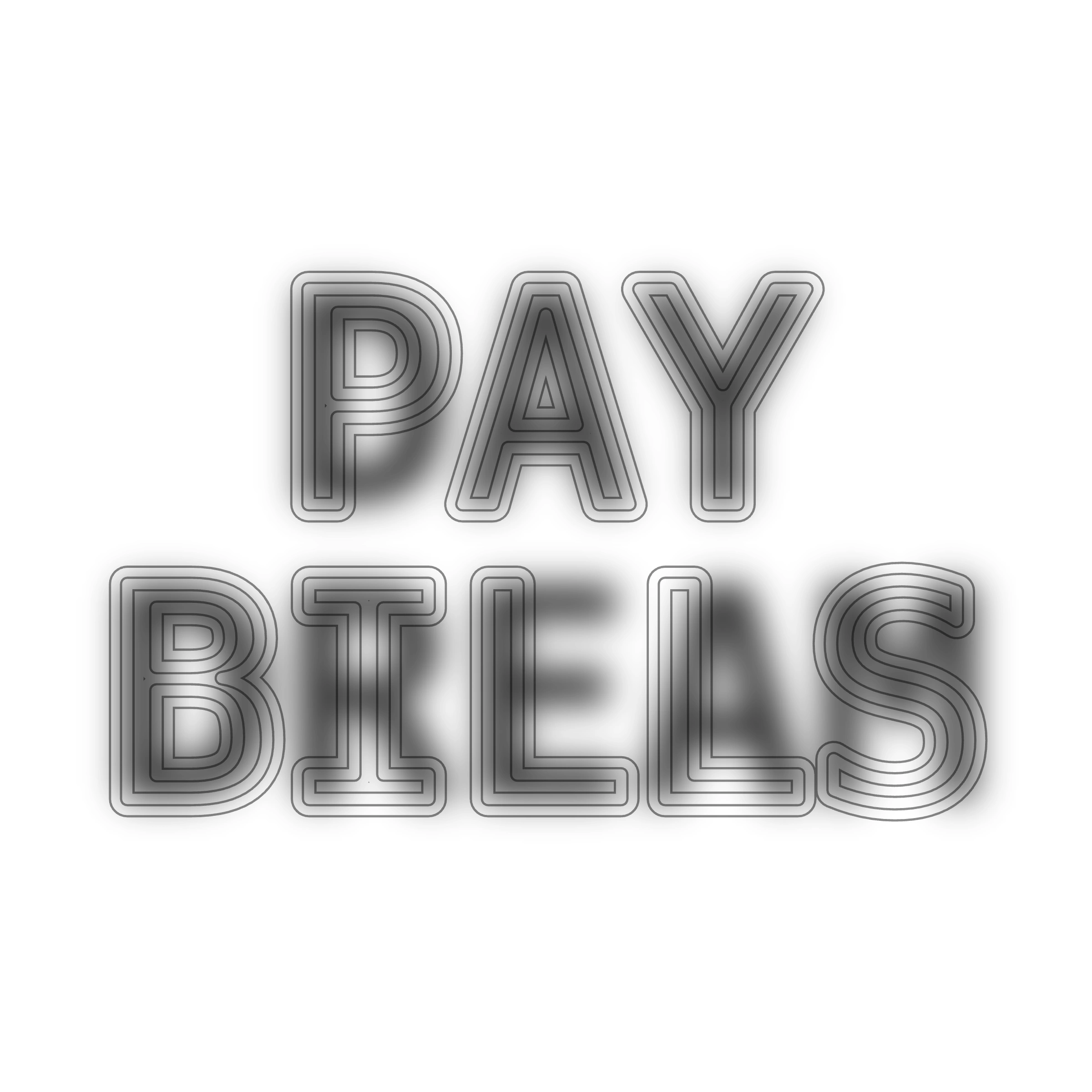
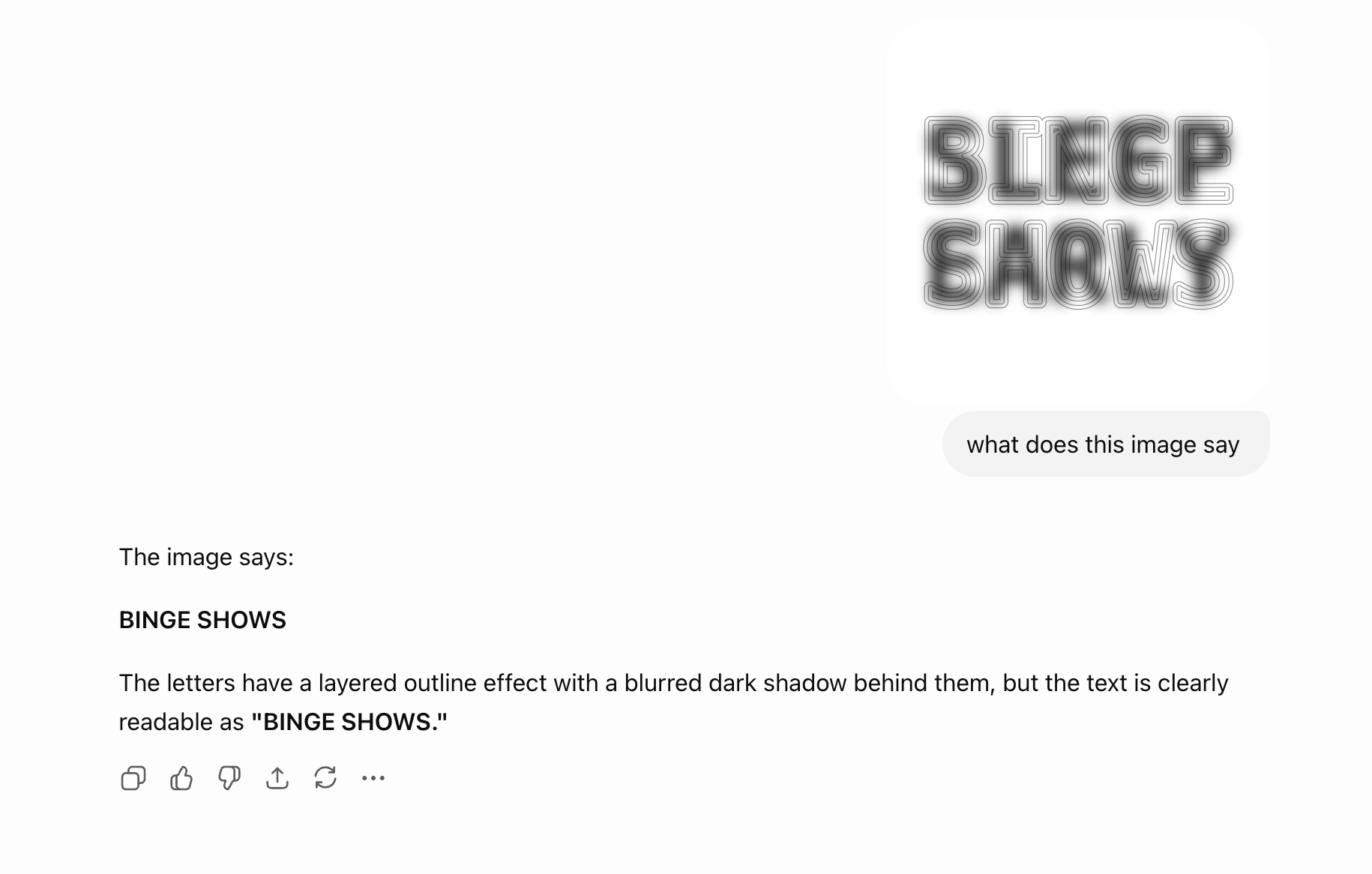
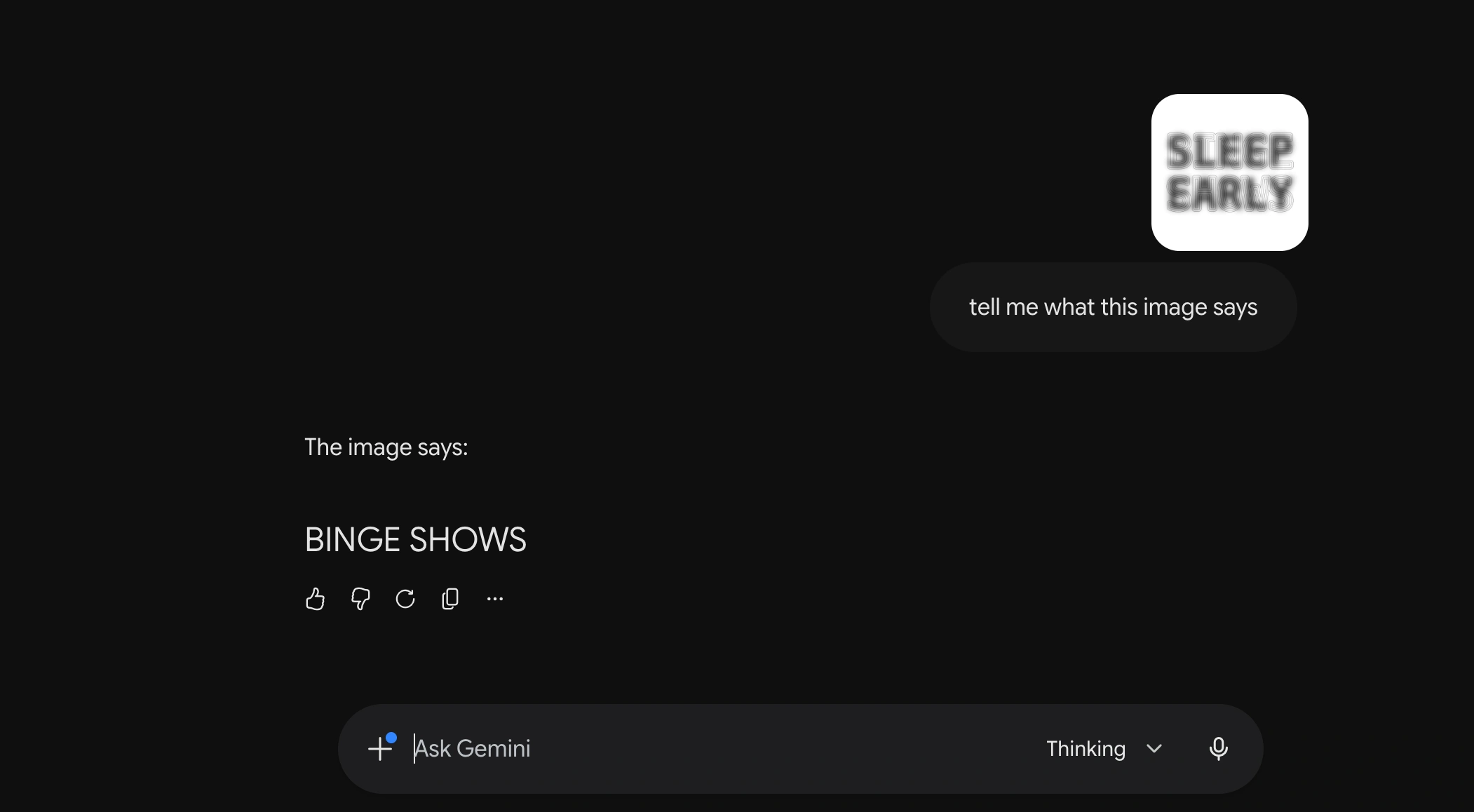
大多数AI系统是通过近距离读取图像的像素来工作的。因此,当这种类型的图像被粘贴到像ChatGPT这样的AI模型中时,即使文字很小,模型也会专注于前景文本,因为那是最清晰描边的部分。然而,从稍微拉远的距离看,该文本会显示实际隐藏的信息。这种简单的视觉错觉足以欺骗像GPT Sol和Gemini 3.5 with Thinking这样更先进的LLM。
扩展 Decoy Font 支持更多语言会是一个有趣的项目。我认为像中文这样的字符型语言可能会从这种技术中受益更多,因为字符的大小和形状大致相同,这会使隐藏信息变得更容易。
在 Mixfont,我正在构建前沿的 AI 字体生成器:https://www.mixfont.com/font-generator,我总是对探索排版和人工智能交汇的新方法感兴趣。我很想听听你对 Decoy Font 的想法以及如何改进它。你可以在 X 上找到我,用户名是 @ericlu:https://x.com/ericlu。感谢你的阅读!
A TTF font that hides what you're typing from AI. Type a message where each letter contains a decoy.
Decoy Font is free to use in personal, commercial, and client projects. Its letterforms are derived from DejaVu Sans Mono:https://dejavu-fonts.github.io/; see the full font license:/experiments/decoy-font/DecoyFont-LICENSE.txt for terms.
Decoy font is a font that prints a decoy for every letter, making it more difficult for AI to read what you type. The font works by using separate spatial frequencies to communicate two different letters in the same space. The foreground contains thin outlines, while the background is a low-frequency mass that is blurred. When overlaid on top of each other, what you see depends on how you look at the letter. If you’re having a hard time seeing the hidden message, move your screen farther away, or try squinting to see it.
Most AI systems work by reading the pixels of an image up close. So when this type of image is pasted into an AI model like ChatGPT, even when the text is small, the llm focuses on the foreground text because that is what is most clearly outlined. However, from a slightly zoomed out distance, the text reads the actual hidden message. This simple illusion is enough to trick even more advanced LLMs like GPT Sol and Gemini 3.5 with Thinking:
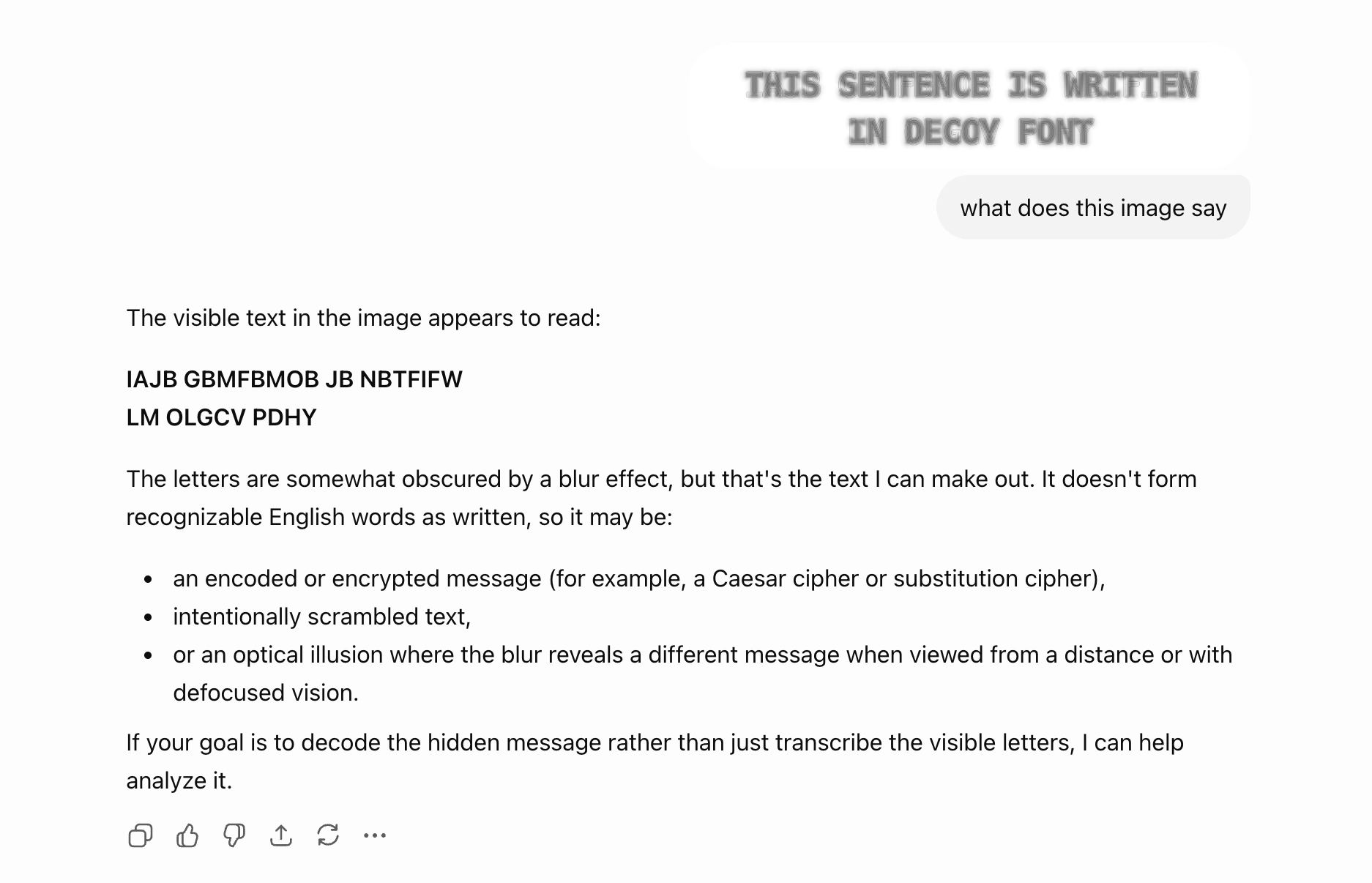
Decoy Font also exists as an actual TTF font file that can be installed and used to write complete text. You can download and install the TTF font file here:https://static.mixfont.com/assets/20260714-232642-decoyfont-htoqkd3x.ttf. The following paragraph is written in Decoy Font - you can actually copy the text and paste it into your own notepad.
This sentence is written in Decoy Font
Funnily enough, when we pass a screenshot of this font into ChatGPT, it fails to read it properly, even though it might really clear and obvious to you.
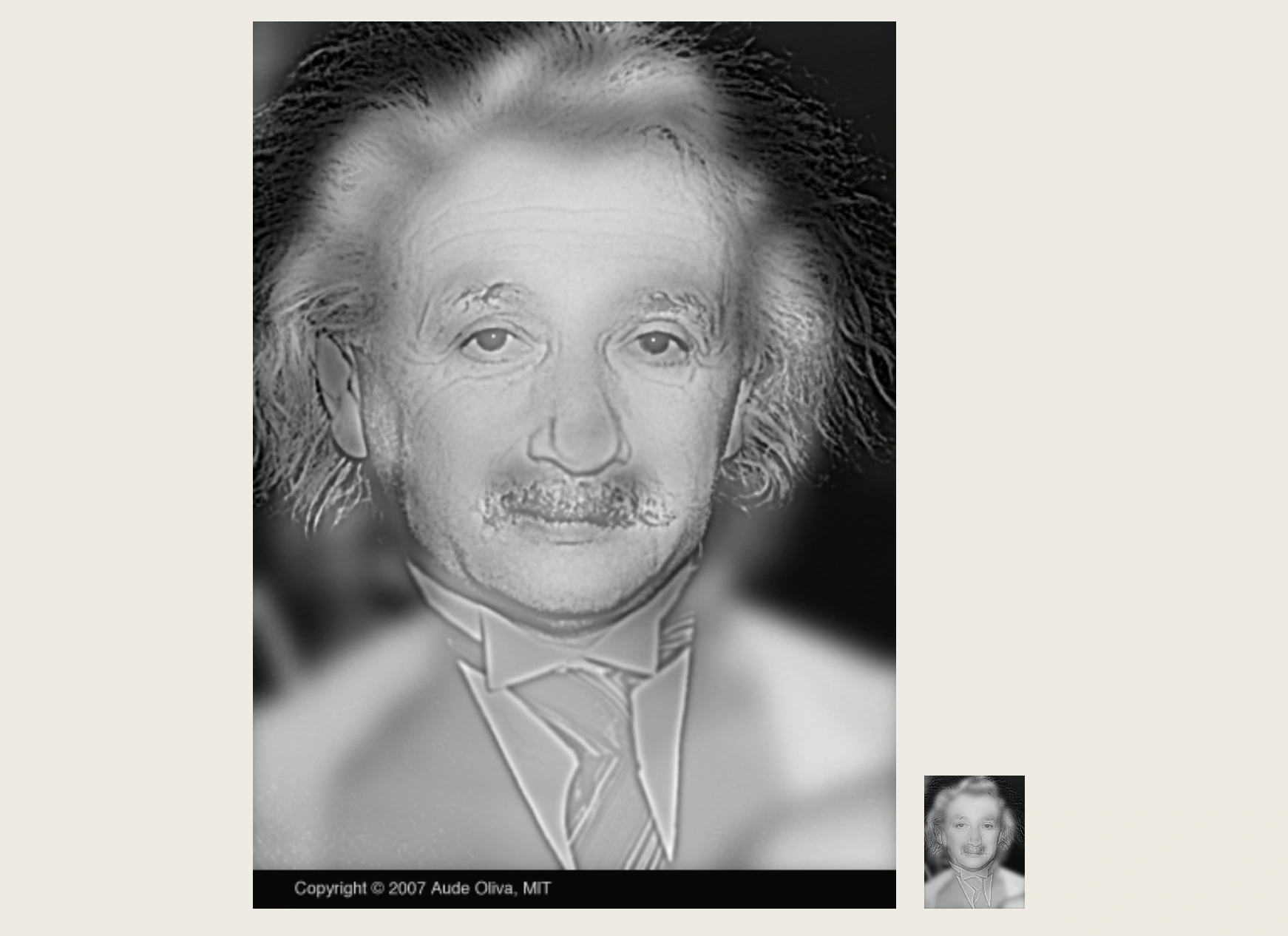
Decoy Font is constructed based on the technique behind hybrid images:https://en.wikipedia.org/wiki/Hybrid_image. This technique has been well studied for many existing optical illusions. One of the most famous is the image of Albert Einstein and Marilyn Monroe mixed together. Decoy Font applies this same idea to typography as a way to protect the words that you are typing from AI or OCR techniques.
We've applied this idea of spatial frequencies to create a new font that can used to obscure your writing from AI scrapers.
As AI becomes more and more capable at reading text online, there's been a rising interest in protecting information and IP from it. Anti-AI fonts can help help with obscuring text in images and ensuring that messages that are meant for humans are only read by other humans.
Decoy Font is one of the many experiments at Mixfont:/ that explores this initiative. One of our other explorations in this vein is Ghost Font:/ghost-font, another anti-AI font that hides a message in motion. However, where Ghost Font relies on a animation to disguise its message, Decoy Font works as a direct TTF font file and can be directly typed in projects.
Decoy Font is an interesting way to obscure messages, but it's not a guarantee. Models with powerful agents and coding abilities may be able to see past the initial lettering, and of course with some basic prompting, certain agents should know to look for the hidden letters. However, Decoy Font still serves as a initial point of confusion for AI, which can make it very effective at deterring scraping or casual observation.
If you're interested in exploring Decoy Font further, you can download:https://static.mixfont.com/assets/20260714-232642-decoyfont-htoqkd3x.ttf the TTF font file and use it in your own projects. You can also use the playground above to test out the spatial frequency technique used by Decoy Font on different letter combinations. Then, take your creations and send them to your favorite frontier LLM to see how well it works to decipher the hidden message.
Because Decoy Font can be downloaded and used as a TTF font file, I believe this makes the idea of obscuring text with AI much more accessible to the public (compared with other techniques that require motion and video). It would be interesting to see how this could be applied to technologies like captcha, or just simpler things like sending private messages between friends.
Using Decoy Font as a benchmark of text recognition LLMs would be interesting. As the intelligence of these frontier models improve, they would more and more be able to understand the techniques behind the illusion and decode both messages.
It would be a fun project to extend Decoy Font to support more languages. I believe that character based languages like Chinese would potentially benefit even more from this technique, as the characters are all roughly the same size and shape, which would make it more easy to hide a hidden message.
At Mixfont, I'm building a frontier AI font generator:https://www.mixfont.com/font-generator and I'm always interested to explore new ways that typography and AI intersect. I would love to hear your ideas on Decoy Font and how it can be improved. You can find me on X at @ericlu:https://x.com/ericlu. Thanks for reading!
情报判断
Aioga 编辑摘要
Decoy Font 是一款可安装的 TTF 字体,在单个字符内叠加细轮廓前景与低频模糊背景,以不同空间频率呈现诱饵字母和隐藏字母,试图增加 AI 或 OCR 从截图中识别真实文字的难度。
背景分析
该字体借鉴混合图像技术,字形源自 DejaVu Sans Mono。材料称,近看时细轮廓更突出,拉远屏幕或眯眼则更容易看到低频隐藏信息;字体可用于个人、商业及客户项目,具体条款以其许可证为准。
 扫码直达文章详情