问题不仅仅是 AI 部署得如此广泛或快速。其他计算机技术也经历过类似的大规模增长,却没有引发如此大的电力激增或计算机组件短缺:视频和音乐现在在全球范围内流媒体播放,每天产生大量 TB 的互联网流量;智能手机热潮需要制造数十亿设备,而这些设备现在正传输大量数据;数十亿家庭设备现在也是物联网的一部分;整个行业也已将其运营转移到云软件,而这些软件并不在空中运行,而是,没错,在数据中心中托管。
阅读:《一万美金的 MacBook Pro 来了》:https://www.theatlantic.com/technology/2026/07/apple-prices-macbook-memory-shortage/687781/
对于生成式人工智能来说,构建高效、可扩展系统的工作尚未完成。而且问题被日益增大的生成式 AI 模型所加剧,据独立估计,这些模型从 2020 年的 1750 亿参数增长到如今超过 1 万亿参数(支持 Claude 和 ChatGPT 等产品的实际模型规模是保密的)。大语言模型中的“大”不应成为卖点。但业界观察到更大的模型往往表现优于较小的模型,这引发了一种图腾式信念——“规模法则”,认为通过简单地将模型做大就可以解决任何问题。OpenAI 首席执行官 Sam Altman 在他九月份的博客中写道:https://blog.samaltman.com/abundant-intelligence “也许有了 10 吉瓦的计算能力,人工智能就能找出治愈癌症的方法。”
然而,回报呈递减趋势。人工智能模型越大,每增加一个参数的提升就越小,因此为了保持稳定进步,模型必须以更快的速度变大。我问了几位 AI 研究人员,他们是否能举出其他现实世界的软件也扩展得如此差。他们都想不出任何例子。即便在软件之外,也很难找到可比的例子,因为规模经济正是使电灯、汽车和服装如此廉价的原则。从经济学和工程学的角度来看,生成式人工智能可能是迄今为止部署的最糟糕的技术。
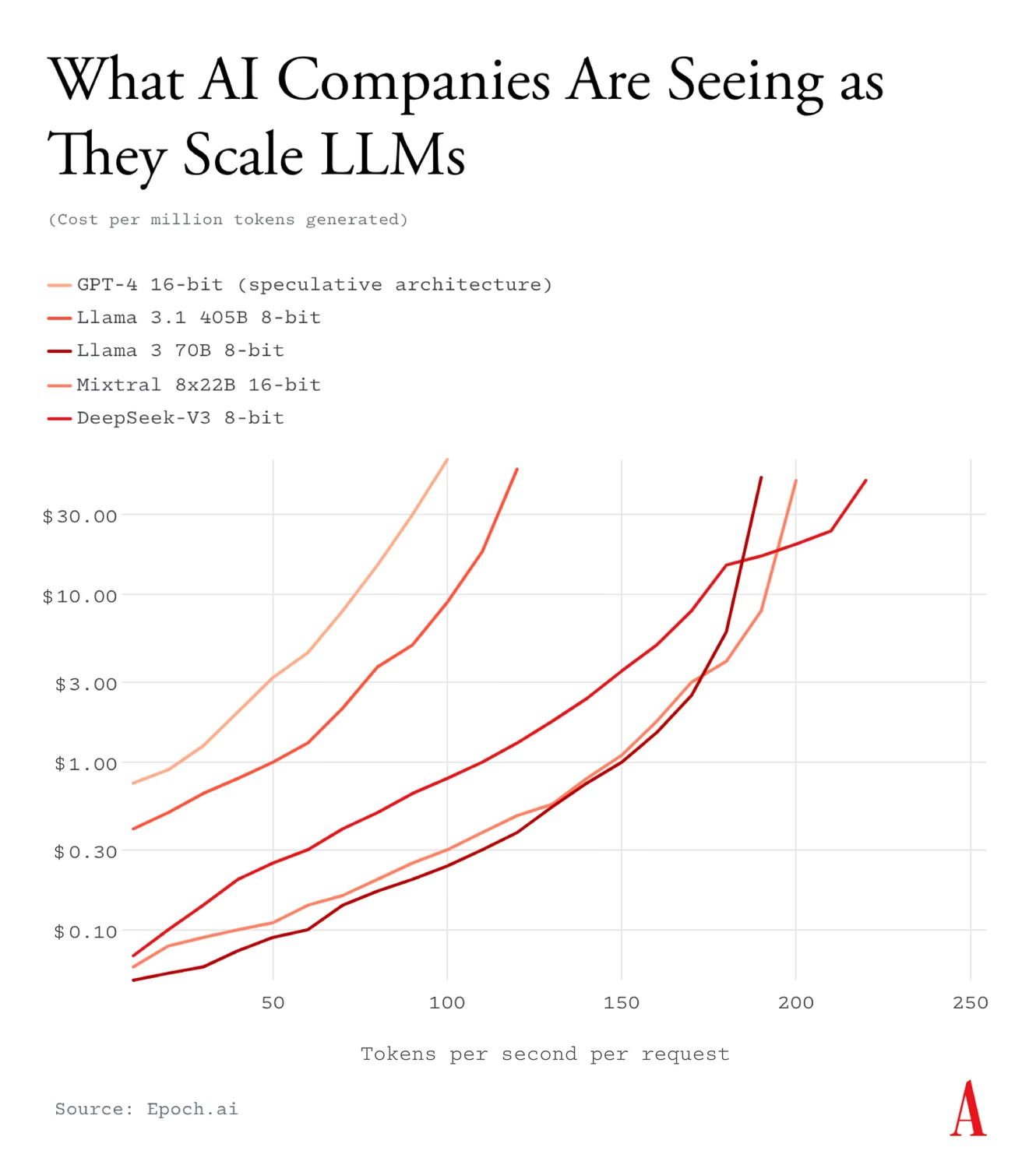
Epoch AI 是一个试图确定 AI 模型运行成本的组织,他们去年发布了一张图表:https://epoch.ai/publications/inference-economics-of-language-models,经许可在此重现。图中展示了为更多“标记”——用户输入给聊天机器人的单词——提供服务时,各种公共 AI 模型成本呈指数增长。
去年,Jolicoeur-Martineau 因她关于“微型递归模型”的论文获得了 50,000 美元的奖金:https://arcprize.org/competitions/2025,该模型不消耗大量计算资源。“认为必须依赖某些大公司以数百万美元训练的大型基础模型,才能在困难任务中取得成功,这是一种陷阱,”她写道:https://github.com/SamsungSAILMontreal/TinyRecursiveModels。她的模型并不是大语言模型的替代品——它被设计用于解决生物学和电气工程等领域的逻辑问题,而不是生成语言——但它可以执行一些目前更大型 AI 模型正在使用的任务。
然而我们似乎被大语言模型困住了,也许是因为它们被如此强烈地推销。无论你是否需要,它们现在都被添加到各种事物中。在 2024 年和 2025 年,它们被集成到 Windows 和 MacOS 中,这意味着运行一台基本的个人电脑现在需要更多的计算能力。智能手机也随着公司预期新的 AI 功能而配备了升级硬件。低效的 AI 也被添加到常用程序如 Adobe Photoshop 和 Microsoft Word 中,这意味着电脑需要更强大的性能才能运行这些软件。
制造商并没有继续缩小组件,而是专注于开发专门针对 AI 的新硬件。这虽提供了偶尔的渐进式性能提升,但没有哪一种能够接近追上 AI 日益增长需求的指数曲线。
A shockingly inefficient trillion-dollar project
Editor’s note: This work is part of AI Watchdog :https://www.theatlantic.com/category/ai-watchdog/ , The Atlantic ’ s ongoing investigation into the generative-AI industry.
As they scramble to keep their systems online, AI companies are making things expensive for the rest of us. Large language models such as ChatGPT and Claude are so resource-hungry that tech companies may be purchasing 70 percent of the world’s supply of high-end computer memory, causing a shortage. As a result, the prices of computer memory and storage are skyrocketing: Hard drives that I bought for my reporting two years ago for $350 each were $800 when I checked two weeks ago, and are now out of stock. The prices of some laptops have gone up as much as 50 percent, and low-cost computers are being hit the hardest. Affordable entry-level computers may “disappear by 2028” according to one forecast. And the memory shortage is expected to continue for years.
The memory is being put into data centers, which tech firms are expanding at incredible speed. They are planning to multiply total U.S.-data-center capacity by a factor of eight over the next few years. The demand for electricity at these sites is already so great that some companies are repurposing jet engines:https://news.constructconnect.com/from-plane-power-to-power-grid-repurposing-jet-engines-for-data-centers to power them.
The problem is not simply that AI is being deployed so widely or quickly. Other computer technologies have seen similarly massive growth without triggering such a large spike in electricity or a shortage of computer components: Video and music are now streamed around the globe, accounting for many terabytes of internet traffic daily; the smartphone boom required the manufacturing of billions of devices that are now transferring huge amounts of data; billions of household devices are also now part of the Internet of Things; and whole industries have moved their operations to cloud software, which is hosted not in the sky but in, yes, data centers.
Read: The $10,000 MacBook Pro is here:https://www.theatlantic.com/technology/2026/07/apple-prices-macbook-memory-shortage/687781/
The problem with generative AI, in the industry’s own jargon, is that it does not scale. The cost of growing from, say, a thousand users to a million is a key factor that venture capitalists examine when they evaluate start-ups. They want to see that the cost of adding each new user decreases over time, so that the company can support millions of users and make increasing profits. This is achieved partly through the careful engineering of computer systems that can efficiently handle more users who want to post photos, hail Ubers, or stream music.
With generative AI, the work of building efficient, scalable systems has not been done. And the problem is exacerbated by the ever-larger generative-AI models, which have grown from 175 billion parameters in 2020 to more than 1 trillion today, according to independent estimates (the actual sizes of the models powering products such as Claude and ChatGPT are secret). The large in large language model should not be a selling point. But the industry’s observation that bigger models tend to outperform smaller ones has given rise to a totemic belief in “scaling laws” that suggest any problem can be solved by simply making models bigger. “Maybe with 10 gigawatts of compute, AI can figure out how to cure cancer,” OpenAI CEO Sam Altman wrote:https://blog.samaltman.com/abundant-intelligence on his blog in September.
Yet the returns are diminishing. The bigger an AI model is, the less it improves with each added parameter, and so it must be made bigger at a faster rate just to sustain steady progress. I asked a few AI researchers whether they could name any other real-world software that scales so poorly. None of them could think of any. Even outside the world of software, it’s hard to find a comparable example, given that economy of scale is the principle that has made light bulbs, cars, and clothing so affordable. By economic and engineering measures, generative AI might be the worst technology ever deployed.
Read: Welcome to a multidimensional economic disaster:https://www.theatlantic.com/technology/2026/03/ai-boom-polycrisis/686559/
But with the massive investment behind the current bloated approach, there may not be much will to change. Ilya Sutskever, a co-founder and former chief scientist at OpenAI, said:https://youtu.be/aR20FWCCjAs?t=1155 in a November interview that companies take the brute-force approach “because it gives you a very low-risk way of investing your resources.” It’s harder, he argued, to invest in research that would reengineer a product currently accruing trillion-dollar valuations. Those who suspect we are in an AI-driven bubble:https://www.theatlantic.com/technology/2026/03/ai-boom-polycrisis/686559/ economy have pointed out that the profitability of these companies remains an open question, largely because of the high cost and inefficiency of the technology.
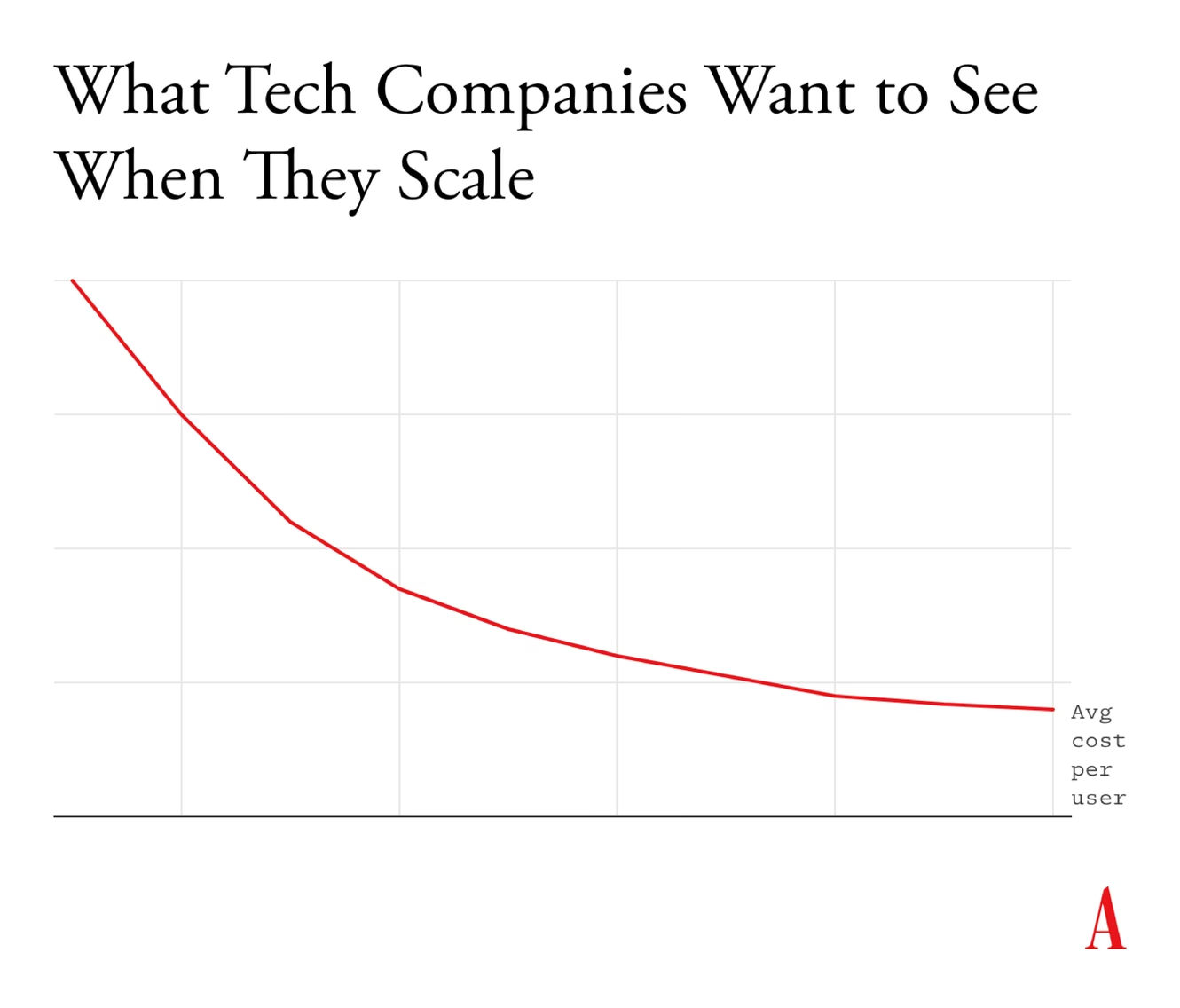
Efficiency is a core principle of computer science. One of the first things undergraduates learn is that writing a program that sorts a list of 50 words is easy. But if you give that program 50 million words, it will likely run out of memory or take hours to finish. Much of computer science is learning the clever coding techniques that prevent this from happening. Many of these techniques take advantage of repeating patterns in the data so that as the program receives more input, it takes less time or memory to process each additional bit. Such efficiency is one reason that modern smartphones and computers are so capable and affordable. This is called logarithmic scaling, and it looks like this when you graph it:
Large language models do not scale logarithmically. When they’re given more words to process, they get slower and use more memory—the time and resources increase faster as the input grows. In technical terms, LLMs scale quadratically. Any computer-science student knows that this is very bad.
Epoch AI, an organization that tries to determine the costs of operating AI models, published a graph:https://epoch.ai/publications/inference-economics-of-language-models last year, which is reproduced here with permission. It shows the exponentially increasing costs of serving more “tokens”—the words users type to chatbots—with several public AI models.
AI does not have to be built this way. Traditionally, the goal of AI was to solve problems in ways that simulated human mental processes. Researchers observed their own thinking and tried to implement their mental habits in code. This approach has mostly been abandoned, partly due to the difficulty of discerning and articulating the rules of human thought, but it did have the benefit of consuming far fewer resources and data.
Today’s approach to AI doesn’t try to describe the rules of human thought; instead, it gives a computer millions of examples to imitate. The huge quantity of examples is one reason that large models can perform better than small ones when generating language, images, and music—they have more material to draw from. Some researchers want to bring back the old, more efficient approach and combine it with the modern approach, but so far these projects have not drawn nearly as much attention or funding as the models that power chatbots.
Chatbot companies are aware that their products are inefficient. Some have found techniques for improvin g performance, but they have not yielded significant gains. Occasionally, companies claim to have made breakthroughs—Anthropic CEO Dario Amodei has called them:https://darioamodei.com/post/on-deepseek-and-export-controls “compute multipliers”—but they are usually described in vague terms, and there is no evidence that the basic problems of quadratic scaling and exploding model size have been overcome. (Anthropic declined to comment on the record when I reached out to ask about this.)
Some researchers are working on extremely small models that require fewer data and less computing power. I spoke with Alexia Jolicoeur-Martineau, an AI researcher at Microsoft who independently designed one of these, and asked her about the industry’s brute-force approach. “It’s a bit insane,” she told me. “At some point you have to learn to be a bit more efficient.”
Last year, Jolicoeur-Martineau won a $50,000 prize:https://arcprize.org/competitions/2025 for her paper on a “tiny recursive model” that doesn’t consume huge quantities of computing resources. “The idea that one must rely on massive foundational models trained for millions of dollars by some big corporation in order to achieve success on hard tasks is a trap,” she wrote:https://github.com/SamsungSAILMontreal/TinyRecursiveModels. Her model isn’t a substitute for an LLM—it’s designed to solve logic problems in fields such as biology and electrical engineering, rather than generate language—but it can do some of the tasks that much larger AI models are currently being used for.
Yet we seem stuck with LLMs, perhaps because they have been so aggressively marketed. They are now being added to everything, whether you want them or not. In 2024 and 2025, they were integrated into both Windows and MacOS, which means that more computing power is now needed to run a basic personal computer. Smartphones are also being sold with upgraded hardware as companies anticipate new AI features. Inefficient AI is also being added to common programs such as Adobe Photoshop and Microsoft Word, meaning that computers need to be more powerful to run this software.
Ted Chiang: No, artificial intelligence is not conscious:https://www.theatlantic.com/philosophy/2026/06/no-artificial-intelligence-is-not-conscious/687378/
This is all especially bad because computers are no longer improving at the rate they used to. Since the 1950s, manufacturers have learned to make microchips steadily faster, smaller, and cheaper, a trend known colloquially as Moore’s Law. But in the past few years, components have gotten so small that manufacturers have run into molecular-level limitations on shrinking them any further, which has slowed progress:https://www.eetimes.com/the-impact-of-the-end-of-moores-law-on-the-ai-gold-rush/ significantly.
Instead of shrinking components, manufacturers have been focused on developing new hardware that is tailored to AI. This has provided occasional incremental improvements in performance, but none has come close to keeping up with the exponential curve of AI’s increasing demands.


 扫码直达文章详情