Moonshot 的 Kimi K3 开放重量模型在几乎每一层都用内存换算计算,而内存是
中国芯片产业落后最远的地方。
Moonshot's Kimi K3 open-weight model trades compute for memory at nearly every layer and...
Moonshot's Kimi K3 open-weight model trades compute for memory at nearly every layer and memory is
where China's chip industry is furthest behind.
Moonshot 的 Kimi K3 开放重量模型在几乎每一层都用内存换算计算,而内存是
中国芯片产业落后最远的地方。
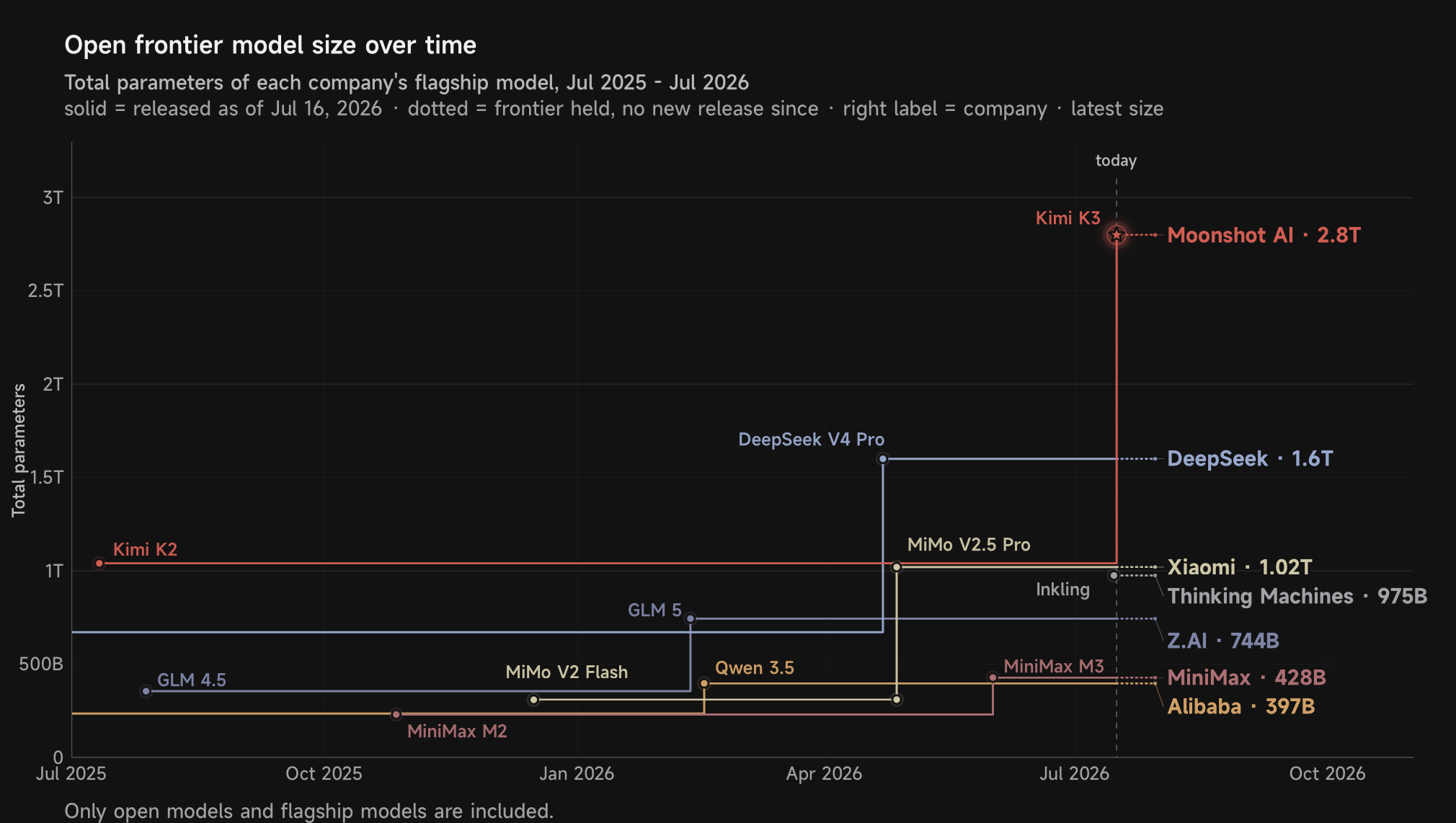
Moonshot AI’s Kimi K3 open-weight model has been read almost entirely through its parameter count since it launched:https://www.kimi.com/blog/kimi-k3on July 16. At 2.8 trillion parameters, it is the largest open-weight model released to date. Model sizes are usually grouped into rough brackets, and 2.8 trillion rounds into what the industry calls the 3T class. A tier no openly available model had entered before.
The natural conclusion is that Moonshot has engineered its way around US compute restrictions. The company’s own technical blog suggests something more specific: K3 does not avoid the constraint so much as relocate it, trading compute for memory at almost every layer of the design.
That trade is worth understanding, because compute and memory are not interchangeable constraints, and they are not equally available to a Chinese lab.
Introducing Kimi K3: Open Frontier Intelligence 🔹 2.8 Trillion Parameters, 1 Million Context, Native Multimodal 🔹 Kimi Delta Attention enables up to 6.3x faster decoding in million-token contexts 🔹 Attention Residuals deliver ~25% higher training efficiency at <2% additional… pic.twitter.com/eFHEbdxn3P:https://t.co/eFHEbdxn3P
Two different things determine what it costs to run a large model. One is how much calculation the machine does to produce each word. The other is how much of the model has to be held ready and instantly reachable the entire time it is working. The first is compute. The second is memory. Chip export controls have squeezed China hard at first, and Moonshot’s design reads as a sustained attempt to spend less of it.
The main move is a technique called mixture-of-experts. Rather than run the whole model for every word, K3 splits itself into 896 specialised sections and calls on just 16 of them at a time, about 1.8% of the total. The calculation per word drops sharply. The memory bill does not move at all, because all 2.8 trillion parameters still have to sit loaded and ready in case they are the ones called next.
So Moonshot went after that bill directly. It trained K3 to work at four bits of precision per parameter instead of the usual sixteen, a method known as quantisation-aware training, which the company applied from the fine-tuning stage onward and says it chose “for broad hardware compatibility”, a phrase worth pausing on, since it reads as a hedge against running on silicon that is not Nvidia’s. The savings are substantial. Independent analysis of the release puts the model at roughly 1.4TB in that format, against the 5.6TB it would need at full precision.
The second change, Kimi Delta Attention, targets a different memory cost. As a model works through a very long document, it accumulates a running store of everything it has already read. At K3’s advertised limit of a million tokens, a few thousand pages, that store, not the model itself, becomes the biggest thing in memory.
Moonshot is unusually direct about the commercial stake here. It contributed caching code to the open-source serving project vLLM, and says this combination is what lets it price K3 competitively despite the model’s size. Moonshot recommends running K3 across 64 or more accelerators wired together closely enough to behave as one pool.
That is the same approach behind Huawei’s CloudMatrix systems, and it points to what the real workaround is. Memory can be gathered up across a large number of individually unremarkable chips. Training-grade compute cannot be assembled the same way.
Whether that pooling happens on Chinese silicon is a question the blog does not answer. Moonshot’s chip-level tests ran on Nvidia H200S and on what it describes only as a “GPGPU from an alternative vendor,” which it declines to name. Other results are benchmarked on an Nvidia L20, the cut-down card sold into China under export rules.
The blog does not say where the H200 hardware sits, and the US House passed a bill in January to close the offshore cloud rental loophole that had let Chinese firms reach restricted accelerators remotely. The reason any of this matters is that memory, not processing power, is where China’s own chip industry is furthest behind.
In trade talks in August 2025, Beijing asked for relief on high-bandwidth memory restrictions rather than on lithography tools or TSMC access, a fair signal of what officials think is actually binding. Domestic output of that memory is projected at around two million stacks this year, enough for roughly 250,000 to 300,000 Huawei Ascend 910C-class chips, while SMIC has wafer capacity for more than a million.
For businesses in this region, the practical question is not whether K3 tops a leaderboard. It is whether an open-weight model at this size is deployable at all. Asian enterprises reach for open weights for three reasons–price, data sovereignty and regional-language coverage–and banks and insurers across Southeast Asia have been piloting self-hosted open models specifically so records never leave their own systems.
The weights land on July 27, and any organisation that can afford the hardware will be free to download, modify and run K3 inside its own walls. The question is how many can. Moonshot recommends serving the model across 64 or more accelerators wired together as a single pool, and the weights alone come to roughly 1.4TB in the format it ships in, based on independent analysis, before the memory needed to work through a long document.
That is a data-centre commitment, not a server-room one. For most enterprises, the practical outcome is renting dedicated capacity rather than owning it. That still keeps data in-country and under contract, which is what most regional regulators are asking for. What it does not deliver is the independence from infrastructure providers that drew many of these buyers to open weights in the first place.
The software is not ready either. K3’s two main architectural changes are new enough that the standard open-source tools for running models do not yet support them, and Moonshot says it is working with inference partners and open-source maintainers to align technical details before release. Teams planning a self-hosted deployment should treat the launch date and the usable date as different things.
The price has also moved. K3 costs $3 per million input tokens, dropping to $0.30 when the model has recently seen that input, and $15 per million output tokens. That is well under Fable 5’s $50 for output, but far above z.ai’s GLM-5.2 at $4.40 and DeepSeek V4 at $0.87. K3 is no longer in the budget tier its predecessors occupied.
It also launches with maximum reasoning effort as the only setting, with lower modes to follow, so long reasoning chains and retried steps add up quickly. Companies should budget on the cost of a completed task, not the list price.
Arena placed K3 first in its Frontend Code evaluation at 1,679 points, ahead of Fable 5, in blind developer testing, as reported by Tom’s Hardware:https://www.tomshardware.com/tech-industry/artificial-intelligence/moonshot-releases-2-8-trillion-parameter-kimi-k3 . That result is real. It is also a benchmark in one domain.
Moonshot itself is more restrained than its headlines. The company states that K3’s overall performance still trails Claude Fable 5 and GPT 5.6 Sol, and lists three limitations: generation quality can become highly unstable if a harness fails to pass back historical thinking content, the model may make unexpected decisions on a user’s behalf when intent is ambiguous, and it shows a noticeable user-experience gap against Fable 5 and GPT 5.6 Sol.
Its own footnotes also disclose that Fable 5 hit fallbacks on 35% of the tasks in Moonshot’s SWE Marathon evaluation, which may have affected that model’s measured score. Everything else remains a first-party claim. No published K3 number can be independently verified until the weights are public.
Bank of America analysts led by Alex Liu said in a note that K3 shows large-scale pre-training combined with architectural work can still deliver step-change gains for flagship Chinese models despite compute constraints, which is the sober version of the argument, and closer to what the blog supports.
The direction of travel is not in dispute. Open-weight models handled 29% of all tokens routed through Vercel’s production gateway in June, up from about a ninth of volume in April, while accounting for under 4% of spending. July 27 is when we find out how much of K3 belongs in that column.
Want to learn more about AI and big data from industry leaders? Check out AI & Big Data Expo:https://www.ai-expo.net/?utm_source=AI-News&utm_medium=Footer-banner&utm_campaign=world-series taking place in Amsterdam, California, and London. The comprehensive event is part of TechEx:https://techexevent.com/?utm_source=AI-News&utm_medium=Footer-banner&utm_campaign=world-series and is co-located with other leading technology events including the Cyber Security & Cloud Expo:https://cybersecuritycloudexpo.com/?utm_source=CloudTech-News&utm_medium=Footer-banner&utm_campaign=world-series. Click here:https://techexevent.com/?utm_source=AI-News&utm_medium=Footer-banner&utm_campaign=world-series for more information.
AI News is powered by TechForge Media:https://techforge.pub/?utm_source=AI-News&utm_medium=Footer-banner&utm_campaign=world-series. Explore other upcoming enterprise technology events and webinars here:https://techforge.pub/events/?utm_source=AI-News&utm_medium=Footer-banner&utm_campaign=world-series.

Dashveenjit Kaur:https://www.artificialintelligence-news.com/news/author/dashveenjit/
Physical AI:https://www.artificialintelligence-news.com/categories/ai-and-us/physical-ai/
AI Business Strategy:https://www.artificialintelligence-news.com/categories/inside-ai/ai-business-strategy/, Artificial Intelligence:https://www.artificialintelligence-news.com/categories/artificial-intelligence/, Features:https://www.artificialintelligence-news.com/categories/features/, Finance AI:https://www.artificialintelligence-news.com/categories/ai-in-action/finance-ai/, World of Work:https://www.artificialintelligence-news.com/categories/ai-and-us/world-of-work/
Sponsored Content:https://www.artificialintelligence-news.com/categories/sponsored-content/


Healthcare & Wellness AI:https://www.artificialintelligence-news.com/categories/ai-in-action/healthcare-wellness-ai/
Artificial Intelligence:https://www.artificialintelligence-news.com/categories/artificial-intelligence/
AI in Action:https://www.artificialintelligence-news.com/categories/ai-in-action/
All our premium content and latest tech news delivered straight to your inbox
AI News is part of TechForge:https://techforge.pub/
Aioga 编辑摘要:Moonshot's Kimi K3 open-weight model trades compute for memory at nearly every layer and memory is Aioga 将其归入「AI资讯」方向,重点关注它对真实使用和行业竞争的影响。
背景分析:AI 行业动态需要结合来源、时间、实际可用性和后续反馈判断,标题或单次发布本身不能替代完整证据。
Aioga 判断:这条动态更适合作为行业观察信号,当前信息足以建立线索,但不足以推导长期结论。
影响分析:对相关团队而言,短期应先核对来源、可用范围和实际成本,再判断是否值得接入或跟进。 后续观察:继续观察原文更新、官方说明、用户反馈和同类产品的后续动作。
本页正文由公开来源页面提取并按原有信息整理,同时保留来源、发布时间和原文入口。版权归原作者及来源网站所有,请通过原文链接核验和阅读来源版本。
抓取通道: RSS · 原始域名: artificialintelligence-news.com
来源: Artificial Intelligence News(RSS)
原文链接: 打开原始来源
Aioga 归档: 查看情报页
Content record: source-page · Updated: 2026-07-20T09:00:00.000Z

统一接入主流 AI 模型 API,为开发、测试与生产环境提供稳定调用入口。
立即访问 api.w173.com 扫码直达文章详情
Aioga 自动聚合全球 AI 动态,并保留来源信息用于核验与引用。