We are now in an era where we should expect 3x more from each other.
Over the last six months, one data point has followed another :
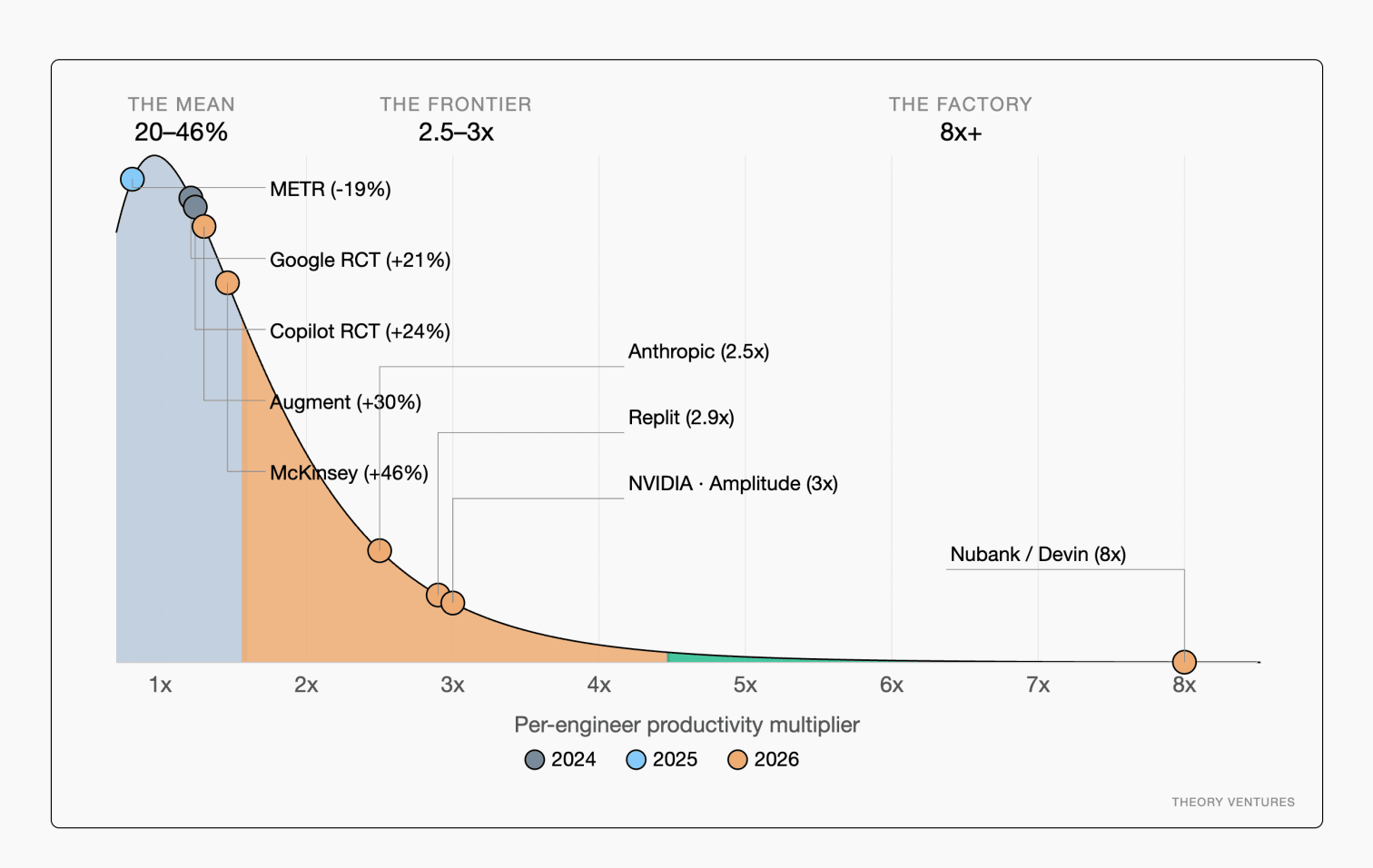
The chart above sorts the ecosystem into three unequal tranches, each defined by how much of the model’s power the company captures. 5:#fn:5
The first tranche is what most companies experience today. Distribute an AI IDE, change nothing else, & the outcome is modest.
“Engineering leaders went into AI expecting 2-3x productivity gains but are landing closer to 30%.”
Faros’s telemetry across 22,000 developers confirms this: engineers completed epics 66% faster, but bugs per developer increased by 54%. 7:#fn:7 The Google randomized controlled trial put the number at 21%, close to GitHub’s 24%. 8:#fn:8 9:#fn:9 This is the default outcome.
The frontier tranche follows. Companies here have built harnesses around the model, orchestrating agents sharing context across GitHub, Linear, & Slack; escalating to engineers for their judgment.
“Every employee gets a manager agent that spawns worker agents in loops. Our internal agent outperformed a seven-figure SaaS tool in security testing and incident triage at one-tenth the cost.”
Human PR review time dropped 30%. Complex support handling time dropped 60%. Total code contribution rose 5.8x. This is where the 3x number lives.
The third tranche are the software factories, & here the name is an apt descriptor. They are AI machines that produce software mechanistically. Cognition’s Devin refactors monolithic codebases end-to-end. Factory.ai is deploying software factories at NVIDIA, Adobe, Blackstone, & EY. 10:#fn:10
“Nubank achieved an 8x improvement in engineering efficiency & a 20x cost reduction using Devin for large-scale refactoring.”
— Contrary Research, January 2026 11:#fn:11
Goldman Sachs is piloting Devin alongside 12,000 human developers & publicly estimates agentic AI could deliver 3-4x the rate of prior tools. 12:#fn:12
AI engineering productivity gains are here. The initial data shows what to expect: most teams should migrate from 20% productivity gains to a 3x productivity gain & they aren’t normal.
Cursor, “How NVIDIA uses Cursor,” February 2026:https://cursor.com/blog/nvidia. ↩︎:#fnref:1
Cursor, “Amplitude and Cursor cloud agents,” April 2026:https://cursor.com/blog/amplitude. ↩︎:#fnref:2
Boris Cherny, head of Claude Code, on the Big Technology podcast, July 2026:https://www.bigtechnology.com/p/boris-cherny-claude-code. ↩︎:#fnref:3
Amjad Masad, “The Self-Driving Company,” July 16, 2026:https://blog.replit.com/self-driving-company. ↩︎:#fnref:4 ↩︎:#fnref1:4
The distribution above is illustrative, not statistical. Each point is a reported multiplier from a published study, RCT, or company disclosure. It is not drawn from a sampled population, & the curve is a right-skewed log-normal fit to the pattern of reported outcomes, not to raw data. Treat it as a shape argument, not an estimator. ↩︎:#fnref:5
Augment Code on X, 2026:https://x.com/augmentcode/status/2070243305385066973. ↩︎:#fnref:6
Google internal randomized controlled trial, ~100 engineers, 2024. Referenced in DORA reports; roundup at Value Add VC:https://valueaddvc.com/blog/ai-coding-productivity-study-data-what-metr-mckinsey-and-github-actually-found-in-2026. ↩︎:#fnref:8
GitHub, Microsoft, and Accenture study with a large fintech, ~450 developers, 2024. ↩︎:#fnref:9
Factory.ai, “Factory 2.0: From coding agents to software factories”:https://factory.ai/news/software-factory. ↩︎:#fnref:10
Contrary Research, “Cognition”:https://research.contrary.com/company/cognition, January 2026. ↩︎:#fnref:11
CNBC, “Goldman Sachs is piloting its first autonomous coder in major AI milestone for Wall Street,” July 2025:https://www.cnbc.com/2025/07/11/goldman-sachs-autonomous-coder-pilot-marks-major-ai-milestone.html. ↩︎:#fnref:12
The 1-minute read that turns tech data into strategic advantage. Read by 150k+ founders & operators.
GP at Theory Ventures. Former Google PM. Sharing data-driven insights on AI, web3, & venture capital.
 扫码直达文章详情