提供了一个方便的 codemod 用于处理标准 API 重命名(例如将 .tool() 重命名为 registerTool):
2026-07-28 规范标志着模型上下文协议的重要转折点,将其从一个有前景的本地集成层转变为企业 AI 应用的基础开放基础设施。
感谢所有 MCP 传输工作组的大力付出:https://github.com/modelcontextprotocol/transports-wg/blob/main/GOVERNANCE.md#members 以及来自多家公司的其他团队共同努力促成这一成果。同时感谢维护 Go MCP SDK 的 Google 团队:https://github.com/modelcontextprotocol/go-sdk,并于 7 月 28 日发布了 v1.7.0:https://github.com/modelcontextprotocol/go-sdk/releases/tag/v1.7.0,该版本在发布当天即可使用,并支持诸如 Github MCP Server 的主要集成:https://github.blog/changelog/2026-07-23-github-mcp-server-supports-the-next-mcp-specification/。
Google 推动无状态传输的初衷源于需求。我们需要一种能够应对全球开发者庞大规模的稳健协议,并希望确保每位开发者,无论是在 Google Cloud 上开发,还是在其他任何地方开发,都能使用高可靠性、安全且可无限扩展的智能基础设施。
通过将状态与传输层解耦,我们使负载均衡变得轻松,自动伸缩变得无缝,并使无服务器部署成为现实。我们迫不及待想看到大家在这一新的无状态基础上构建的极具可扩展性的 AI 代理!
通过会话感知负载均衡,扩展实时 AI 代理
Gemini 企业代理平台中的代理和模型评估现已 GA(全面可用)
As you deploy agentic workflows and scale up your users, your bottlenecks change. When the Model Context Protocol (MCP) was first introduced in late 2024, it provided an elegant, session-oriented framework that allowed LLMs to negotiate capabilities, invoke external tools, and retrieve contextual resources. It was perfect for a single client talking to a single server on a local machine and optimized for stdio.
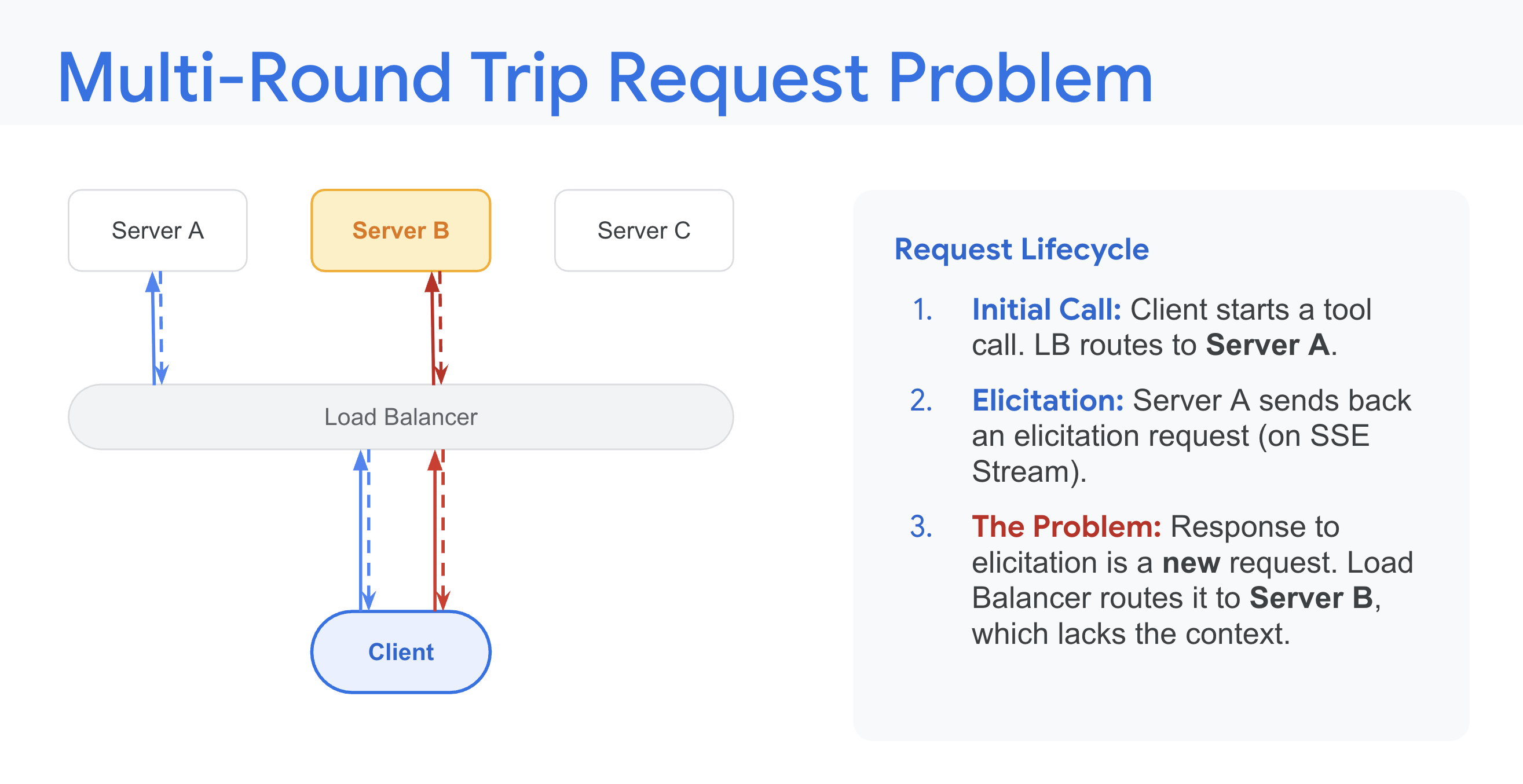
But when we at Google began deploying MCP servers across our cloud-native infrastructure, we hit a hard wall. The original protocol-level session model required persistent state, handshakes, and session pinning. In short, it was built on stateful transports that broke the core tenets of modern cloud-native scalability.
To solve this, Google led the charge:https://github.com/modelcontextprotocol/modelcontextprotocol/pull/2575 to decouple the protocol from stateful transport constraints. Our teams needed MCP to scale across millions of concurrent queries on Google Cloud, and we knew that you all needed MCP to be ready for real-world enterprise scale too. Working closely with Hugging Face and other industry partners, we co-founded the MCP Transports Working Group.
Today, we are thrilled to celebrate the culmination of that work: the 2026-07-28 Model Context Protocol specification release candidate , which is already being widely adopted:https://aaif.io/blog/the-ecosystem-responds-to-stateless-mcp. This landmark release removes transport-level session management entirely, giving you a stateless protocol core that scales on ordinary HTTP load-balanced infrastructure. It’s the biggest change to MCP spec since launch, and if you don’t read the rest of this article, rest assured, it’s a change for the better - more scale, more secure, just as easy .
In the original protocol model (specification version 2025-11-25) [392], connecting to an MCP server over HTTP required a stateful initialization process:
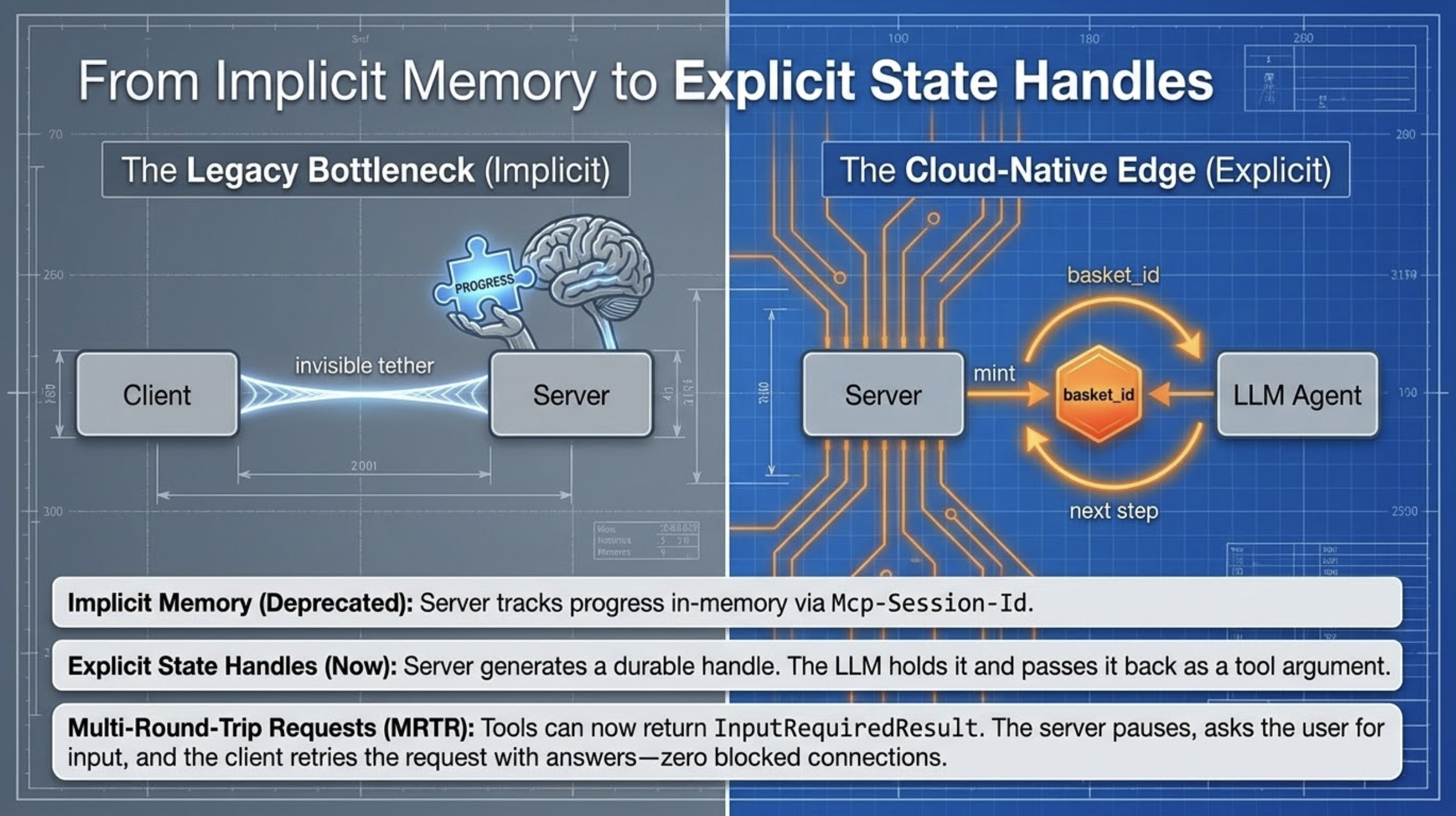
The server responded with an Mcp-Session-Id header. To make any subsequent tool call or resource query, the client had to include that unique session ID on every request, pinning the client to the specific container or pod that held its in-memory session state.
This stateful constraint breaks the horizontal scaling models that cloud-native engineers depend on:
The new 2026-07-28 specification solves this by making the protocol core completely stateless. The handshake is gone . The initialize / initialized handshake (SEP-2575) and the logical Mcp-Session-Id header (SEP-2567) have been removed entirely.
Instead, every request is now self-describing and independent . Protocol version, client info, and client capabilities that used to be exchanged once at connection setup now travel in a _meta field inline on every single request.
Here is how a stateless tool call looks under the new 2026-07-28 specification:
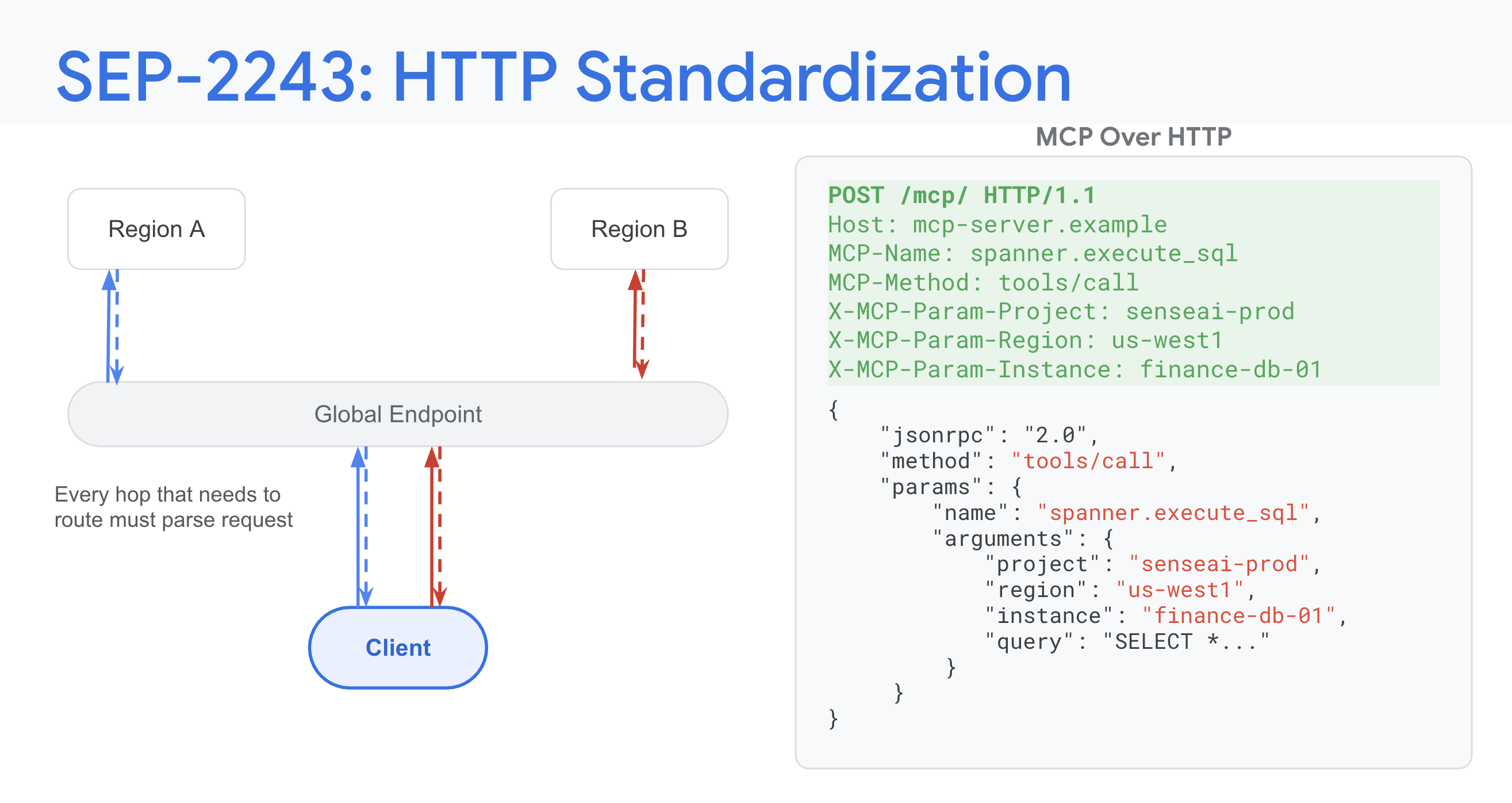
Without protocol sessions, we needed standard mechanisms to route and govern traffic efficiently. Working under the Transports Working Group, we helped design SEP-2243 (HTTP Standardization) [302, 542].
Streamable HTTP POST requests now carry specific HTTP headers:
These headers are mirrored to match the JSON-RPC body. If they disagree, the server rejects the request with a -32020 header mismatch code.
By promoting these values to standard HTTP headers, proxies, gateways, and load balancers can route, rate-limit, and audit traffic without inspecting the request body . For security and logging teams, this is a massive win that drastically lowers the latency and processing overhead at the gateway layer.
To eliminate the need for long-lived Server-Sent Events (SSE) connections just to monitor if a tool or prompt list changed, the spec introduces caching fields modeled after HTTP's Cache-Control. Tool and resource results can now return a ttlMs (Time-to-Live in milliseconds) and a cacheScope . Clients know exactly how long a tools/list response is fresh and whether it is safe to cache across multiple users.
One of the most complex challenges we faced in a stateless world was how to handle server-to-client requests. Under previous versions, if an MCP server needed user clarification (an "elicitation prompt") or a confirmation during a tool call, it had to keep an SSE connection open to push that request to the client.
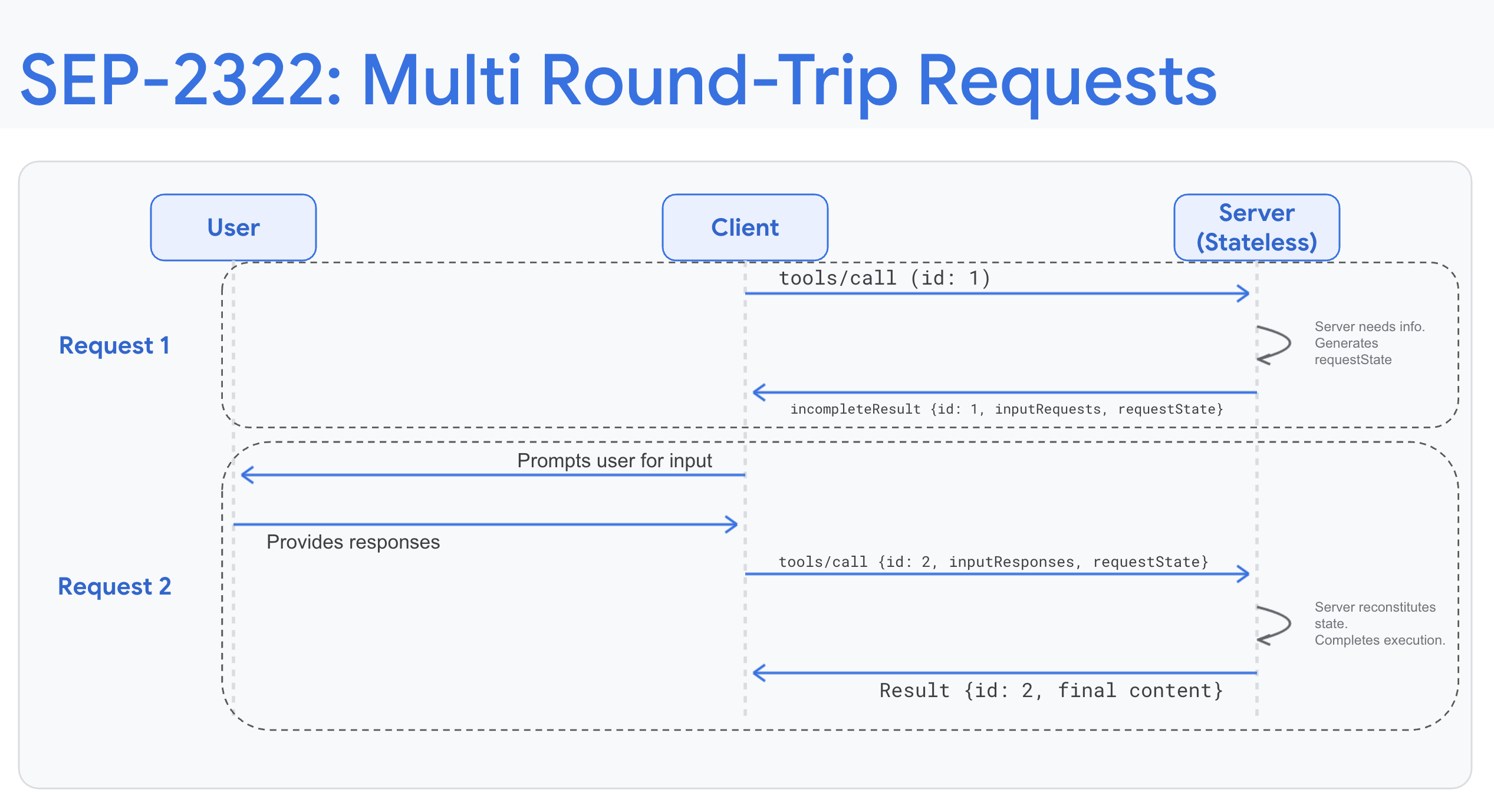
Multi Round-Trip Requests (SEP-2322) solves this problem beautifully by restructuring the interaction lifecycle into self-contained steps:
Instead of blocking the thread or holding a connection open, the server immediately returns an InputRequiredResult with a requestState payload containing serialized context [398]:
The client prompts the user, gathers the boolean answer, and reissues the call with inputResponses and the echoed requestState . Because the requestState contains everything needed to resume the task, any server instance behind your load balancer can pick up the retry request !
Sometimes a tool call simply takes a long time to run. A database backup, a CRM sync, or a refund through a payment gateway can take anywhere from 10 to 60 seconds. Holding the client connection open blocks the customer conversation and creates massive connection queues.
The Tasks Extension graduates from an experimental feature to a robust, first-class protocol extension. Now, when a client calls a long-running tool, the server immediately returns a taskId and kicks off the execution in the background:
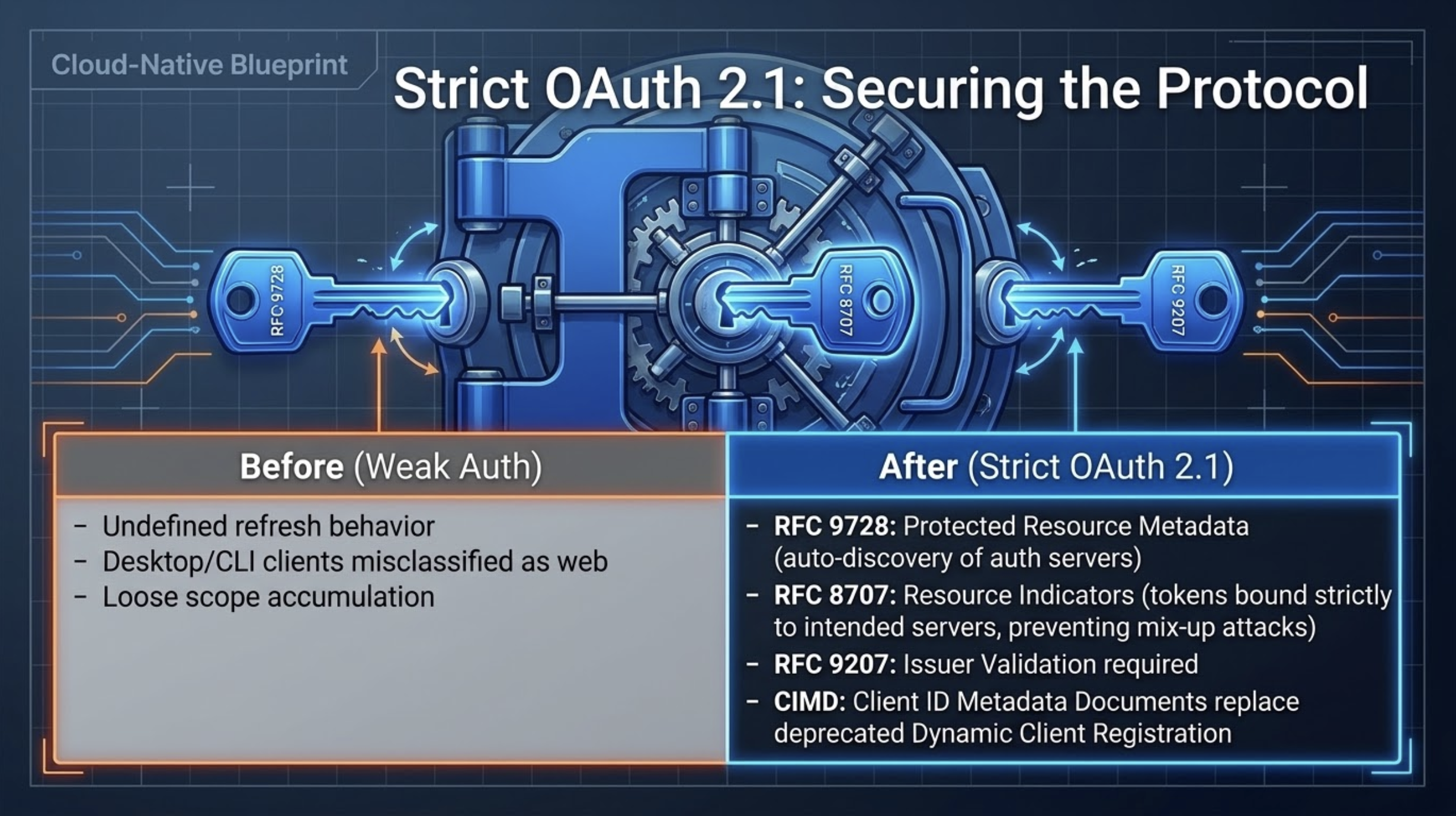
As the responsibility of managing state shifts from the transport layer to the application layer, security becomes paramount. The 2026-07-28 spec delivers several crucial security enhancements:
For the first time, MCP now has a formal deprecation policy. Features move through a structured Active -> Deprecated -> Removed lifecycle with a minimum 12-month transition window . Three features enter deprecation today:
All four Tier-1 SDKs (TypeScript, Python, Go, and C#) already have beta releases available supporting the 2026-07-28 specification. We highly encourage you to start testing these in your staging environments today.
In Python, the MCPServer decorator API is fully compatible [303]. You can install the beta directly with:
TypeScript v2 replaces the monolithic @modelcontextprotocol/sdk package with modular, focused libraries to keep your dependencies light. Install them with:
A convenient codemod is available to handle standard API renames (like renaming .tool() to registerTool ):
The 2026-07-28 specification marks a watershed moment for the Model Context Protocol, transitioning it from a promising local integration layer into the foundational, open infrastructure for enterprise AI applications.
Thank you to the huge effort from all of the MCP Transports Working Group:https://github.com/modelcontextprotocol/transports-wg/blob/main/GOVERNANCE.md#members and other teams who worked to make this happen, from across many companies. Thanks also to the Google team who maintain the Go MCP SDK:https://github.com/modelcontextprotocol/go-sdk and shipped v1.7.0:https://github.com/modelcontextprotocol/go-sdk/releases/tag/v1.7.0 on July 28th which was ready on launch day and powers major integrations like Github MCP Server:https://github.blog/changelog/2026-07-23-github-mcp-server-supports-the-next-mcp-specification/.
Google’s push for stateless transports was born out of necessity. We needed a protocol robust enough to handle the massive scale of our global developers, and we wanted to ensure that every developer, whether building on Google Cloud or anywhere else, had access to highly reliable, secure, and infinitely scalable agentic infrastructure.
By decoupling state from the transport layer, we have made load balancing boring, autoscaling seamless, and serverless deployment a reality. We can’t wait to see the incredibly scalable AI agents you build on top of this new stateless foundation!
Scaling real-time AI agents with session-aware load balancing
Agent and Model Evaluations in Gemini Enterprise Agent Platform are now GA
情报判断
Aioga 编辑摘要
Google Developers Blog称,2026年7月28日的MCP规范候选版本移除了传输层会话管理,以完全无状态的协议核心支持普通HTTP负载均衡、云原生水平扩展和无服务器部署。

 扫码直达文章详情