Anthropic 发布 AI 原生 SDLC 实战手册,提出将传统六阶段软件开发生命周期重构为 AI 嵌入各环节的闭环流程。手册指出,当代码不再是瓶颈时,规划、审查、部署等人...
行业动态Claude:Blog(网页)
今日 AI 情报摘要
Anthropic 发布 AI 原生 SDLC 实战手册,提出将传统六阶段软件开发生命周期重构为 AI 嵌入各环节的闭环流程。
手册指出,当代码不再是瓶颈时,规划、审查、部署等人速环节成为新约束,需通过 Claude 将需求压缩为 intent.md、以技能编码标准、用持续评测替代阶段门禁,并保留人工对关键代码的审查。 🔗 阅读原文 via AIHOT · https://aihot.virxact.com/items/cmt31oi0x0ehyro6tui3xycqe
工程师在计划模式下启动 Claude Code 会话:https://code.claude.com/docs/en/permission-modes,向 Claude 提供第二阶段设计中的已批准 spec.md,让其进行访谈,并在工程师满意前不断迭代计划。
设计评审在任何代码生成之前进行,此时更改方向仍然只是编辑文档而已。计划模式本身强制执行这一点,因为 Claude 在工程师接受计划前无法编辑文件。计划及其修订记录会与接受者信息一同记录。常规更改由工程师批准,而组织认定的高风险更改则交给技术负责人或架构师处理。
Claude Code 还可以在自动模式下运行,即工程师批准计划后,一旦满意并完成迭代,Claude 可以不依赖每次编辑提示地应用每个更改。随着后续环节的护栏逐步完善(经过调优的 CLAUDE.md、编码政策的技能、阻止不安全操作的钩子,以及 Claude 可以运行的测试套件),自动接受模式成为例行工作的默认模式:紧凑的 spec.md、小范围影响、以及已有测试覆盖的代码。
CLAUDE.md:https://code.claude.com/docs/en/memory 为 Claude 提供新加入成员所需的上下文,涵盖规范、命令、架构以及团队最常见的错误。以前存储在人员脑海和维基上的知识,现在变成了一个在每次会话开始时由代理读取的文件,由整个团队维护,并在出现错误时进行迭代。
技能是一种控制,但属于建议性控制。它使 Claude 在代码编写时更可能遵循政策,但不会强制会话必须遵守。必须始终保持的政策需要技能背后有确定性机制,例如阻止操作的钩子或在 PR 时重新检查政策的审查流程。技能使违规行为罕见,而钩子使其几乎不可能发生。技能调用会记录在会话跟踪中,政策所有者像审查代码一样审查技能更改。
How to transform your software development lifecycle with AI—stage by stage.
Organizations have started using AI to write code at a speed unthinkable one year ago, yet the processes around the code haven't changed at the same pace.
Many engineering teams still have the same approval gates, reviews, handoffs, and policies, stalling productivity gains made by using agentic coding solutions like Claude Code:https://claude.com/product/claude-code.
The software development lifecycle (SDLC) is the process that takes software from idea to production. Most organizations run some version of the same six stages, covering planning, design, building, testing, deploying, and maintaining software. Traditionally, each stage is a discrete phase owned by a different role. Product managers write requirements, technical architects turn them into designs, engineers build the designs, QA teams at regulated enterprises verify it, releases teams ship it, and operations monitors what is running. Work moves between the phases through documents, tickets, and sign-offs.
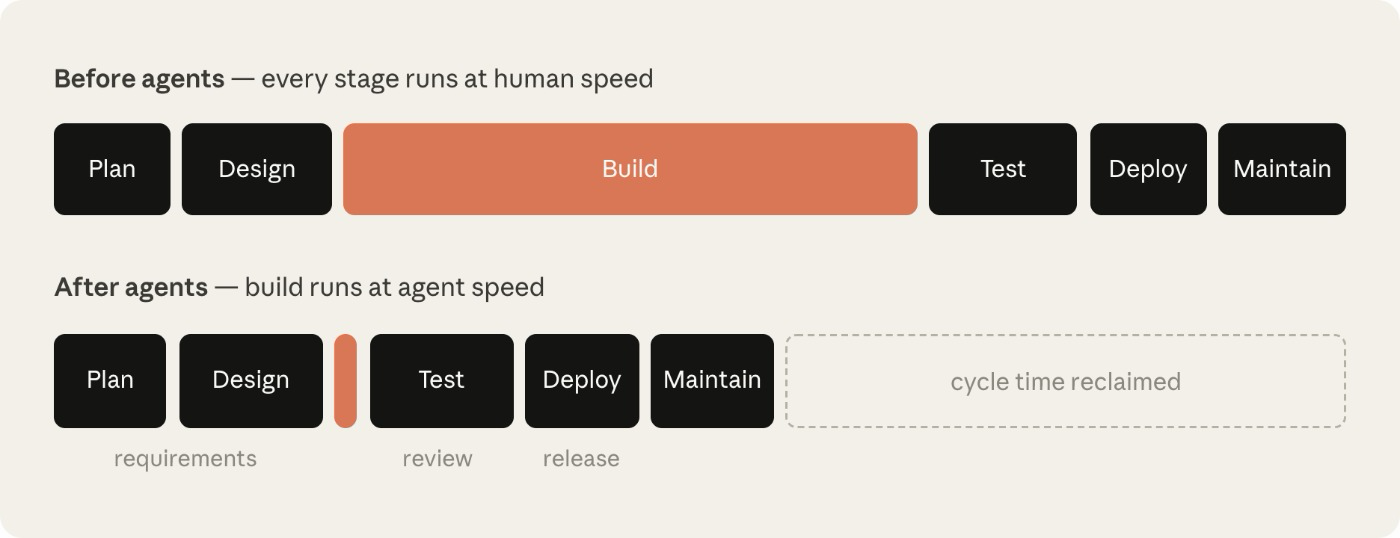
The traditional software development lifecycle (SDLC) is process-heavy to ensure accountability and control at each step. However, the traditional SDLC was designed to maximize efficiency in an era where the most time-consuming and expensive stage was writing and implementing code, which is no longer the case. PRDs, estimation rituals, and product security reviews all existed to force alignment during what could be weeks, months, or quarters of development work.
The traditional SDLC also features controls that assume every step is performed by humans. The organizations generating the most value have rebuilt their process around what agentic AI can now do, while ensuring that humans stay in the loop. In this guide, we walk through several of our Applied AI team's best practices for integrating Claude internally across each stage of the SDLC to accelerate development and make processes run faster, inspired by working with our customers.
When code is no longer the bottleneck and the build phase runs faster than the traditional SDLC allows for, three things become true:
Let's use a security bottleneck as an example. Security teams are sized for human output, so when agents multiply code output, either the review queue builds or code ships under-reviewed. A regulated organization can't accept either outcome, so its security and policy checks have to keep pace with the agents.
To better realize the productivity gains of and secure agentic AI, the traditional SDLC lifecycle requires the same level of transformation as the implementation phase has undergone.
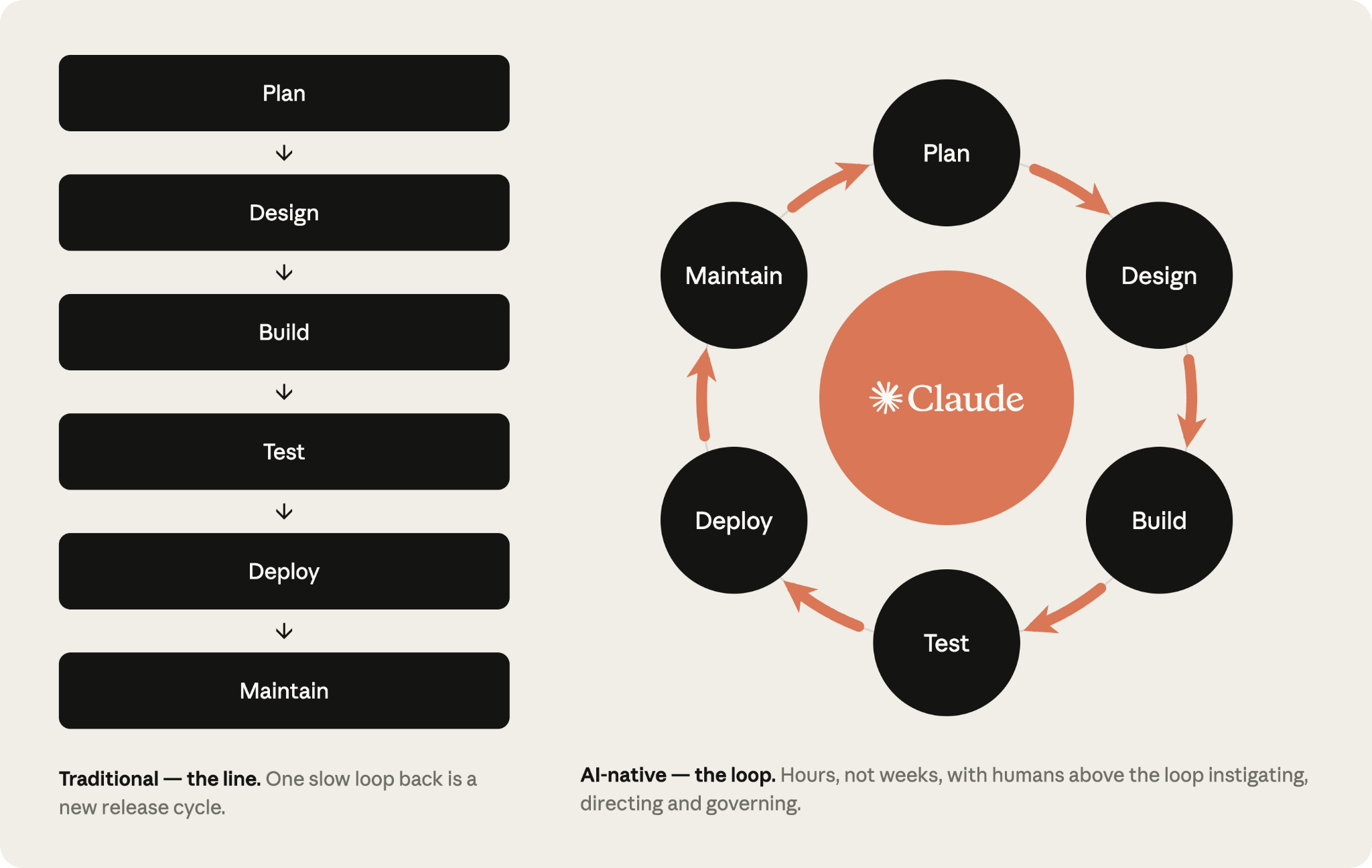
The AI-native SDLC is a reimagined process that combines the old control objectives with new enforcement. Instead of a linear flow, the process becomes a loop, and AI is embedded at each point. The AI-native SDLC promotes automated handover and triggering of subsequent plays, helping to address the manual and clunky nature of handoff between the phases of the traditional SDLC.
The table below highlights the ends of the spectrum between traditional SDLC and AI-native SDLC, supported by Claude. Most organizations sit somewhere between the two columns.
The thread running through the right-hand column is the committed artifact. Each stage ends by writing one to version control (including intent.md , spec.md , plan.md , the diff and its tests, the PR with its review findings, and the incident record) and the next stage begins by reading it. For the early stages, .md files are the predominant artifact because a product owner and an agent can both read and act on the same file. From Build onward, the artifact is code and its records. The chain of commits is also the audit trail: who asked for what, what the agent produced, and who approved it.
Humans remain accountable for every decision that requires judgment. In the agentic SDLC world, the human attention shifts along with the artifacts that must be reviewed.
The plays are the core of the playbook and are grouped into six non-linear stages (Plan, Design, Build, Test, Deploy, Maintain), which together cover the complete lifecycle.
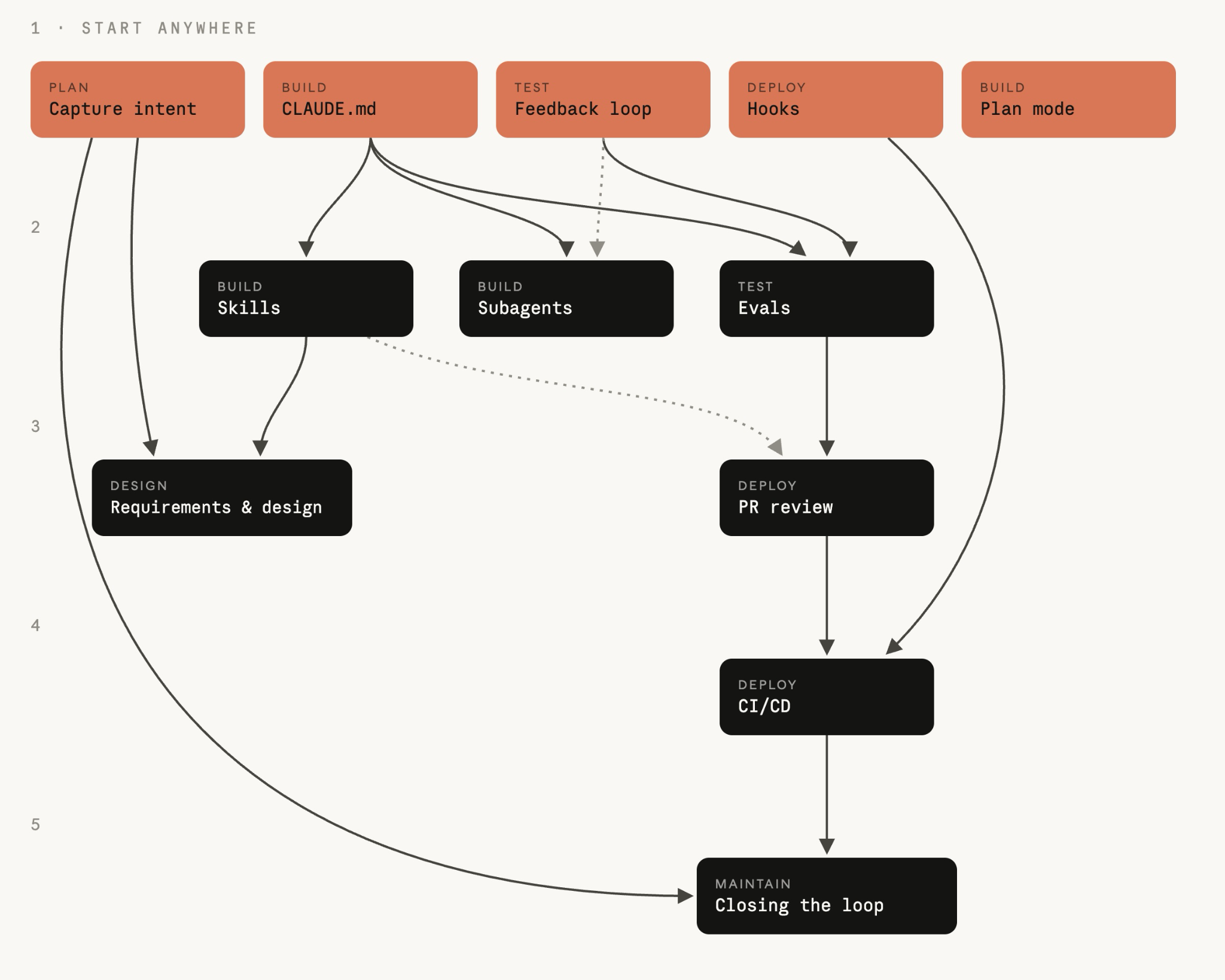
These steps are modular and organizations may choose to prioritize transforming different stages at different times based on their unique needs. Each play names its dependencies under "Prerequisites," which the dependency graph further illustrates.
A stage ends by committing an artifact with the commit initiating the next stage. An accepted intent.md triggers the requirements and design pass, an approved spec.md triggers plan mode, a merged PR triggers the pipeline, and a breached control band in production writes the next intent.md and so the loop continues.
First, you prompt each step by hand with the end state being a loop in which each accepted artifact fires the next gate. Human attention concentrates at the gates, reviewing what the agent flagged rather than starting each stage from scratch.
The intent.md , which kicks off the software development process can enter through different routes. A person has an idea, a ticket is filed, or an incident is surfaced via an alert (see Stage 6: Maintenance).
When a person has an idea, they brainstorm with Claude and produce a markdown proto-spec. In the traditional SDLC, the same person must then convince a member of the product team to write the idea up with them or on their behalf.
The proto-spec generated by Claude is human readable, version-controlled, and immediately consumable by the next stage. The proto-spec is saved as an intent.md .
Regardless of whether the intent originates from an event trigger or an agent, the same steps apply: the product owner reviews and corrects the agent-written intent.md before it is committed.
Setting this up is a one-time task for the platform or engineering team. A technical team member needs to stand up the intent home and decide who can write to it, since many contributors will come from across the organization.
Once the repository exists, contributors without git experience don't need to use git directly. Instead a connector to the version-control system (e.g. GitHub) lets Claude commit markdown files on their behalf from claude.ai or Cowork.
The evidence is the committed intent.md , which lists the author, the timestamp and the full revision history. It's logged in the git history of the intent home. The product owner approves, and the accept or reject decision that sends the intent into Stage 2: Design is recorded as the merge or the closing review.
Once approved by the product owner, Claude takes the accepted intent.md and produces a requirements and design spec. This is guided by the organization's skills:https://code.claude.com/docs/en/skills for brand, security, compliance, and UX.
The product owner reviews that spec, but doesn't write it. The goal of this process is to create a spec the engineering team can plan against, with flagged areas of concern.
Instead of being discovered in a review weeks later, the live policy is read and applied while the spec is written. The organization's skills are applied as constraints on the spec. The spec, the prompt that produced it, and the skill versions in force are all logged in version control. The product owner signs off the spec, and routes flagged concerns to the named policy owners.
Engineers start Claude Code sessions in plan mode:https://code.claude.com/docs/en/permission-modes, give Claude the approved spec.md from Stage 2: Design, and let it interview them, iterating on the plan until the engineer is happy with it.
Design review happens before any code is generated, when changing course is still a matter of editing a document. Plan mode enforces this itself, since Claude cannot edit files until the engineer accepts the plan. The plan and its revisions are logged along with who accepted it. Routine changes are approved by the engineer, and anything the organization classes as higher risk goes to a tech lead or architect.
Claude Code can also run in auto mode, where the engineer approves the plan and, once happy and iterated upon, Claude applies each change without a per-edit prompt. As the guardrails from the later plays mature (a tuned CLAUDE.md , skills that encode policy, hooks that block unsafe actions, and a test suite Claude can run), auto-accept becomes the default for routine work: a tight spec.md , a small blast radius, and code the tests already cover.
The shift is now away from the user watching the agent make the edits and reviewing actions, towards the review of artifacts after longer autonomous sessions. Auto-accept mode further enables parallelism across individuals and the team when used with worktrees and is fundamental to running the SDLC autonomously and closing the loop as described in Stage 6: Maintenance.
CLAUDE.md :https://code.claude.com/docs/en/memory gives Claude the context a new joiner would need, covering conventions, commands, architecture, and the mistakes the team sees most often. Knowledge that used to sit in people's heads and on wikis becomes a file the agent reads at the start of every session, maintained by the whole team and iterated on whenever a mistake is made.
CLAUDE.md is version controlled, so the instructions the agent works to are reviewable and auditable. Team conventions are applied through the file, changes to it are logged in git history, and code owners approve those changes in PR review.
Skills are how an organization makes its institutional knowledge operational. The instructions are explicit, version-controlled, applied broadly, and updated centrally when policy changes. The rule of thumb: write a skill for institutional knowledge that must be applied consistently; don't write a skill for components that belong in CLAUDE.md or a prompt.
A skill is a control, though an advisory one. It makes Claude likely to apply the policy while the code is written, and nothing forces a session to comply with it. A policy that must always hold needs something deterministic behind the skill, such as a hook that blocks the action or a review pass that re-checks the policy at the PR. The skill makes violations rare and the hook makes them close to impossible. Skill invocations are logged in session traces, and the policy owner reviews skill changes like code.
A skill is an advisory control while a hook:https://code.claude.com/docs/en/hooks is the deterministic layer behind it. Most of Claude's actions are file edits and shell commands during implementation, so the build phase is where hooks can end up firing most often.
Back any skill whose policy has to hold without exception. A hook runs on each action that matches it, so build-phase hooks should be fast and scoped to the file that changed. Heavier checks such as the full test suite belong at the commit or the PR.
A hook that asks a human for approval belongs with the gates in Stage 5: Deploy, because an approval prompt during the build puts a person back on the critical path of all the sessions running in parallel.
One engineer can drive several streams of work at once.
A parallel session is another full Claude Code instance, working a separate task in its own git worktree:https://code.claude.com/docs/en/worktrees. Each independent session knows nothing about the others, and the engineer steering them is the only thing they share.
A subagent:https://code.claude.com/docs/en/sub-agents runs inside a single session as a scoped helper with its own context window and tool limits and suits jobs that recur in multiple tasks such as verifying the app runs as expected.
Parallel sessions raise the number of tasks an engineer can have in flight, while subagents keep each session focused on its own task. The engineer's job is steering and reviewing all of them.
More sessions means more output, so the controls have to come from configuration in the repo. Hooks and permission settings there apply to all sessions, and what a session does is logged and attributed to the engineer who ran it.
Always give Claude a way to verify its own work, whether tests, a build, or a screenshot diff. A session checks its own work and fixes its own mistakes before an engineer sees them.
The feedback loop should not be confused with a verifier subagent (Stage 3: Build). The feedback loop runs through the whole task as many times as the work. The verifier subagent, on the other hand, is one way to package the final check by running a fresh context window once the session believes the work is done. This way the verdict is not colored by the assumptions that produced the code.
Evals are the AI-native equivalent of stage-gate QA. In practice that means a suite that runs whenever the agent's configuration changes. When a new model is swapped in or a prompt is rewritten, the eval suite says whether the agent still does the work to the same standard.
The evals should be seen as a live suite. As models improve, cases that once discriminated stop doing so and new ones must be added that arise from ongoing monitoring.
Depending on the use case, some teams may prefer to run these evals offline on a set cadence rather than on every change. The steps below are for continuous evaluations.
Evals give QA a gate that keeps up with agent output. The pass-rate threshold is enforced as a merge check, runs are logged so results can be compared over time, and the team that owns the configuration change approves it.
Claude both gives and receives reviews. It reviews incoming PRs against the organization's policies and addresses review comments on its own PRs. This allows engineers to focus on behavior in their PR review, which boils down to judging intent and risk.
Separation of duties is preserved, because the agent that wrote the code has no way to approve it. The review policy in REVIEW.md is applied to all PRs, and findings, fixes, ratings and approvals are logged in the PR history, so the PR is the audit record. Approval comes from a human through branch protection, informed by the findings.
The build phase used hooks as guardrails, allowing or blocking actions with no human involved (Stage 3: Build). A hook can also ask, pausing the action until a specific person approves, which is what release gating needs.
The play sits in Stage 5: Deploy because the release gate is the clearest case, but hooks are not deploy-specific: they run wherever Claude acts. For example, hooks can block edits to migrations and infra without a change ticket during Stage 3: Build, and stop the agent editing test files during a fix task in Stage 4: Test.
Hooks are the approval gates. The gate condition is enforced every time, for everyone. Allow and block decisions are logged with a timestamp. The gate also defines what counts as approval, whether that's an approved change ticket or the release manager's sign-off.
Run Claude Code non-interactively inside the CI/CD pipeline, sandbox the execution so long-running agents run safely, expose deployment through MCP integrations, and rehearse the rollback paths before the agent ever needs them.
The governing principle is that the agent may act up to the production gate and cannot pass it. The controls below enforce this principle.
So far, we've discussed how to add Claude to each stage of the SDLC process, with each stage requiring a human to launch the initial steps. This stage, however, shifts the focus to autonomous running of Claude to close the loop.
For example, a continuously running monitoring agent could, off the back of a bug ticket being raised, create an intent.md , and flow through the requirements, plan, build test and review phases. Stage 6: Maintenance runs headless, with an independent confidence gate between stages, a deterministic check or an adversarial reviewing agent, deciding whether the previous stage's output continues or is escalated to a human.
A deterministic script watches production and invokes Claude when a control band is breached. Monitoring of a breach is a helpful example of the pattern for the loop running autonomously, while the Claude Tag:https://claude.com/product/tag (public beta) section at the end of the stage covers work arriving through different channels.
The tier boundaries are enforced from version-controlled config, with permissions and managed settings denying production access. Invocations, findings and triage decisions are logged with a timestamp. A service owner triages and approves findings, resulting changes go through the normal PR review gate, and the runbooks the agent may trigger were approved in advance.
情报判断
Aioga 编辑摘要
Anthropic 发布 AI 原生软件开发生命周期手册,主张把 AI 嵌入规划、设计、构建、测试、部署和维护六个阶段。材料认为,代码生成提速后,审批、审查、交接及安全检查等人工作业可能成为新的约束。
背景分析
传统 SDLC 通过文档、工单和签字在不同角色之间推进工作,其流程设计建立在代码编写和实现最耗时的前提上。Anthropic 表示,部分组织正围绕代理式 AI 重建流程,同时保留人在关键环节的参与。

 扫码直达文章详情