寓言 5.1 现在可以首次识别软件漏洞,但不能开发利用程序。渗透测试和利用生成仍然会通过 Opus 模型处理。Mythos 也是 Claude Security 的一部分,用于防御目的:https://the-decoder.de/anthropic-macht-sein-staerkstes-modell-claude-mythos-5-erstmals-fuer-die-cyber-verteidigung-verfuegbar/。
Claude Fable 5.1 现已可在所有平台立即使用,包括 AWS、Google Cloud 和 Microsoft Azure。开发者可以通过 API 使用 claude-fable-5-1 访问它。对于企业客户,Anthropic 正在推出企业前沿防护(Enterprise Frontier Safeguards, EFS),该方案将客户数据仅存储在客户自己的云基础设施上。
Claude Mythos 5.1 当前仅限于美国机构,通过两个项目提供:用于防御性安全工作的网络验证计划(Cyber Verification Program)和与美国政府合作开发的生命科学验证计划(Life Sciences Verification Program)。Anthropic 计划将访问权限扩展到国际合作伙伴。
Anthropic 还在打击蒸馏攻击,即通过成千上万个虚假账户系统地提取模型能力。新的 API 账户在多轮对话中不能再编辑 Claude 以往的上下文,同时保留思考记录,据 Anthropic 称,这封堵了已知的蒸馏技术。
保持对 AI 的关注。清晰、有用,无废话。
关注 The Decoder 获取 AI 新闻、背景故事和专家分析。
解码器:https://the-decoder.com/
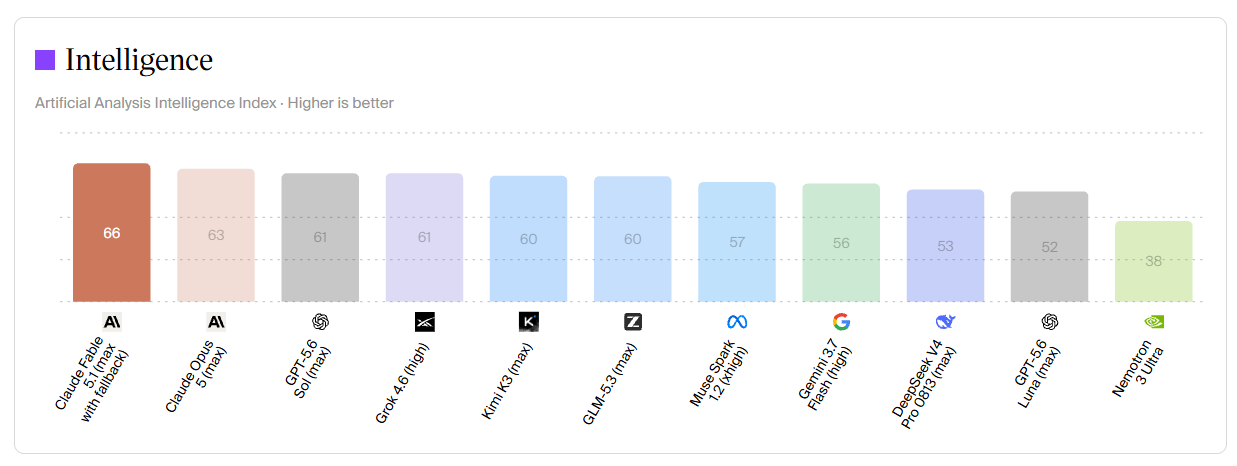
Artificial Analysis, which helped Anthropic with pre-release testing, disputes the savings claim:https://www.linkedin.com/posts/artificial-analysis_claude-fable-51-tops-the-artificial-analysis-activity-7500649293469335552-6g83?utm_source=share&utm_medium=member_desktop&rcm=ACoAABfX0nABz6sCWbPldiV_9liETVfz5fRLAD0. While the cache read cut saves about $1.40 per task on agentic workloads, Fable 5.1 at max effort actually costs 20 percent more per task than Fable 5 because it uses roughly 1.7 times as many output tokens. At max effort, Fable 5.1 runs $3.76 per Intelligence Index task compared to Opus 5 at $2.34, which scores only three points lower. At extra-high effort, Fable 5.1 scores 65 at $2.72 per task, closing the gap but still costing more than Opus 5.
Anthropic launches Claude Fable 5.1 and Mythos 5.1, its most capable AI models yet. Along with gains in agentic coding and text quality, the company cuts costs by up to 45 percent.
Like their predecessors, both 5.1 models share the same base model but differ in safety guardrails. Fable 5.1 is broadly available, while Mythos 5.1 is restricted to special access programs for cybersecurity and life sciences.
Fable 5.1 costs about 25 percent less than Fable 5 for typical workloads, with savings climbing to roughly 45 percent for heavily agentic tasks involving long, autonomous runs with many tool calls. Anthropic made that possible by slashing cache reads from $1 to $0.25 per million tokens. All other API prices remain unchanged at $10 per million input tokens and $50 per million output tokens. For comparison, Opus 5 runs at half that price with $5 input and $25 output per million tokens. Ad
High cost was the biggest complaint about Fable 5, and it likely contributed to the model seeing low adoption among enterprise customers:https://the-decoder.com/fable-5s-slow-adoption-suggests-corporate-willingness-to-pay-for-frontier-ai-has-hit-a-ceiling/. The price pressure has been building since Opus 5 launched:https://the-decoder.com/anthropics-claude-opus-5-costs-well-below-fable-5-while-matching-or-beating-it-across-most-benchmarks/ in late July, already matching or beating Fable 5 on most benchmarks at a lower price. Like earlier Claude models, the new versions come with an effort-level system that controls compute usage. At low or medium effort, Fable 5.1 should match Fable 5's results at lower cost.
Fable 5.1 posts major gains on agentic benchmarks. On Terminal-Bench-Science 0.1, the model hits 52.6 percent, more than double Fable 5's 24.7 percent and far ahead of GPT-5.6 Sol at 22.4 percent. On Terminal-Bench 4.0 for agentic coding, Fable 5.1 scores 55.8 percent while Mythos 5.1 reaches 60.9 percent, compared to 42.0 percent for Fable 5 and 37.3 percent for GPT-5.6 Sol. Whether these gains translate to real-world use at the same scale will become clear over the coming weeks. Ad
Anthropic researcher Felix Rieseberg:https://x.com/felixrieseberg/status/2094849659059703818 says Fable 5.1 also improves its writing style. Earlier models leaned too heavily on bullet points and bold text in chat, and Fable 5.1 dials that back while following style instructions more closely and sounding more natural overall.
The safety filters for cybersecurity, biology, and medical questions are less aggressive than in earlier versions. In the 5.0 models, they were so sensitive that they triggered on well-intentioned requests too, producing false positives at a frustrating rate. Ad
The cybersecurity filters in 5.1 generate 60 percent fewer false positives, and for biology-related queries, the filters fire 85 percent less often on harmless questions about basic biology and medicine. Ad
Fable 5.1 can now identify software vulnerabilities for the first time, though not develop exploits. Penetration testing and exploit generation still get routed to the Opus models. Mythos is also part of Claude Security for defensive purposes:https://the-decoder.de/anthropic-macht-sein-staerkstes-modell-claude-mythos-5-erstmals-fuer-die-cyber-verteidigung-verfuegbar/.
Claude Fable 5.1 is available immediately on all platforms, including AWS, Google Cloud, and Microsoft Azure. Developers can access it via the API using claude-fable-5-1 . For enterprise customers, Anthropic is rolling out Enterprise Frontier Safeguards (EFS), which store customer data solely on the customer's own cloud infrastructure.
Claude Mythos 5.1 is currently limited to US organizations through two programs: the Cyber Verification Program for defensive security work and the Life Sciences Verification Program, developed with the US government. Anthropic plans to expand access to international partners.
Anthropic is also cracking down on distillation attacks, where a model's capabilities are systematically extracted through thousands of fake accounts. New API accounts can no longer edit Claude's prior context in multi-turn conversations while keeping the thinking transcript, which according to Anthropic closes a documented distillation technique.
Stay in the loop on AI. Clear, useful, no fluff.
Follow The Decoder for AI news, background stories and expert analyses.
The Decoder:https://the-decoder.com/
情报判断
Aioga 编辑摘要
Anthropic 发布 Claude Fable 5.1 与 Mythos 5.1,两者采用相同基础模型但安全护栏不同。新模型主打智能体编码与文本质量提升,官方称部分工作负载成本最多可降约45%。

 扫码直达文章详情