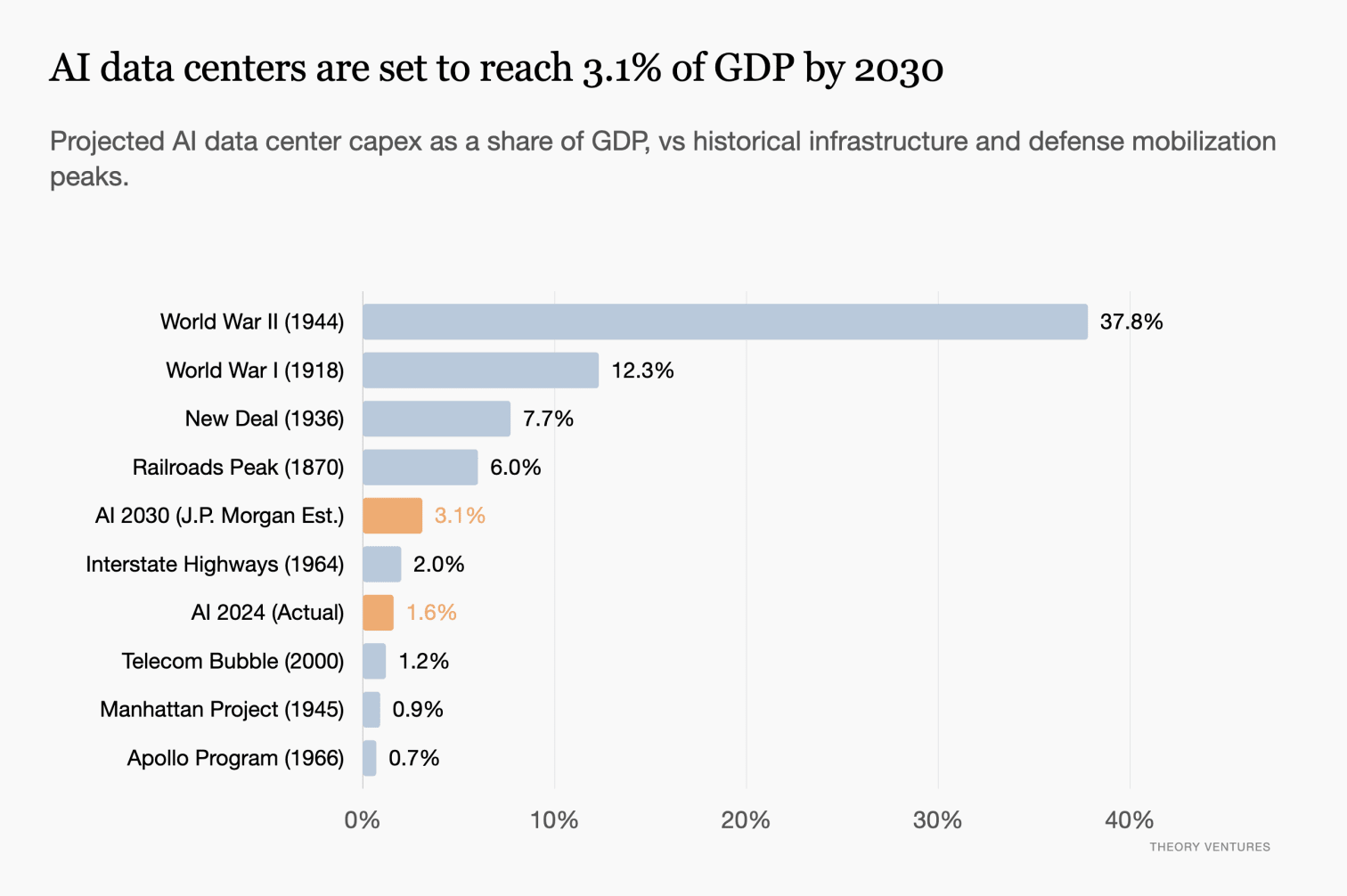
Over the next five years, US data center capacity will grow from 25 gigawatts to 70 gigawatts, part of a global buildout costing roughly $5t. 1:#fn:1
Data centers are built as real estate projects with some equity, but the majority debt : typically 70% or more 2:#fn:2 . Assuming we achieve our plans to build all these data centers, is there enough debt available in the credit markets to finance it? 3:#fn:3
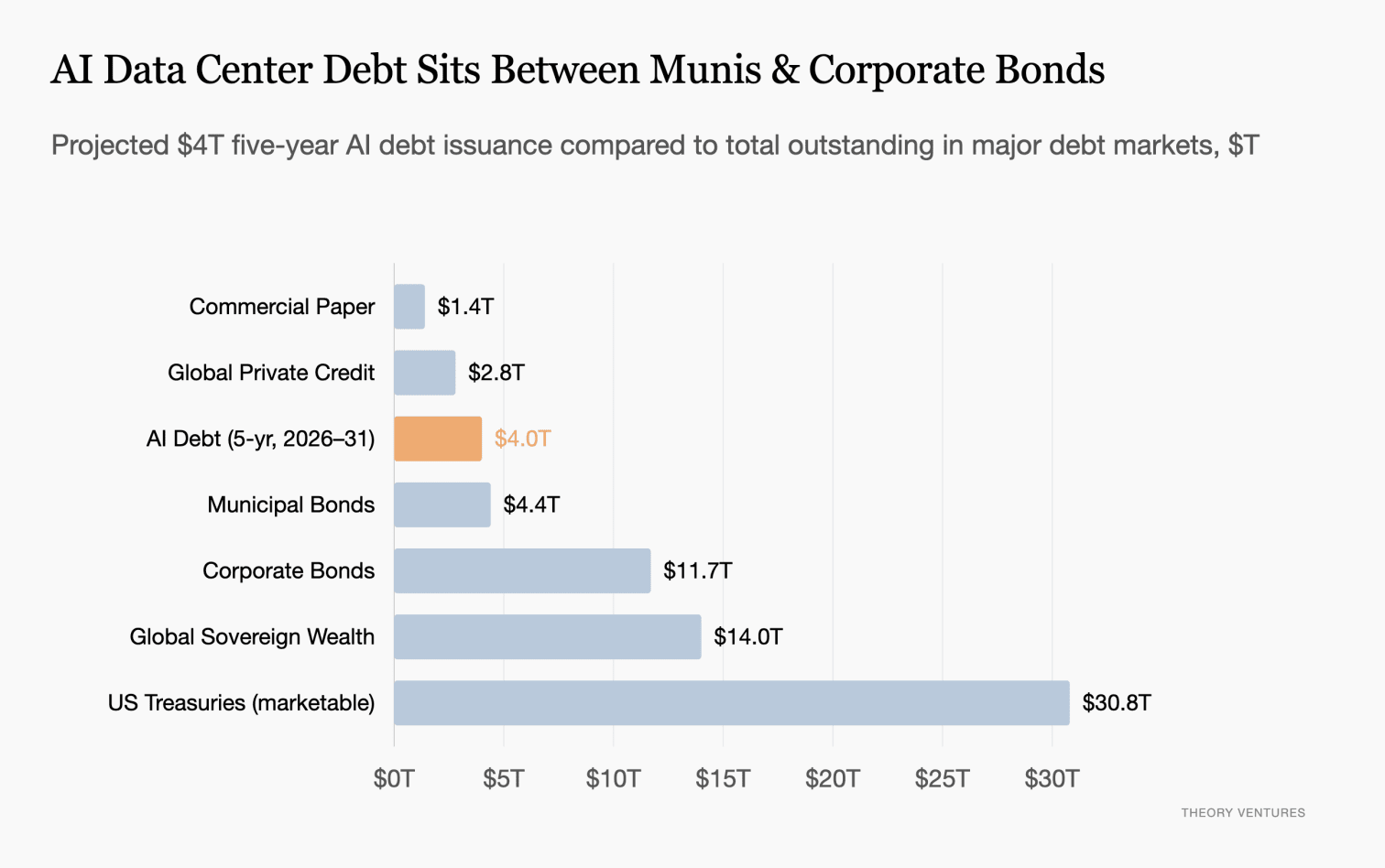
To understand the magnitude, I compared the $4t of new AI debt to the sizes of the world’s primary credit markets. The AI buildout represents a 34% expansion of the US corporate bond market.
At this scale, data center debt triples the outstanding commercial paper market, grows larger than the global private credit market, & equals 91% of the US municipal bond market. 4:#fn:4
For decades, the $4.4t municipal bond market has financed the physical buildout of American roads, bridges, water systems, & airports. It also raises the question of whether municipalities seeking economic growth will use municipal bonds to fund some of these data centers, much like power plants. 5:#fn:5
All of this debt needs to be serviced from profits : annual AI revenue must exceed $1.2t to $1.5t by 2030 across software, tokens, & enterprise automation. 6:#fn:6
Today, annualized AI data center revenue across all cloud providers & model labs is estimated at $100b to $200b. 7:#fn:7
Reaching $1.35t from roughly $150b today requires a 55% compound annual growth rate (CAGR) over the next five years. By comparison, hyperscalers currently grow between 37% & 82% annually (AWS at 37%, Azure at 43%, & Google Cloud at 82%) ; but the growth is accelerating. 8:#fn:8
For perspective, the global enterprise software market totals roughly $1.4t today, out of an estimated $9t in worldwide IT spending in 2030. 9:#fn:9
Financing the AI infrastructure boom is no longer a venture capital or corporate earnings story. It is a macroeconomic credit event that will rival the largest debt expansions in financial history.
J.P. Morgan Asset Management, Western Asset, & PIMCO research estimates on data center capacity expansion & $5t in total capital expenditure through 2030. ↩︎:#fnref:1
Columbia Business School real estate professor Stijn Van Nieuwerburgh & CREFC analysis on data center project finance find facility-level leverage routinely carries 65% to 75% debt (& up to 90% in synthetic joint venture SPVs like Meta’s Beignet vehicle), compared to traditional 40% corporate leverage. ↩︎:#fnref:2
As a venture capitalist, I have a naive view of the bond market. ↩︎:#fnref:3
Commercial paper is short-term corporate debt, typically maturing in under 270 days, that companies use to fund payroll & day-to-day operations. Corporate bonds, by contrast, are long-term debt with maturities of several years or more, used to finance capital projects. Global private credit assets under management across direct lending, mezzanine, & distressed credit strategies. ↩︎:#fnref:4
Municipal bonds are debt issued by state & local governments to finance public infrastructure like roads, bridges, water systems, & airports. ↩︎:#fnref:5
Servicing $4t in debt at prevailing market rates between 6.5% & 7.5% requires $260b to $300b in annual interest expense alone. At an investment-grade interest coverage ratio of 3x, the infrastructure requires roughly $800b to $900b in annual operating profit to satisfy lenders. Assuming cloud & AI gross margins of 60% to 70%, that implies $1.2t to $1.5t in annual AI revenue. ↩︎:#fnref:6
Based on hyperscaler disclosures through mid-2026: Microsoft reported an AI revenue run rate surpassing $13b, AWS reported an AI & custom silicon run rate exceeding $50b, alongside rapidly scaling AI infrastructure revenue across Google Cloud, Oracle Cloud, & leading foundation model labs. ↩︎:#fnref:7
https://tomtunguz.com/aws-answers-the-cloud-race/:https://tomtunguz.com/aws-answers-the-cloud-race/ reports current cloud growth rates: AWS at 37%, Azure at 43%, & Google Cloud at 82%. ↩︎:#fnref:8
Gartner Worldwide IT Spending Forecast projects enterprise software spending reaching $1.4t in 2026, with overall worldwide IT spending compounding toward $9t in 2030. ↩︎:#fnref:9
The 1-minute read that turns tech data into strategic advantage. Read by 150k+ founders & operators.
GP at Theory Ventures. Former Google PM. Sharing data-driven insights on AI, web3, & venture capital.

 扫码直达文章详情