要开始使用 ADK for Kotlin 1.0,请将必要的依赖项添加到模块的 build.gradle.kts 中:
浏览仓库,查看示例应用,并开始构建您的多代理体验:
无论您是在服务器端的 JVM 还是在 Android 移动设备上开发代理,我们都迫不及待想看到您如何利用 ADK for Kotlin!给仓库加星:http://github.com/google/adk-kotlin,试用示例,并与我们分享您的反馈!
企业级精度:用于云 TPU 上长上下文多模态嵌入推理
弥合领域差距:使用 Antigravity 和 Gemini 构建的 AI 赛跑教练
推出 Credentio:Google 的开源 C++ 库,用于 C2PA 内容凭证
推动开发者卓越:深入了解项目冲刺
Today, we're thrilled to announce the 1.0 general availability release of the Agent Development Kit (ADK) for Kotlin ! Check out the GitHub repository:https://github.com/google/adk-kotlin to dive into the code and build your first agent today, and explore the documentation:https://adk.dev/get-started/kotlin/.
When we introduced ADK for Kotlin 0.1.0:https://developers.googleblog.com/adk-kotlin-android-building-ai-agents/, our mission was to bring idiomatic, lightweight, and composable AI agent development to Kotlin, Java, and Android developers. Over the past months, we've worked to evolve the framework into a production-ready toolkit.
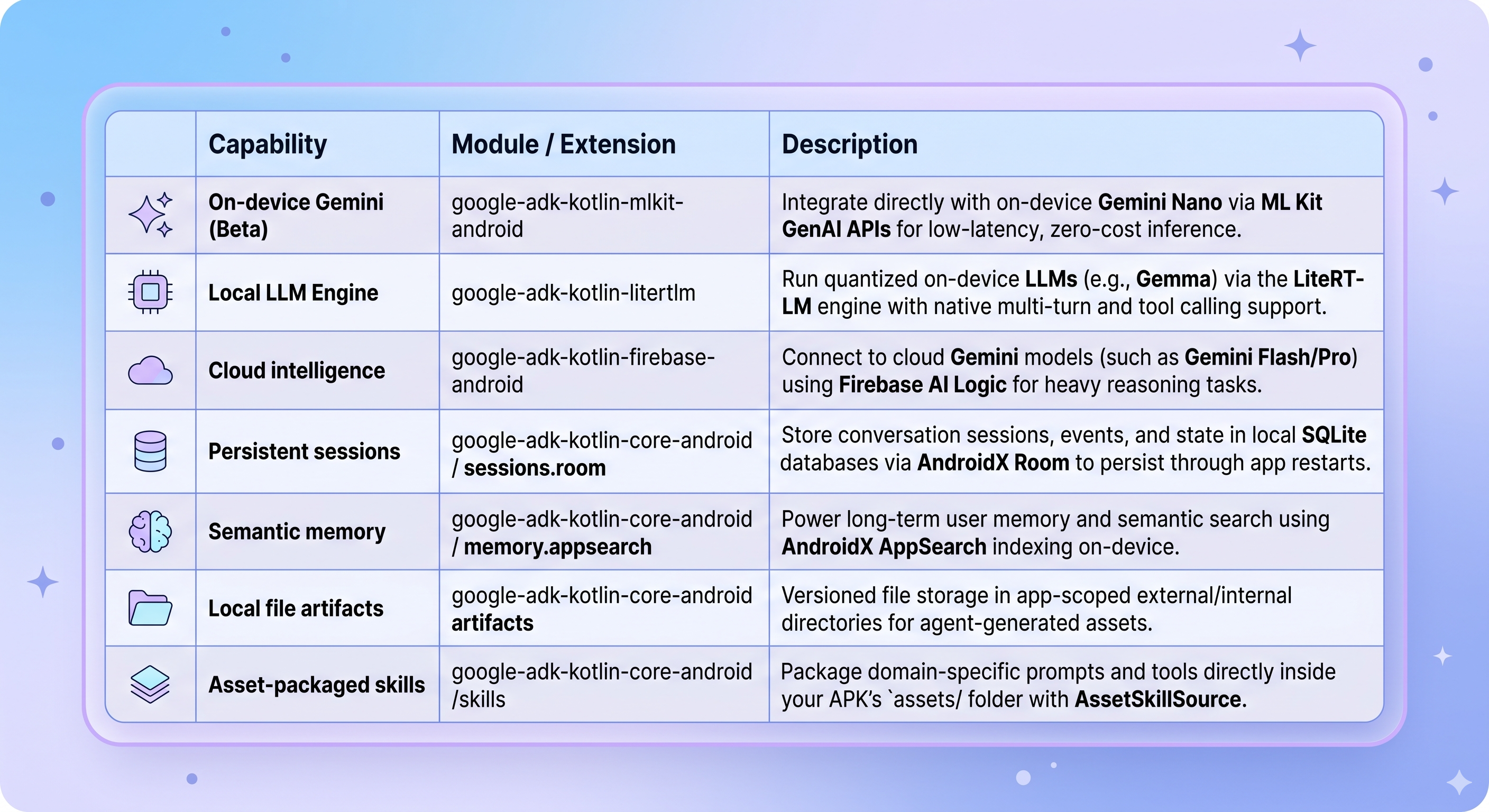
With version 1.0, ADK for Kotlin reaches full feature parity with ADK 1.0 Core while delivering a rich suite of Android-first, on-device extensions . Whether you want to run fast, private on-device agents using LiteRT-LM and ML Kit (beta) , orchestrate hybrid cloud workflows via Firebase AI Logic , or persist agent state across process restarts with Room and AppSearch , ADK for Kotlin 1.0 provides everything you need.
ADK for Kotlin is not only for Android though, as server-side Kotlin developers will be able to write idiomatic Kotlin code to create their enterprise-ready agents and smart applications.
ADK for Kotlin is built around a Kotlin Multiplatform (KMP) core that remains completely agnostic to specific model backends, session providers, or memory systems. Version 1.0 combines core multi-agent orchestration capabilities for local and cloud scenarios, along with plug-and-play Android extensions for developers targeting mobile devices.
ADK for Kotlin 1.0 delivers complete alignment with ADK Python and Java, bringing advanced multi-agent coordination patterns to idiomatic Kotlin:
Let's take ADK for Kotlin 1.0 for a spin, and build an incident triage & diagnostics agent that investigates production database alerts. Our agent will take advantage of ADK function calling and agent skill capabilities:
ADK leverages KSP (Kotlin Symbol Processing) to generate function call definitions at compile time , giving you type-safe schemas, support for suspend functions, and zero runtime reflection .
You define your services using regular Kotlin data classes:
And functions annotated with @Tool and @Param :
At build time, KSP automatically creates the extension function InfrastructureDiagnosticsService().generatedTools() .
Instead of hardcoding triage guidelines in code, place standard operating procedures in src/main/resources/skills/database-incident-triage/SKILL.md :
Skills can bundle auxiliary assets (e.g. assets/mitigation_rules.txt ) that the model only fetches if needed, keeping token usage minimal—that’s a mechanism called progressive disclosure .
Now it’s time to equip our agent with both tools and skills in a declarative way:
With our agent ready, let’s execute it using Kotlin Coroutines and InMemoryRunner :
When the alert fires, the agent executes autonomously in a structured turn loop:
Let's look at how ADK for Kotlin integrates into a production Android app. In the following example, we build a financial assistant powered by Gemini 3.8 Flash, via Firebase AI. It uses KSP-generated function calling to handle sensitive transactions requiring explicit user approval, while taking full advantage of first-class Android persistence services, like storing chat sessions in Room , indexed memory in AppSearch , and files directly in Android storage:
Let’s first define the bank transfer tools (requiring human confirmation):
Here’s how we configure the agent, using Gemini 3.8 Flash via Firebase AI, and configuring the tools we’ve just defined:
We configure the InMemoryRunner with the session service backed by Room , and the memory service powered by AppSearch :
Time to run the agent, with the two turns requesting the transfer and confirming the transfer via human approval:
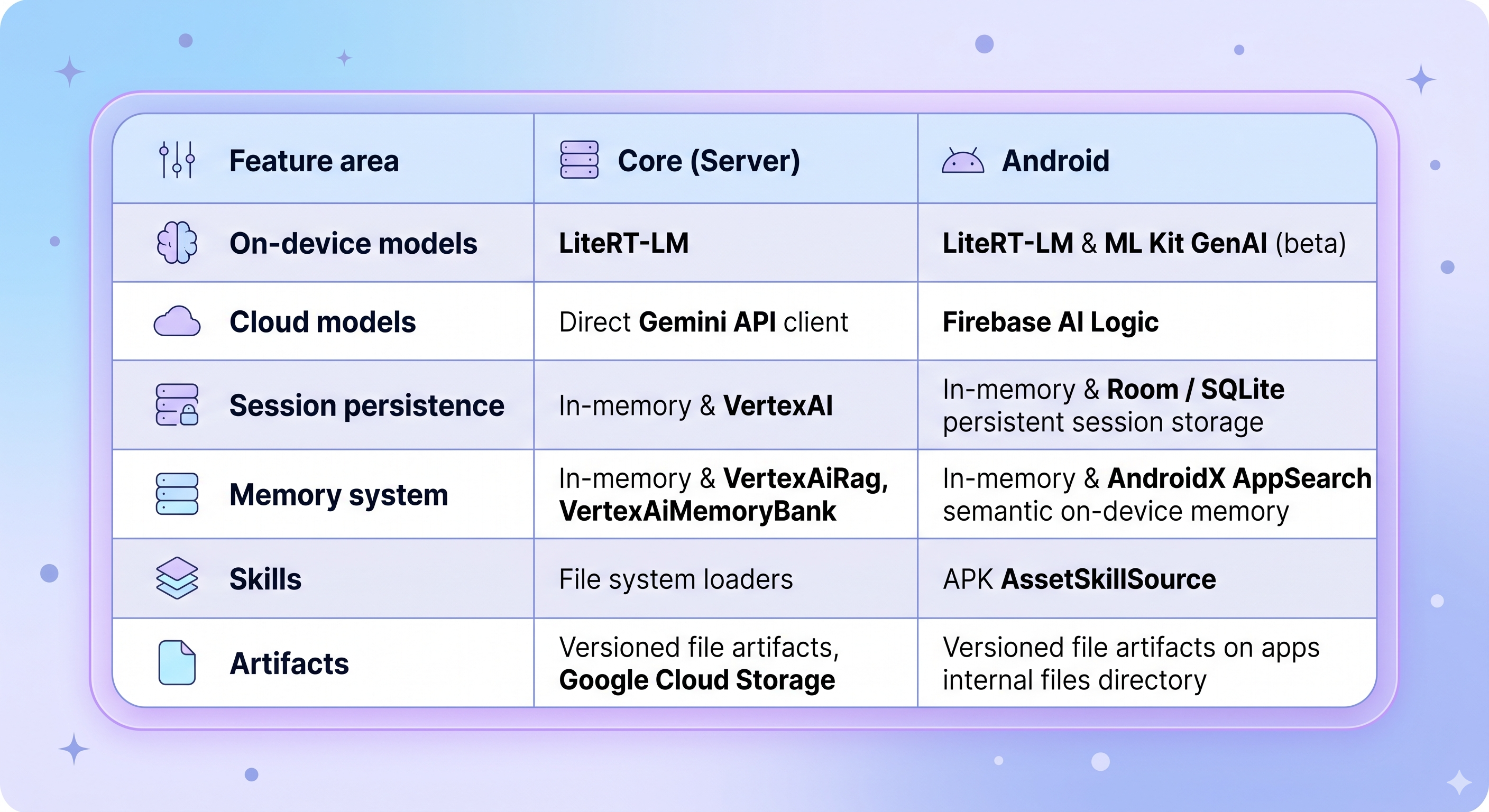
📊 Comparing ADK for Kotlin Features — Core and Android
To get started with ADK for Kotlin 1.0, add the necessary dependencies to your module's build.gradle.kts:
Explore the repository, check out sample applications, and start building your multi-agent experiences:
Whether you develop agents on the server-side on a JVM or for Android mobile devices, we can’t wait to see how you’ll take advantage of ADK for Kotlin! Star the repo:http://github.com/google/adk-kotlin, try out the samples, and share your feedback with us!
Enterprise-Grade Precision for Long-Context Multimodal Embedding Inference on Cloud TPU
Bridging the Domain Gap: AI Race Coach built with Antigravity and Gemini
Introducing Credentio: Open Source C++ Library for C2PA Content Credentials from Google
Driving Developer Excellence: Inside the Program Sprints
情报判断
Aioga 编辑摘要
Aioga 编辑摘要:Google 宣布 Agent Development Kit (ADK) for Kotlin 1.0 正式发布,实现与 ADK 1.0 Core 的完整功能对齐。 Aioga 将其归入「行业动态」方向,重点关注它对真实使用和行业竞争的影响。




 扫码直达文章详情