为此,我们分享三项指标,以帮助公众跟踪前沿 AI 实验室内的 AI 发展情况:AI 自身执行了多少研发工作、AI 代理的行为监督情况如何,以及计算资源的分配情况。
理解前沿实验室内 AI 发展速度的测量指标
AI 系统正在呈指数级增强,并且已经开始自动化更多:https://www.anthropic.com/institute/recursive-self-improvement 构建自身的过程。当世界在考虑减缓前沿 AI 开发的速度时:https://darioamodei.com/post/we-must-pace-the-frontier,公众需要更多的信息。
在这篇文章中,我们展示了能够揭示 AI 开发三大关键方面的测量工具:
我们还提供了来自 Anthropic 内部的这些指标的快照。值得注意的是,如果如 Anthropic CEO Dario Amodei 所呼吁的那样进行前沿开发速度的协调,这些数字预计会发生变化。我们计划在 Anthropic 内部嵌入来自多个组织的独立第三方评估人员,并向他们提供与内部风险评估团队相当的内部流程、系统和数据的访问权限。第三方将验证安全实践、报告事件,并监控本文中提到的关键指标。
我们报告这些指标,是因为它们可以让公众、第三方和政府更好地了解前沿实验室内 AI 发展的速度。对于每一项测量,我们描述了测量的内容、测量结果以及定期以他人可验证的形式发布这些测量所需的条件。我们在附录中分享了方法学细节。
本段中的测量重点是模型的构建方式。通过更好地理解模型的生产过程,我们更有可能将模型的输入(如计算资源)与模型的输出(如能力)进行关联。这些测量与能力评估相辅相成,能力评估用于衡量模型能做什么。我们会通过《负责任的扩展政策》(Responsible Scaling Policy, RSP)风险报告单独发布这些信息,其中包括关于我们的模型在加速人工智能研发方面的证据:https://www.anthropic.com/responsible-scaling-policy。在我们关于先进人工智能的政策提案《先进人工智能框架》(Advanced AI Framework, AAIF)中:https://www-cdn.anthropic.com/files/4zrzovbb/website/0a58d567024a8b448ff15158ebc3625328dfcc1f.pdf,我们提出了任何实验室发布安全模型的行为准则,包括政府可能要求的透明义务,例如风险报告。这些提议的测量和政策共同构成了从实验室外部监测 AI 发展速度的起点。
为什么要测量 AI 主导的研发?前沿 AI 实验室越来越多地使用 AI 来构建未来的 AI 模型。这一过程使得民主国家的实验室能够更快地开发更高能力的模型,并在发布之前进行更多的模型安全性和测试,以确保 AI 的益处,同时保持在前沿。然而,模型加速自身发展的能力可能使人类更难理解或控制这些系统。因此,分享这些指标以了解世界距离递归自我改进有多近非常重要:https://www.anthropic.com/institute/recursive-self-improvement(即一个模型完全自主地构建其继任模型)。
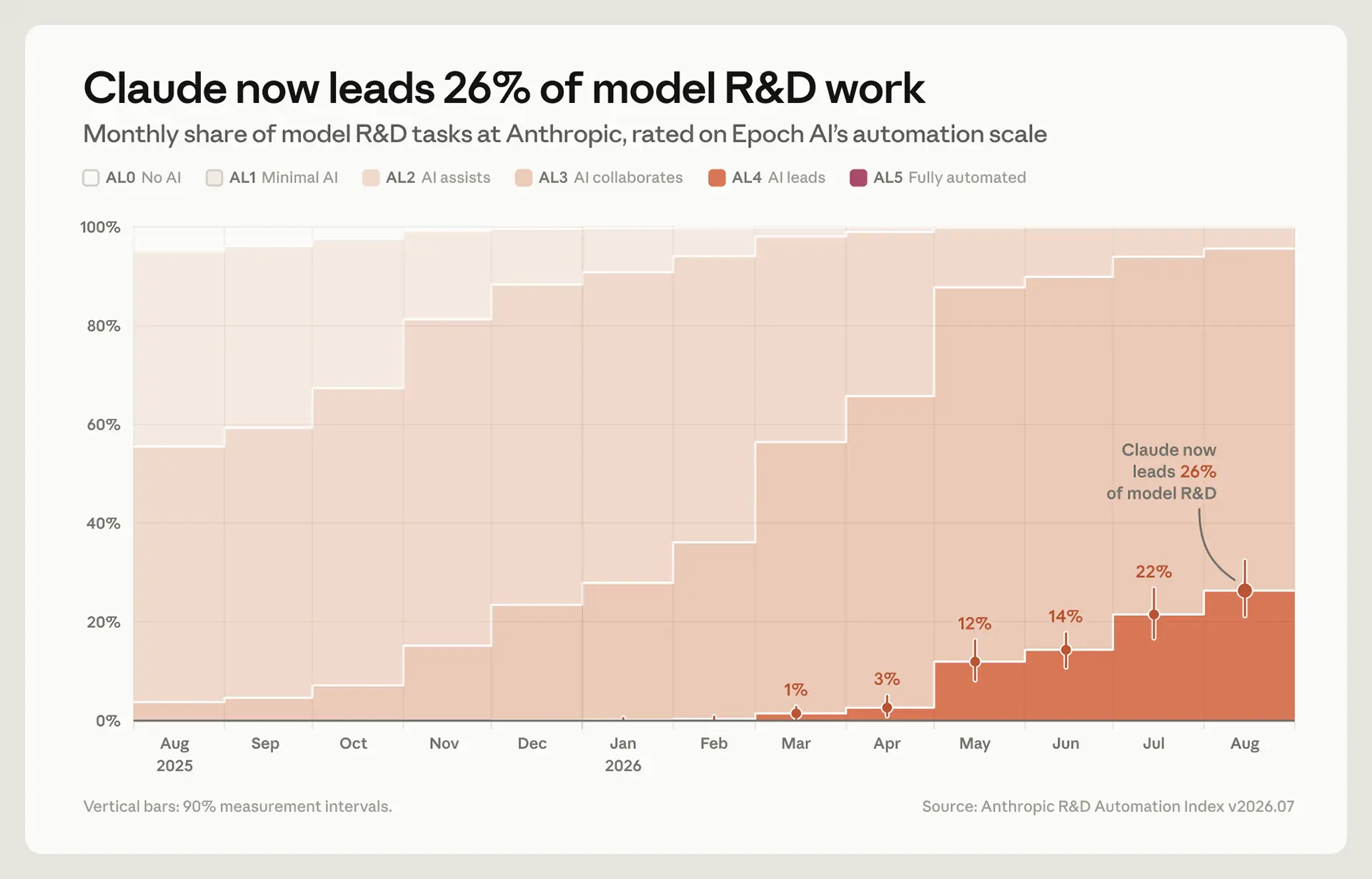
我们测量了什么。我们构建了一个原型指数,用于衡量 Anthropic 的人工智能研发(R&D)中有多少是由 Claude 执行的,称为 Anthropic R&D 自动化指数。该指数通过列举公司进行的每一种 AI 研发工作,对每项任务当前的自动化程度进行评级,并汇总这些评分来构建。
我们所测量的内容。我们已经构建了一个系统,使我们能够监督并干预 AI 代理在 Anthropic 系统上采取的行动。在这里,我们考虑三个不同的指标:覆盖率,描述代理行为中有多少比例在执行前或执行后会经过监控;审查延迟,即从行为发生到其被审查的时间,首先由自动化监控完成,然后由人工审查完成;以及升级率,即代理活动中有多少比例被阻止/重定向(对于在线监控)或被标记以供进一步审查(对于离线监控)。
AI 开发者今天可以报告的内容。任何在自己研究和工程工作负载上运行代理的开发者,都可以公开相同的衡量指标:覆盖率(受监控的代理活动比例)、审查延迟(被标记活动的审查速度)以及升级率(监控阻止或标记的代理活动比例)。这些指标一起,可以让社会看到监督是否跟上了 AI 在 AI 研发中日益增长的作用。我们在最近的风险报告中公布了所有这些测量数据:https://www.anthropic.com/aug-2026-risk-report。
为什么要衡量计算分配?广义上讲,AI 开发者使用计算资源来构建更强大的模型、为客户提供服务,以及进行关注安全的工作,例如审计模型的“思维”:https://www.anthropic.com/research/natural-language-autoencoders,训练模型有机体以研究错位问题:https://www.anthropic.com/research/emergent-misalignment-reward-hacking,以及评估模型是否可以安全部署:https://www-cdn.anthropic.com/f61d49fa5596956a5dec75fea0e973bf6a6a8378/Redacted%20Risk%20Report%20August%202026%20.pdf。了解 AI 开发者如何分配其计算资源可以告诉你开发者将资源集中在哪些方面,以及这种关注随时间的变化情况。
此外,计算是 AI 研发过程中最容易验证的投入之一,这意味着它可能是未来节奏管理工作的关键杠杆。一项协调的节奏管理工作可以鼓励公司增加整个行业用于安全的计算分配,并投入更多资源到对齐、可解释性、安全测试和评估。
AI 开发者今天可以报告的情况。任何前沿开发者都可以发布其 AI 研发计算资源中用于安全工作的比例,并附上分类定义,同时由独立第三方进行核查。
安全研究很难与能力研究区分开,每个开发者都会倾向于将界限划得宽一些。举证责任应由开发者承担,证明工作与安全相关。开发者、政府以及更广泛的研究社区将从提前达成共享定义中受益。这类测量可以为未来行动提供依据,例如实验室对用于安全研究的计算比例承诺,或对用于 AI 研究代理的计算比例设定限制。
在世界考虑前沿节奏时,我们应尽一切可能将前沿实验室的知识与公众知识之间的差距降到最低。这意味着更好地衡量 AI 的发展,公开报告,并给予社会决定如何使用这些信息的机会。我们希望通过发布这些测量来示范这一透明度,并将继续这样做。
以下是我们已原型化的所有测量方法的细节。
我们是如何做到的。自动化指数需要三样东西:Anthropic 所有 AI 研发任务的完整地图、评价自动化程度的方法,以及对任务进行权重分配的方法,使重要工作领域比不那么重要的领域计算更多。没有人可以手工列出前沿 AI 公司中的每一个 AI 研发任务,至少无法达到我们想要的粒度。相反,我们是从工作记录(包括 Slack 及各种内部文档资源)底向上构建了这份任务列表。
对于研究培训和评估运行,我们构建了一个分类器,该分类器读取运行的元数据和使用的代码,并返回分类、理由和置信度水平。我们没有对一周几乎 10,000 次的运行全部进行分类,而是对其中约 14% 的运行进行了抽样,并将样本权重偏向于使用计算量最多的运行,以使结果反映计算实际使用的情况,而不是运行次数的多少。在 AI 研究代理的推理过程中,同一分类器的一个变体读取了代理的会话记录。在无法访问会话记录的情况下(通常是因为工作被分隔开),我们通过用户的团队进行分类,或保守地默认将其归类为 AI 研发。我们计划完善这一流程,使独立的第三方能够对作业和会话记录的随机子样本重新运行分类器,并检查分类和总量。
Marina Favaro 和 Phillie Wright 共同撰写了这篇文章,Santi Ruiz、Adam Farina 和 Sarah Pollack 提供了编辑支持。Jack Clark 提供了研究方向。Dan Altman、Kerry Persen、AJ Kourabi、James Bradbury、Holden Karnofsky、Kevin Troy 和 Avital Balwit 提供了反馈。Jun Shern Chan、Brian Calvert、Francesco Mosconi、Henry de Valence、Fabien Roger 和 Joe Benton 开发了技术概念验证。Shan Carter、Johnnie Gomez、Maria Gonzalez、Fayaz Ashraf、Monika Tuchowska 和 Kim Withee 制作了视觉资料。Alex Cloud 和 Andrea Vallone 组织了一次研讨会,与外部专家一起对这些及其他测量提案进行了红队演练。
感谢 Nate Rush、Eli Lifland 和 Peter Wildeford,他们也提供了反馈。
AI systems are getting more powerful, and they’re increasingly being used to build the next version of themselves.
We want to illuminate the pace of progress for the public.
To do that, we’re sharing three measurements that will help the public track AI development inside frontier AI labs: how much of AI R&D is performed by AI itself , how well the actions of AI agents are overseen , and how compute is allocated .
Measurements for understanding the pace of AI development inside frontier labs
AI systems are becoming exponentially more powerful and have begun to automate more:https://www.anthropic.com/institute/recursive-self-improvement of the process of building themselves. As the world considers slowing the pace of frontier AI development:https://darioamodei.com/post/we-must-pace-the-frontier, the public needs more information.
In this post, we lay out measurement tools that can illuminate three critical aspects of AI development:
We also provide a snapshot of these metrics from inside Anthropic. It’s important to note that we would expect these numbers to shift if there were coordination on pacing the frontier, as called for by Anthropic CEO Dario Amodei. We plan to embed independent third-party evaluators from multiple organizations at Anthropic, and give them access to internal processes, systems, and data comparable to what internal risk assessment teams have. These third parties will verify safety practices, report incidents, and monitor key metrics such as the ones in this piece.
We are reporting these measurements because they give the public, third parties, and governments better visibility into the pace of AI development inside frontier labs. For each measurement, we describe what we measured, what the measurement showed, and what it would take to publish these measurements regularly in a form others can verify. We share methodological details in the Appendix.
The measurements in this piece are focused on how models are built. By better understanding the production process of models, we have a better chance of correlating model inputs, like compute, with model outputs, like capabilities. They complement capability evaluations, which measure what models can do . We publish those separately through our Responsible Scaling Policy:https://www.anthropic.com/responsible-scaling-policy (RSP) risk reports, which include evidence on how much our models are accelerating AI R&D. In our policy proposal on advanced AI, the Advanced AI Framework (AAIF):https://www-cdn.anthropic.com/files/4zrzovbb/website/0a58d567024a8b448ff15158ebc3625328dfcc1f.pdf, we propose rules of the road for how any lab releases safe models, including transparency obligations that governments could require, such as risk reports. Together, these proposed measurements and policies are a starting point for monitoring the pace of AI development from outside the labs.
Why measure AI-led R&D? Frontier AI labs increasingly use AI to build future AI models. This process allows labs in democratic countries to develop more capable models more quickly and conduct more safety and testing on models before they are released to secure AI’s benefits while staying on the frontier. However, models accelerating their own development could make it more challenging for humans to understand or control these systems. It is therefore important to share these metrics to understand how close the world is to reaching recursive self improvement:https://www.anthropic.com/institute/recursive-self-improvement (a model fully autonomously building its successor).
What we measured. We built a prototype index of how much of Anthropic’s AI research and development (R&D) is performed by Claude, called the Anthropic R&D Automation Index. It’s built by cataloguing every kind of AI R&D work done at the company, rating how automated each task currently is, and aggregating those ratings.
What we found. To measure the extent to which AI is doing AI R&D at Anthropic, we use an automation rating scale:https://epochai.substack.com/p/toward-an-onet-for-ai-r-and-d developed by Epoch AI that measures “Automation Level,” or AL. It runs from AL0 (no AI involvement) to AL5 (AI operates fully autonomously, with no human in the loop). In AL3, AI “collaborates”: it can do large chunks of work under close human direction. In AL4, AI “leads”: it can complete most of the task end-to-end from a high-level prompt, while the human supervises 1:#footnote-1 .
What any AI developer could report today. Any frontier developer could publish these measures regularly, using a public methodology. This would enable the numbers to be compared over time, and potentially across labs.
Two obstacles stand in the way of cross-lab comparison on this type of reporting. First is the lack of a common methodology. Second, we’re using our own models to evaluate our systems, which could mean that the “judge” model could make the same kinds of errors as the model it is checking. To address these challenges, a developer’s measurements could be verified by a third party, or by other developers’ models, with guardrails in place to limit the exchange of competitively sensitive data. These measures could also become the trigger for stronger requirements, like a fixed testing window before a new model is used for further AI R&D.
Why measure oversight of agents? Like other frontier developers, Anthropic employees increasingly delegate tasks to agents that work semi-autonomously for long stretches, and that delegate work to one another. As work becomes increasingly automated, from “AI collaborates” toward “AI leads,” agents could make more consequential decisions, such as which research direction to pursue next.
These decisions need safeguards to block harmful behavior from an individual agent, as well as an oversight regime to detect problems that might only arise across many agents. In our monitoring data to date, individual agents rarely misbehave. But when there are millions or billions of agents operating in the economy, even rare events can happen regularly.
What we measured. We’ve built a system that lets us oversee and intervene in actions AI agents take on Anthropic’s systems. Here, we consider three different metrics: coverage, which describes the share of an agent’s actions that pass through a monitor before or after execution; review latency , which is the time between an action and its review, first by an automated monitor and then by a human; and escalation rate, which is the share of agent activities that are either blocked/redirected (in the case of online monitors) or flagged for further review (in the case of offline monitors).
What we found. As of August 2026, there were approximately 30,000 agents doing research and engineering work at Anthropic at any one time in our most-used internal platform. These measurements cover this platform only. The actions of these agents are constrained by two kinds of monitors, summarized below:
What an AI developer could report today. Any developer running agents on its own research and engineering workloads could publish the same measures: coverage (the share of agent activity that is monitored), review latency (how soon flagged activities are reviewed), and escalation rate (what share of agent activities the monitors block or flag). Together, these measures would allow society to see whether oversight is keeping pace with the growing role of AI in AI R&D. We published all of these measurements in our recent risk report:https://www.anthropic.com/aug-2026-risk-report.
Developers should share how often known agent misbehavior is caught by monitors, and should have third parties do this kind of testing independently. In the past, METR has independently red-teamed our offline monitoring platform:https://www-cdn.anthropic.com/f61d49fa5596956a5dec75fea0e973bf6a6a8378/Redacted%20Risk%20Report%20August%202026%20.pdf. As described above, we are now setting up:https://darioamodei.com/post/we-must-pace-the-frontier external third party evaluators at Anthropic.
Why measure compute allocation? Broadly speaking, AI developers use compute for building more powerful models, serving customers, and safety-focused work like auditing a model’s “thoughts”:https://www.anthropic.com/research/natural-language-autoencoders, training model organisms to study misalignment:https://www.anthropic.com/research/emergent-misalignment-reward-hacking, and evaluating whether a model can be safely deployed:https://www-cdn.anthropic.com/f61d49fa5596956a5dec75fea0e973bf6a6a8378/Redacted%20Risk%20Report%20August%202026%20.pdf. Understanding how AI developers allocate their compute can tell you where a developer is focusing its resources and how that focus changes over time.
Additionally, compute is among the most verifiable inputs to the AI R&D process, meaning that it could be a critical lever in a future pacing effort. A coordinated pacing effort could encourage companies to increase the compute allocated to safety across the industry and devote more resources to alignment, interpretability, safety testing, and evaluation.
What we measured. We examined a snapshot of how Anthropic used all of its compute from July 13 to July 20 2:#footnote-2 . To do that, we sorted every workload into a small number of categories, then asked how much of the compute going to AI R&D was safety work.
Safety research tends to use less compute than frontier training runs by its nature, so compute is an imperfect proxy for how much a company focuses on safety. This is because safety research consists of individual researchers designing experiments, which is time-consuming even though running the experiments is not particularly compute-intensive. The value of this metric, therefore, is less the absolute numbers and more that it provides a straightforward mechanism to compare like with like, across developers and over time.
What we found. Over the examined week, about 6% of compute that went to AI R&D was allocated toward safety, and about 12% of compute that went to AI-driven AI R&D was allocated toward safety.
These are deliberately conservative estimates. For example, if a token was used to advance capabilities as much as it was to advance safety, it was not counted in these metrics. Additionally, these metrics do not account for safeguards classifiers, which are a separate, comparable amount of compute that make our models much safer for the world.
What an AI developer could report today. Any frontier developer could publish what share of its AI R&D compute goes to safety work, with the category definitions published alongside and the classification checked by an independent third party.
Safety research is hard to distinguish from capabilities research, and each developer will be tempted to draw the line generously. The burden of proof should sit with the developer to show that work is safety-related. Developers, governments, and the wider research community would benefit from converging on a shared definition ahead of time. A measurement like this could inform future actions, such as a lab’s commitments about the share of compute going to safety research, or limits on the share of compute going towards AI research agents.
As the world considers pacing the frontier, we should do everything possible to minimize the gap between what frontier labs know and what the public knows. This means better measuring the development of AI, reporting on it publicly, and giving society an opportunity to decide how to use this information. We hope to model that transparency by releasing these measurements, and we’ll continue to do so.
Here are methodological details on all of the measurements we’ve prototyped.
How we did it. The Automation Index requires three things: a complete map of all the AI R&D tasks being done at Anthropic, a way to rate the level of automation, and a way to weight the tasks, so that important areas of work count for more than less important ones. No one person can list every AI R&D task at a frontier AI company by hand, at least not at the granularity we want. Instead we constructed this list of tasks in a bottom-up manner from work records including Slack and various sources of internal documentation.
For each week in July 2026, we randomly sampled 20% of staff from each department that make up the model R&D loop. A Claude research agent reviewed each sampled person’s week using Slack and internal documentation, and listed the tasks they worked on. Repeating this for each week in July 2026 gives us a flat list of ~15,000 granular model R&D tasks. We then used Claude to organize these tasks into a hierarchical tree, starting from all model R&D at the root and branching into areas such as training and product, then pretraining and reinforcement learning, and so on down to increasingly specific kinds of work. The resulting tree has 542 nodes at different depths, of which 378 are leaves like “eval platform defect diagnosis and fixes,” “RL sandbox egress and network policy,” and “serving incident postmortems.” We freeze this tree so that every measurement we make happens against the same basket of work.
For each node in the tree (a task category describing all the work beneath it), a Claude agent deeply researches how that kind of work is done across the company: who does it, with what tools, and how much of it AI performs. An independent Claude judge then read the resulting evidence and assigned one of six automation levels, adopting a scale:https://epochai.substack.com/p/toward-an-onet-for-ai-r-and-d proposed by Epoch AI to differentiate the degree to which AI is used: no AI involvement, minimal AI involvement, AI assists, collaborates, leads, or is autonomous. When we rate a given month’s automation, we only allow the research agents that do the ratings to see evidence from that month or earlier.
To aggregate all the automation level ratings into one number, we want to give each node in the tree a weight corresponding to how important that work is to the overall model R&D effort. Rather than deciding ourselves what kinds of work are more important than others, we used the amount of person-time dedicated to that task as a proxy. Using our sample, we had Claude research what each person worked on during each week of July 2026. Each person gets one unit of weight per week, split evenly across the tasks they worked on that week. If person A worked on four tasks, each gets 0.25; if person B worked on ten, each gets 0.10. A category’s weight is the sum of all the person-time weights given to it. This is a crude approximation, but on average the scheme behaves sensibly: it assigns more weight to categories that many people are assigned to.
What this does and doesn’t capture. First, the automation ratings depend on the judge model. To check them, we asked Anthropic staff who own the relevant work areas to rate the relative automation of their areas. To ensure an unbiased read, staff made their ratings without knowing what evidence the models had gathered or how they had judged that evidence. Our judge model agreed with humans about as often as humans agreed with each other (model-versus-human exact agreement was 59%, human-versus-human was 35%), and model and human ratings were within one level of each other 97% of the time. There remains real room for disagreement on borderline cases, such as where exactly “AI collaborates” ends and “AI leads” begins.
Second, the basket is frozen. A growing index number on a July 2026 baseline tells us that the work humans were doing at that time is being automated; it does not, on its own, tell us whether new kinds of work are appearing that humans have shifted onto. To investigate this, we constructed an alternate version of the frozen tree from January 2026 data, and compared new tasks arriving every month from February to July 2026 against that January 2026 basket. We found no rise in the number of “novel” tasks between the January and July baskets of tasks, suggesting that the structure of model R&D work is stable at our level of analysis. Nevertheless, we plan to rebuild the basket of tasks periodically and re-version our published automation numbers as appropriate.
How we did it. In our most commonly used internal agent scaffold, two design choices allow us to more easily detect unknown unknowns and let agents monitor each other:
What this does and doesn’t capture. At this scale of agent activity, it is hard to be certain we have a complete picture of all possible kinds of behaviors, or that we are making these patterns adequately legible to human oversight. We have been doing this kind of monitoring for months, not years, and expect the science of agent monitoring to change considerably going forward.
How we did it. We started with our existing compute monitoring tools; Anthropic, like presumably every frontier developer, has several monitoring tools built for capacity planning that periodically sample accelerator usage and tag workloads with best-efforts labels (i.e., research and model development, internal usage, first-party inference, and so on) based on its metadata. Usage on third-party cloud compute is reported to us by the providers and folded in. Most of the work of this exercise was stitching these existing sources together.
We then used Claude to classify each workload as either safety work or AI R&D via a prompted classifier. Safety work was defined as work whose dominant purpose is making AI systems safer, more understandable, or more secure. Everything else, including capability research, training production models, product development, and developer tooling, was counted as AI R&D. Work that helps capability as much as it helps safety was also counted as AI R&D, so the safety share is conservative.
For research training and evaluation runs, we built a classifier that reads the run’s metadata and the code it used, and returns a classification, a justification, and a confidence level. Rather than classify all of the week’s almost 10,000 runs, we sampled about 14% of them, weighting the sample toward the runs that used the most compute, so that the result reflects where the compute actually went, rather than how many runs there were. For inference for AI research agents, a variant of the same classifier read the agent’s session transcript. Where transcripts were inaccessible (usually due to the work being compartmentalized), we classified them by the user’s team or conservatively defaulted to classifying them as AI R&D. We plan to refine this pipeline so that an independent third-party could re-run the classifier on a random subsample of jobs and transcripts and check both the sorting and the totals.
What this does and doesn’t capture. The main lesson of this exercise is that classifying what is and isn’t safety work is difficult but tractable, since the boundary between these categories is not black and white. For example, research on scalable oversight might make future models more aligned and current models more commercially useful — it’s difficult to determine whether this is primarily safety- or capabilities-advancing. We found that an extensive written definition of each task, with clear boundary cases (an excerpt is above), gets the classifier to agree with human reviewers within one or two percentage points of difference between the human and machine raters. But some cases were too difficult to determine even after several hours of human review. Our definition is one reasonable choice among many; a different developer, or a regulator, might draw the line differently.
Three further limitations matter. First, many of the underlying labels we relied on (i.e., reasons for runs, workload tags, the source of API traffic) are set by automated rules, or occasionally directly by users, and are best-effort, not verified. In most cases, we expect that our classifications are accurate, but in some cases usage may be mislabeled and our pipeline would not necessarily catch it. A measurement meant to be trusted by outsiders will need to be complete, accurate, and technically enforced. Second, the measurement covers one week, which is enough to show that the measurement can be made, but not enough to show a meaningful trend. Third, and most importantly, compute share measures only what is spent. A more efficient safety classifier, or a faster inference stack for production models, lowers the safety portion, but doesn’t mean we’re doing less safety work. Our own classifier overheads have fallen with efficiency improvements, and have risen when production inference was more efficient than the classifiers were.
Marina Favaro and Phillie Wright co-authored this piece, with editorial support from Santi Ruiz, Adam Farina, and Sarah Pollack. Jack Clark provided research direction. Dan Altman, Kerry Persen, AJ Kourabi, James Bradbury, Holden Karnofsky, Kevin Troy, and Avital Balwit provided feedback. Technical proofs of concepts were developed by Jun Shern Chan, Brian Calvert, Francesco Mosconi, Henry de Valence, Fabien Roger, and Joe Benton. Shan Carter, Johnnie Gomez, Maria Gonzalez, Fayaz Ashraf, and Monika Tuchowska, and Kim Withee created the visuals. Alex Cloud and Andrea Vallone organized a workshop to red team these and other measurement proposals with external experts.
Thanks to Nate Rush, Eli Lifland, and Peter Wildeford, who also provided feedback.
情报判断
Aioga 编辑摘要
Anthropic 发布用于观察前沿 AI 实验室开发节奏的测量框架,覆盖 AI 参与研发、AI 智能体行为监督及算力分配,并披露 Anthropic 内部相关指标的阶段性快照。
背景分析
Anthropic 表示,AI 系统正变得更强,并已开始自动化部分自身构建过程。此次发布旨在让公众、第三方和政府更清楚地了解前沿实验室的 AI 开发节奏,文中同时提供方法细节。
 扫码直达文章详情