Anthropic just shipped Claude Sonnet 5:https://www.anthropic.com/news/claude-sonnet-5 . They call it its most agentic Sonnet model yet. It plans, drives browsers and terminals, and runs autonomously across long tasks.
Sonnet 5 is the default model for Free and Pro plans today. Max, Team, and Enterprise users can select it. It is also live in Claude Code and on the Claude Platform.
Sonnet sits in the middle of Anthropic’s lineup. It is above the cheaper Haiku 4.5 and below the flagship Opus 4.8.
Sonnet 5 is an upgrade to Sonnet 4.6, which launched in February 2026. Anthropic frames this release around agentic reliability, not one headline benchmark.
In practice, that means longer task chains without losing context. It means better self-correction when a tool call fails. It means steadier behavior across extended sessions inside Claude Code or Cowork.
The model exposes effort levels: low, medium, high, and xhigh (extra high). Higher effort spends more tokens on reasoning. That raises both quality and cost.
It is important to note that Sonnet 5 uses an updated tokenizer, the same one introduced with Opus 4.7. The same text can map to roughly 1.0 to 1.35 times more tokens.
Estimate per-task cost across models and compare published benchmarks. All figures from Anthropic’s June 30, 2026 launch.
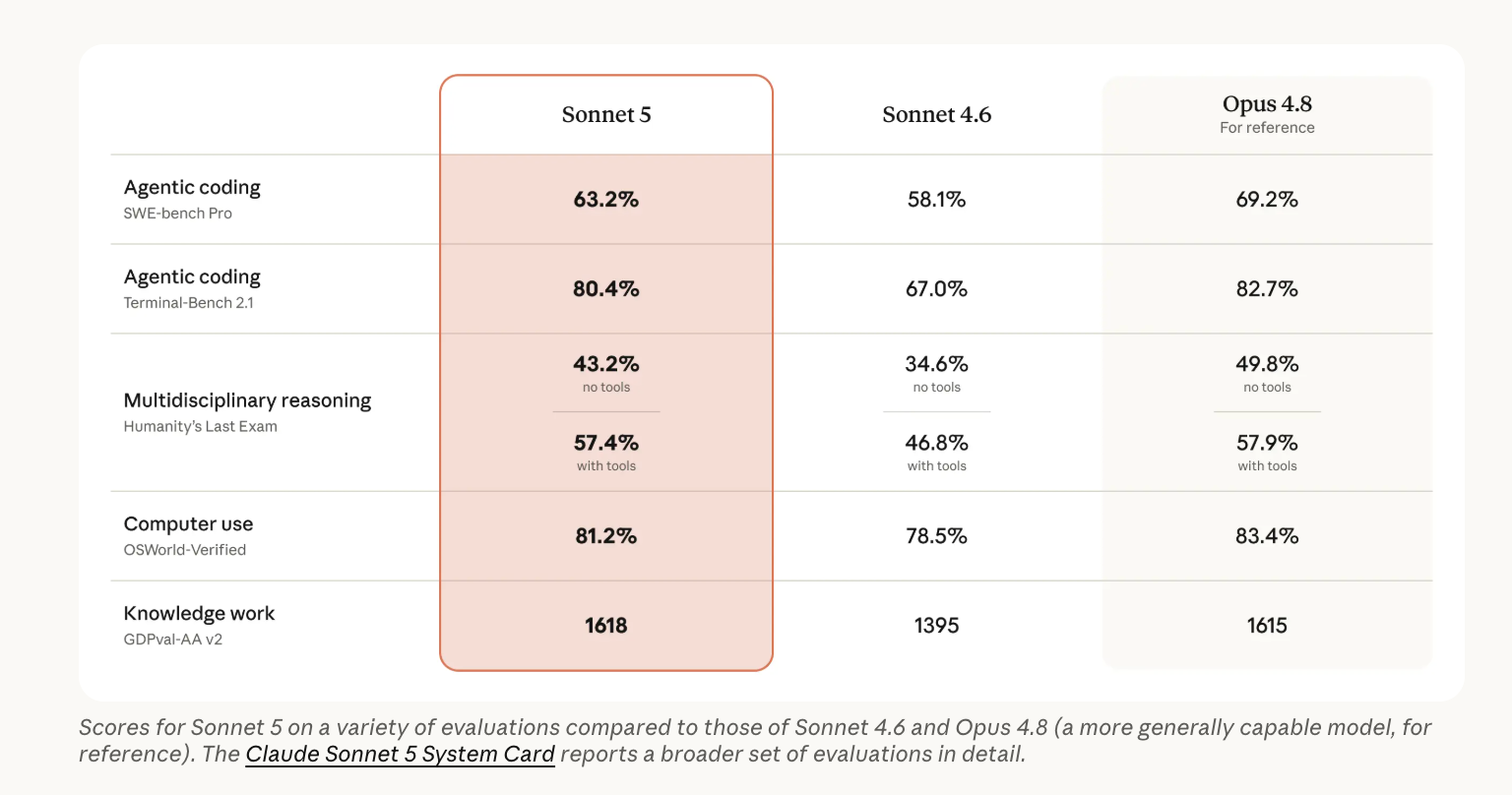
Anthropic team published a benchmark table comparing Sonnet 5, Sonnet 4.6, and Opus 4.8. Sonnet 5 beats its predecessor in every tested category. It closes much of the gap to Opus 4.8.
On agentic coding (SWE-bench Pro), Sonnet 5 scores 63.2%. Sonnet 4.6 scored 58.1%. Opus 4.8 still leads at 69.2%.
On computer use (OSWorld-Verified), Sonnet 5 posts 81.2% against Sonnet 4.6’s 78.5%. On Terminal-Bench 2.1, it reaches 80.4% versus 67.0%.
On Humanity’s Last Exam with tools, Sonnet 5 hits 57.4%. That nearly matches Opus 4.8 at 57.9%.
There is one place where Sonnet 5 edges ahead. On the GDPval-AA v2 knowledge-work benchmark, it scores 1,618 against Opus 4.8’s 1,615.
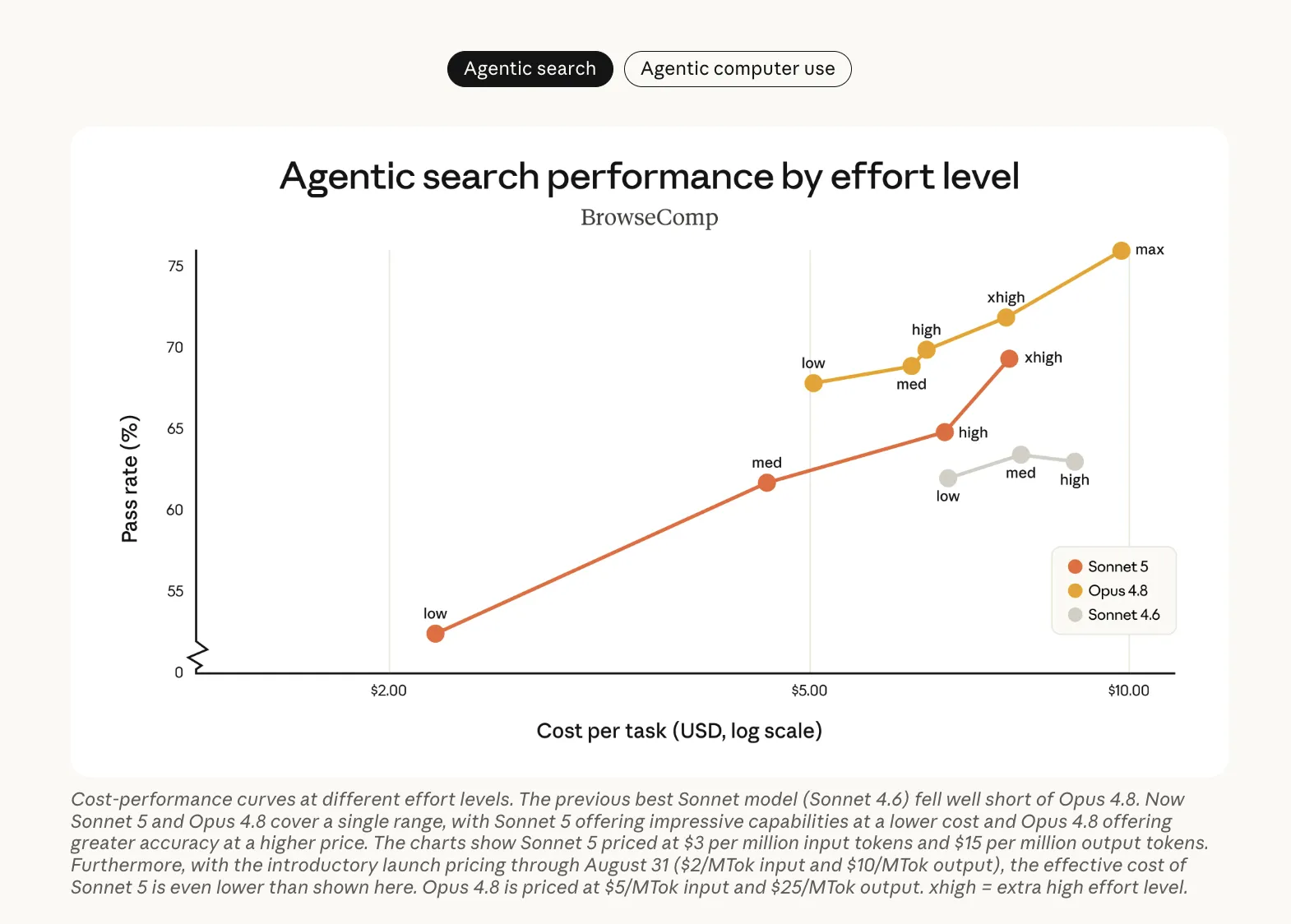
The cost-performance story is the most important part for developers. Sonnet 5 is a strict improvement over Sonnet 4.6 across every effort level. The clearest value appears at low and medium effort.
At those levels, Sonnet 5 delivers quality that earlier Sonnet pricing could not buy. Opus 4.8 remains the accuracy leader at the top of the range.
A practical routing policy follows from this. Send most agentic coding, tool use, and knowledge work to Sonnet 5. Reserve Opus 4.8 for accuracy-critical tasks. Keep Haiku 4.5 for high-volume, latency-sensitive calls.
Early access partners described concrete workflows. Their reports map to common engineering jobs.
Sonnet 5’s introductory pricing runs through August 31, 2026. Standard pricing of $3/$15 begins after that date. Standard prompt caching (cache reads at 0.1x input) and the 50% Batch API discount also apply. Per token, Sonnet 5 undercuts GPT-5.5 and Gemini 3.1 Pro, but costs more than Gemini 3.5 Flash. Anthropic lists a 1M-token context window for Sonnet 5 in its launch post. It does not publish context figures for the other models here.
The API call mirrors any other Anthropic model. You change the model string to claude-sonnet-5 .
Early developer reactions from Hacker News and X on launch day, June 30, 2026.
Mixed reception: praise for price-to-value, doubts about standing at full $3/$15 pricing. Manually labeled from the public posts below; the two Reddit links are live threads, not counted here.
Need to partner with us for promoting your GitHub Repo OR Hugging Face Page OR Product Release OR Webinar etc.? Connect with us :https://forms.gle/wbash1wF6efRj8G58

Asif Razzaq is the CEO of Marktechpost Media Inc.. As a visionary entrepreneur and engineer, Asif is committed to harnessing the potential of Artificial Intelligence for social good. His most recent endeavor is the launch of an Artificial Intelligence Media Platform, Marktechpost, which stands out for its in-depth coverage of machine learning and deep learning news that is both technically sound and easily understandable by a wide audience. The platform boasts of over 2 million monthly views, illustrating its popularity among audiences.

 Scan to open this article