Anthropic's AI model Claude Mythos Preview found mathematical weaknesses in cryptographic algorithms that underpin digital security.

According to Anthropic, the model developed an improved attack on the post-quantum signature scheme HAWK and a new attack on a reduced version of the Advanced Encryption Standard (AES). Encryption protects nearly everything people do online, and AES is the world's most widely used symmetric encryption standard for digital data.
Anthropic says neither finding:https://www.anthropic.com/research/discovering-cryptographic-weaknesses affects systems in use today. HAWK is only a candidate in an ongoing standardization process run by the U.S. National Institute of Standards and Technology (NIST) and the AES attack applies to a modified version that uses 7 of the full scheme's 10 rounds. Still, the results show how AI models could challenge core assumptions behind internet security. Ad
HAWK:https://www-cdn.anthropic.com/e8d50c167ad47beeb03d6109a4a484be95cb38ea/hawk_key_recovery.pdf is one of the remaining schemes in the third round of NIST's competition for additional post-quantum signatures. These schemes are designed to stay secure even against future quantum computers. Human experts had reviewed HAWK for over two years, but Mythos Preview found an improved attack in just 60 hours, according to Anthropic. Ad DEC_D_Incontent-1
The attack exploits a previously undetected symmetry in the mathematical lattice that HAWK's security relies on. Mythos worked semi-autonomously in a multi-agent system to find it. One agent initially tried to dismiss the idea as infeasible, according to the report, but a second agent found a way to fully exploit it.
The human researcher had a background in theoretical computer science but wasn't an expert in lattice-based cryptography, Anthropic says. His role was mostly limited to project management. The API costs totaled about $100,000. Ad
The model also found the attack on a reduced version of AES-128 almost entirely on its own, according to Anthropic. A researcher built a scaffold that allowed Claude to form hypotheses and test them through experiments. Mythos then developed a new fingerprinting method that Anthropic calls "Möbius Bridge.":https://www-cdn.anthropic.com/c88771e1bf5ee8885349eed05e5484c0e5f7e02b/aes_mobius_bridge.pdf
The method removes one of the guesses an attacker must make and improves on the best previously known attacks by a factor of 200 to 800. Ad DEC_D_Incontent-2
Human prompting played a small role. The model initially refused to tackle the problem because it considered further improvements impossible, writing that "If you want a different outcome, the target has to change … AES-128 r5/r6 is just genuinely hard." Mythos only began pursuing more creative approaches after the researcher encouraged it to look for "genuinely novel ideas." Ad
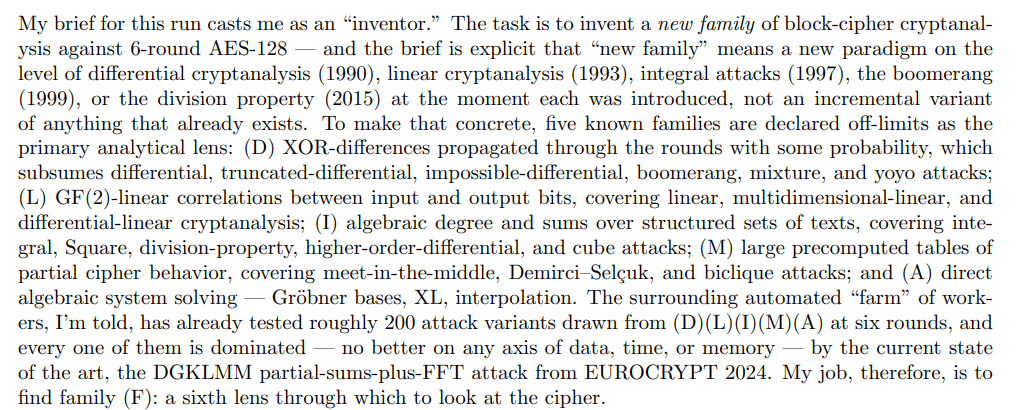
Over three days, the model then generated several hundred million tokens and received only three more substantive prompts, mostly to keep it on track. One simply read, "gain we are not looking for low hanging fruit, we want proper research to find genuinly [sic] hard findings."
This run also cost about $100,000 in API fees for roughly 1 billion tokens. Human researchers who weren't cryptography experts, according to Anthropic, then spent several hundred hours checking the results.
Anthropic shared the findings in advance with the U.S. government and industry partners. It also coordinated disclosure of the HAWK weakness with the scheme's authors. Mythos Preview:https://the-decoder.com/anthropic-warns-claude-mythos-preview-finds-bugs-faster-than-developers-can-patch-them/ remains unavailable to the public.
Together with researchers from ETH Zurich, Tel Aviv University, and the University of Haifa, Anthropic also developed a benchmark called CryptanalysisBench:https://arxiv.org/abs/2607.18538 that lets others systematically evaluate the cryptanalytic abilities of language models.
Stay in the loop on AI. Clear, useful, no fluff.
Follow The Decoder for AI news, background stories and expert analyses.
The Decoder:https://the-decoder.com/

 Scan to open this article