Learn how Warp devised a simple development pattern that anyone can use to create self-improving agents.

In our series, , we highlight how startups are transforming their industries with AI. In this article, we share how Warp turned stateless user feedback into a self-improvement loop for its agents.
Agents need to handle recurring tasks reliably and effectively. A first-pass prompt that gets 80% of the task correct can create a noisy and annoying experience for the user. Warp learned this the hard way, and used this to inform its product strategy, creating an improved experience for nearly 1M developers worldwide.
Warp, the AI-powered terminal and agentic development environment, builds on the Claude Platform. The team ran into this “noisy experience” problem with their internal code review agent. Engineers complained that their agent made unhelpful comments and produced low-quality output.
The team initially tried stopgap solutions, like manually rewriting the prompt based on observed code review failures. This made output more usable but didn’t scale. Improving context files like AGENTS.md also helped, but was far from a complete fix.
Ultimately, they realized, the real issue was that feedback to an agent, no matter what its purpose, typically disappears when the session ends, removing critical context from the agentic loop. Their solution: an Agent Skills:https://platform.claude.com/docs/en/agents-and-tools/agent-skills/overview-based framework to create self-improving agents where feedback compounds over time to continually refine and enhance agent output.
Read on to learn how they built it with skills on top of the Claude Platform.
The central technique is a self-improvement loop using skills :https://support.claude.com/en/articles/12512176-what-are-skills, which are file based encodings of knowledge that keep instructions out of the raw prompt. Warp evolved a self-improving agent architecture consisting of two skills, with human feedback in between.
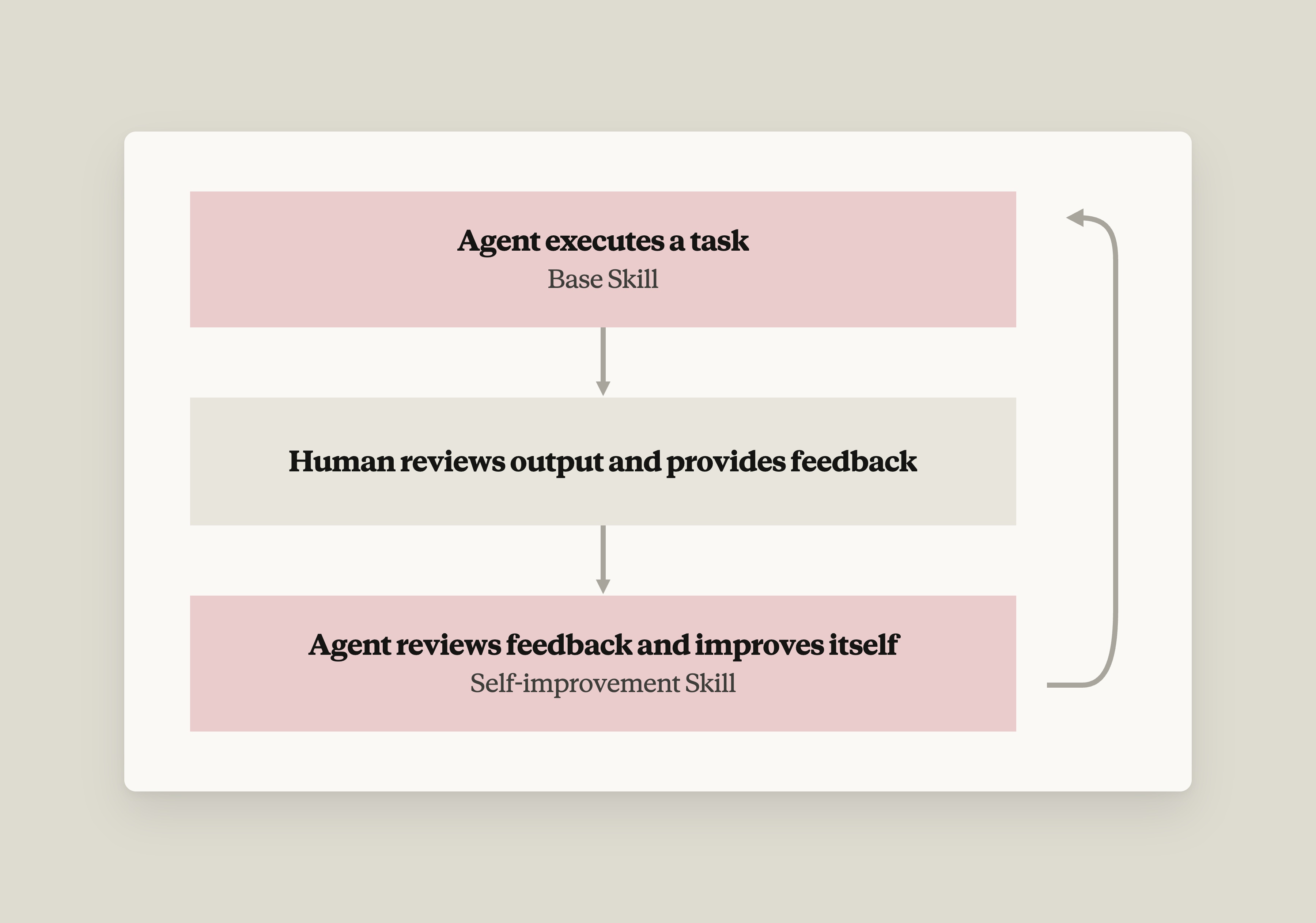
The inner/base skill holds the functional domain knowledge and instructions. For example, when a PR is opened, Warp’s code agent executes using that base skill and context to produce its review.
Human feedback on agent output is a critical component for the self-improvement loop. For code review this could be something as simple as a thumbs up, but the more explicit the better.
“A human could affirm, ‘this was a good, useful comment’,” Warp founder Zach Lloyd explains, “But the human could also give detailed reasons why a code review wasn't good. Specifics like ‘you suggested renaming this variable, but our code base convention is this type of global variable uses this particular naming context’ tell the agent how to do it right next time.”
The outer/improver skill functions as an observer agent that runs on a schedule rather than per-task. It pulls the accumulated human feedback, compares what the agent suggested against how humans responded, and proposes a small, focused edit to the base skill.
Because skills are plain files, agents are extremely good at updating them. These updates, which are reviewable, approvable, and mergeable, can flow through a normal PR/code-review workflow; once merged, the next run of the inner skill inherits the improvement.
Warp now runs this pattern across its entire open-source repo, with separate spec-writing, review, and triage agents, each carrying their own self-improvement loop.
“File-based skills are a way of encoding knowledge for agents without putting that knowledge directly in the prompt, as something the agent can simply look up in the course of doing its job,” says Zach. “The framework is really simple actually: there's the base domain-specific skill and then there's the improver skill that refines that domain-specific skill. This simplicity is the beauty of this approach.”
Here are some of the Warp team’s tried and true tips for writing self-improving skills for agentic loops:
Warp’s issue triage agent:https://github.com/warpdotdev/warp-agents-demo-github-issue-triage demonstrates the self-improving agent skills framework. The pattern is triggered whenever someone files a new GitHub issue: a GitHub Action fires an agent that analyzes the issue for complexity and feasibility, assigns labels, and suggests a direction for the fix. That triage agent runs off an inner skill file holding the domain knowledge about what each label means and how to research the codebase before acting.
On a sample issue, the first-stage inner skill did a solid job but missed one label, ready to spec, which signals that a contributor can start building product and technical specs against the issue. A maintainer on the Warp team caught the gap and left feedback directly on the issue, exactly where the work was happening. Critically, he explained both what he expected and why he expected it: actionable feedback easy for the agent to absorb later.
The outer improver skill runs in Oz, Warp's agent orchestration platform:https://docs.warp.dev/, as a scheduled “update triage” agent. The agent authenticated to GitHub, ran a Python script bundled with the skill to pull recent issues carrying feedback, summarized them into a JSON file, and read that back into context. The bundled script is itself a best practice; skills can reference resource files instead of writing fresh code on every run.
From there, the agent identified the concrete feedback signals in the maintainer comments and proposed the smallest edit that captured them. It opened a PR editing the inner skill to apply the "ready to spec" label when an issue describes a real problem, even though the exact UI or UX shape is not yet defined.
Because the whole update is a skill file, it moves through the normal code-review workflow. The PR arrived with a description explaining which signals prompted the change and what it altered. A human reviews, approves, and merges, and the next run of the triage skill inherits the new knowledge. That final human step closes the loop and keeps a person in control of what actually changes.
This is the same mechanism Warp now runs at scale across its open-source repo, where spec-writing agents, review agents, and triage agents each carry their own self-improvement loop.
Any agent, no matter what its task, gets better over time if you build one of these loops into it from the start to capture human feedback signals, turn them into skill updates, and expand agents from one-off helpers into capable systems that compound across your org.
View the full webinar :https://www.anthropic.com/webinars/how-warp-builds-self-improving-agents-on-claude for a live demo and deeper discussion of how Warp uses Claude to build agents that learn from team feedback and improve themselves over time.
Start building with the Claude Platform :https://platform.claude.com/ today.
Explore more product news and best practices for teams building with Claude.


Product updates, how-tos, community spotlights, and more. Delivered monthly to your inbox.
Enables security and basic functionality.
Enables tracking of site performance.
Enables ads personalization and tracking.
 Scan to open this article