PrismML has released Bonsai 27B, an AI model that it says fits on a smartphone without sacrificing reasoning or agent capabilities. Apple is reportedly testing the technology.
PrismML, a company founded by a team of Caltech researchers, has released Bonsai 27B, a 27-billion-parameter AI model designed to run directly on an iPhone. Bonsai 27B is based on Alibaba's Qwen3.6-27B:https://the-decoder.com/qwen3-6-27b-beats-much-larger-predecessor-on-most-coding-benchmarks/. PrismML says it supports multistep reasoning, tool use, image understanding, and agent-based tasks.
PrismML argues that modern AI apps increasingly need powerful models to run locally. An agent may make hundreds of model calls in sequence, each carrying context, producing structured output, and feeding into the next step. In the cloud, per-token costs pile up, every call adds network latency, and intermediate results, tool calls, and private data such as screen content or documents all leave the device.
According to a CNBC report:https://www.cnbc.com/2026/07/14/apple-prismml-ai-compression-iphone.html, PrismML is already in talks with Apple about the compression technology behind Bonsai. PrismML CEO Babak Hassibi confirmed that Apple and other companies are testing the models for speed, power draw, and performance. The talks are "very early," but "things are progressing nicely."
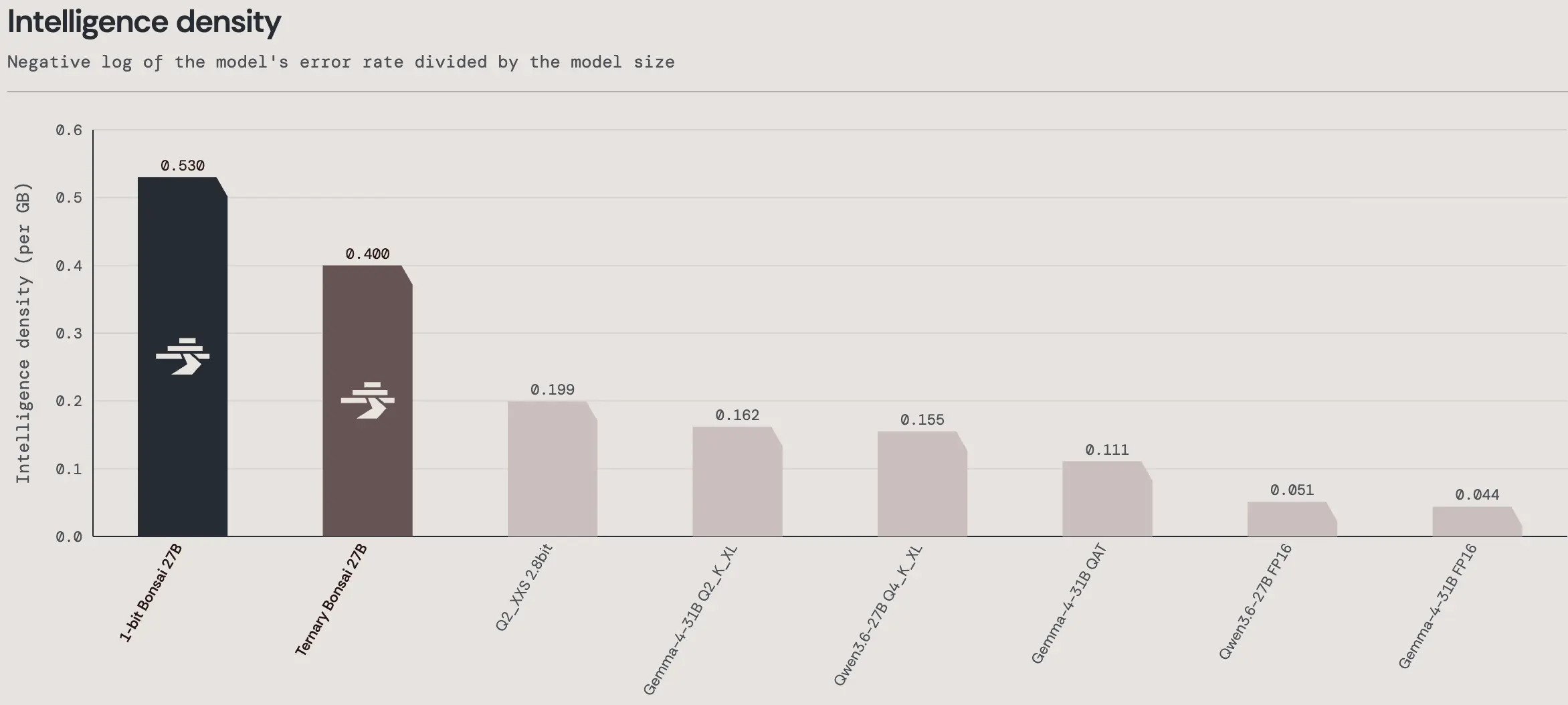
A model this size typically takes up about 54 GB of storage. Even with standard compression, it still needs around 18 GB. PrismML offers two much smaller versions: The quality-focused variant takes up about 5.9 GB and is meant for laptops, though the packages currently shipping may be larger depending on the runtime. The white paper lists about 7.2 GB for the llama.cpp version and 8.49 GB for the MLX version.
The smaller variant comes in at about 3.9 GB, small enough to fit within the limited storage of an iPhone 17 Pro Max. According to PrismML, an iPhone with 12 GB of RAM actually makes only about 6 GB available to a single app, split between the model and the cache.
Instead of storing each neural network weight as 16 bits, PrismML uses only one or just under two bits. In the most aggressive variant, each weight has only two states. In the slightly larger one, three. This approach is applied across the entire language model. As an example of common labeling issues, PrismML points to the Qwen3.6-27B-IQ2_XXS build compared in the white paper, which averages 2.8 bits per weight despite its "2-bit" label.
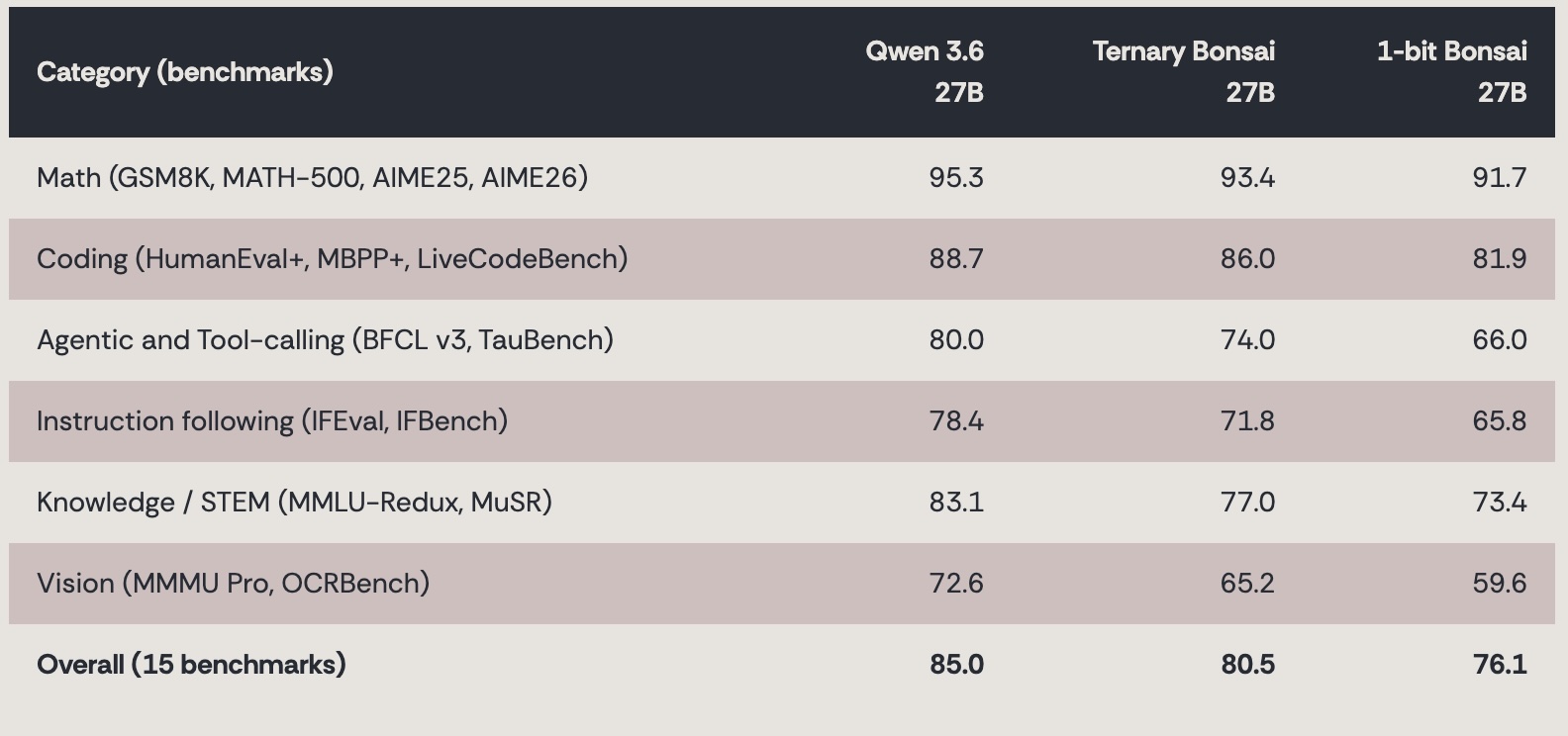
In PrismML's own evaluation across 15 benchmarks, the larger variant keeps 95 percent of the original model's performance. The smaller one keeps 90 percent. Math and coding stayed "virtually unaffected," according to PrismML.
The bigger drops showed up with the more aggressive compression, especially in image understanding, instruction following, and agent-based tool use. A conventionally compressed Qwen3.6-27B model at 9.4 GB scores only 72.7 points, while the smaller Bonsai variant at 3.9 GB scores 76.1.
According to the white paper, the smaller variant generates about 11 tokens per second on an iPhone 17 Pro Max. A battery test yielded roughly 672 generated tokens per percentage point of battery charge, which extrapolates to about 67,000 tokens on a full charge. The chip throttled slightly after a little over five minutes.
The model weights are available under the Apache 2.0 license. Bonsai 27B runs on Apple devices:https://github.com/PrismML-Eng/Bonsai-demo/tree/main via Apple's MLX framework and on NVIDIA GPUs. PrismML also provides a time-limited, free Developer Preview API:https://www.together.ai/models/prism-ml-ternary-bonsai-27b and a live demo on HuggingFace:https://huggingface.co/spaces/webml-community/bonsai-webgpu-kernels.
The company was founded with backing from Khosla Ventures, Cerberus, and Google, and Samsung continues to support it. PrismML plans to apply its compression tech to Google's Gemma model:https://the-decoder.com/google-deepminds-gemma-4-12b-squeezes-multimodal-ai-onto-a-laptop-with-just-16-gb-of-ram/ series next, smaller versions of which already run on smartphones:https://the-decoder.com/googles-gemma-4-puts-free-agentic-ai-on-your-phone-and-no-data-ever-leaves-the-device/.
A licensed compression technology would also matter to Apple, whose own models have trailed the competition in benchmarks so far:https://the-decoder.com/emergency-meetings-and-failed-billion-dollar-talks-reveal-the-chaos-behind-apples-pivot-to-google-gemini/. At WWDC 2026:https://the-decoder.com/apple-intelligence-gets-a-second-go-with-the-help-of-google-and-nvidia/, Apple unveiled a revamped Siri built on foundation models developed with Google using Gemini technology. The most powerful on-device model already requires an iPhone with at least 12 GB of RAM, and complex queries run on Nvidia GPUs in Apple's cloud.
Stay in the loop on AI. Clear, useful, no fluff.
Follow The Decoder for AI news, background stories and expert analyses.

 扫码直达文章详情