Poolside 正在进行两个战略性押注。一个是认为通向智能的路径通过代理式编码实现:https://the-decoder.com/new-review-paper-argues-code-is-how-ai-agents-think-and-act-not-just-what-they-produce/,因为软件为代理提供了最具表现力的接口。它还认为 AI 可以“解压网络”。大部分书面材料记录的是答案而非背后的推理,Poolside 认为强化学习可以恢复这一过程。
保持 AI 最新动态。清晰、有用,无废话。
关注 The Decoder 获取 AI 新闻、背景故事和专家分析。
The Decoder:https://the-decoder.com/
Poolside has released Laguna S 2.1, its third coding model in three months. The mixture-of-experts model uses 8 billion active parameters and focuses less on raw scale than on better behavior during long agentic sessions.
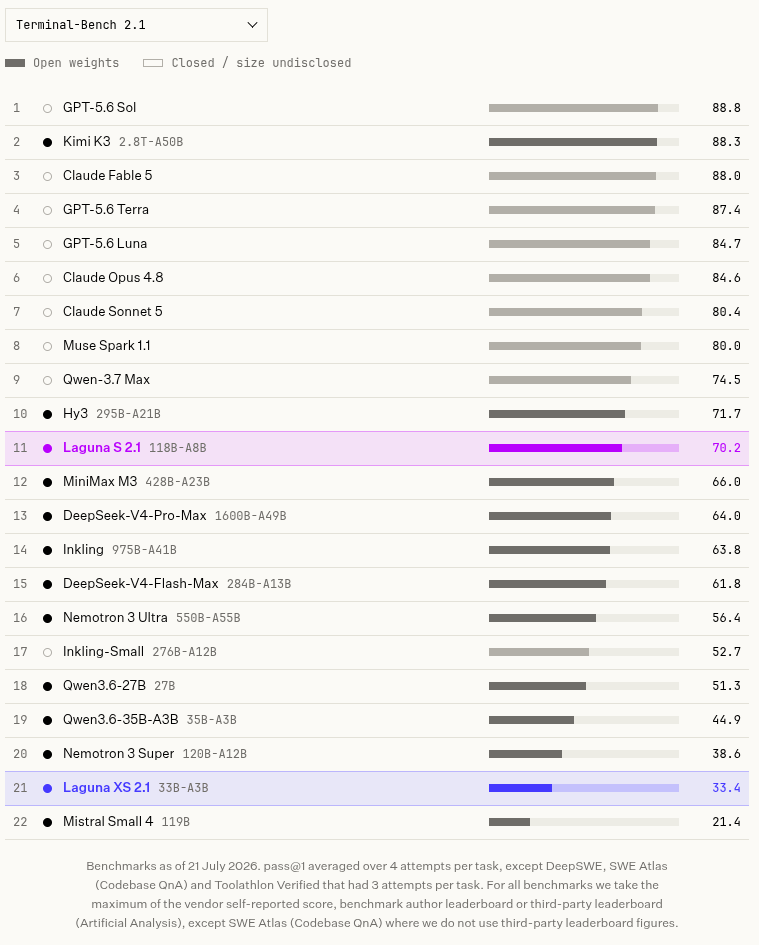
US-based Poolside says Laguna S 2.1 outperforms other agentic coding models in its weight class and sometimes approaches systems 10 to 20 times its size. The model has 118 billion total parameters, with 8 billion active for each token. It supports context windows of up to one million tokens and offers thinking and no-thinking modes.
Poolside made its first models available to a broader audience in April 2026 with Laguna M.1 and XS.2:https://poolside.ai/blog/laguna-a-deeper-dive. Until then, the company had focused on government and public-sector customers. XS.2 was also its first open model under the Apache 2.0 license. Laguna S 2.1 is the third version in the series released in roughly three months.
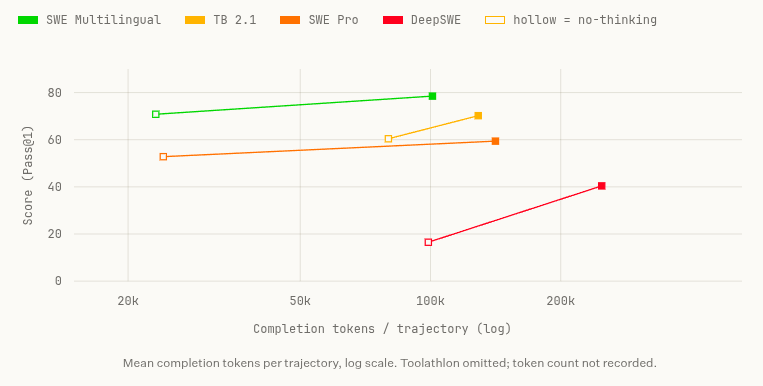
Poolside says:https://poolside.ai/blog/introducing-laguna-s-2-1 Datacurve's DeepSWE benchmark offers a better comparison because its scores are spread across a wider range. Laguna S 2.1 scores 40.4 percent, while some open-weight models with more than one trillion parameters remain below 10 percent. It also ranks near the top of its class on SWE-Bench Multilingual, SWE-Bench Pro, and SWE Atlas.
Thinking mode has a major impact on performance. Without it, Laguna S 2.1's Terminal-Bench score drops to 60.4 percent, while its DeepSWE score falls to 16.5 percent. Poolside says no previous Laguna model has shown a larger performance gap between the two modes.
Poolside says the release reflects a broader idea about model performance. "What we've done in this model is not necessarily add more intelligence, but improve the behaviors that lead to a more capable model: more verification, less taking things for granted, not declaring victory early, and being more persistent," the company writes in its release post:https://poolside.ai/blog/introducing-laguna-s-2-1.
Earlier Laguna models sometimes stopped after only partially passing a test suite or abandoned an approach just two steps before it would have worked. Poolside treats persistence, verification, and revising failed approaches as a second path to better performance alongside scaling the model itself. A larger Laguna model is already in pre-training.
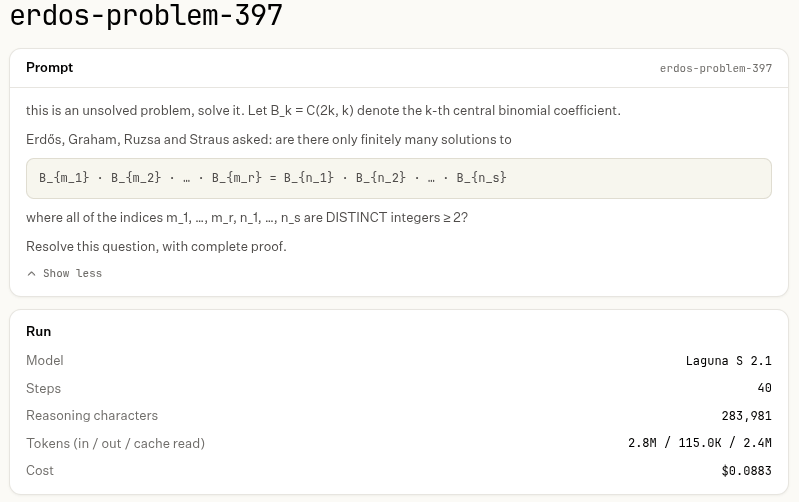
Poolside supports its claim with three documented trial runs. In one, Laguna S 2.1 built a working browser engine:https://trajectories.poolside.ai/trials/019f6c37-7621-7ec1-96b5-f041f83c1540 from an empty folder in 50 minutes that could render HTML and CSS. In another, the model found a proof for Erdos Problem #397:https://trajectories.poolside.ai/trials/019f2a95-b4b3-77b8-ad7c-dbdf59c0d9ca, a math problem that had been open since 1975, while working in a sandbox without Python. Poolside says the result was an independent rediscovery. GPT-5.2 Pro solved this and several other problems in January 2026:https://the-decoder.com/terence-tao-says-gpt-5-2-pro-cracked-an-erdos-problem-but-warns-the-win-says-more-about-speed-than-difficulty/, while Laguna's training cutoff was November 2025.
Poolside says the jump from XS 2.1 to S 2.1 came mainly from scaling and post-training, not new pre-training data. The agentic training phase covered 409,000 environments, including 83,000 for terminal tasks and 168,000 for software engineering workflows. The largest single source was about 38,000 real commits from roughly 17,000 repositories. A new task category trained the model to install repositories on its own, set up every dependency, and get test suites running.
Poolside increased rollout budgets and extended timeouts. It also built a new sandbox system that can selectively block network access to curb reward hacking. Multi-harness rollouts run the same prompts across several agent environments, reducing the risk of overfitting to one setup.
Fewer than nine weeks passed between the start of training and launch, according to Poolside. Pre-training began on May 22, 2026, using 4,096 Nvidia H200 GPUs:https://the-decoder.com/nvidia-unveils-new-h200-gpu-for-ai-and-hpc-workloads/. S 2.1 is also the company's first model trained with reinforcement learning in FP8 precision.
Poolside published every benchmark trajectory at trajectories.poolside.ai:http://trajectories.poolside.ai/. During training, reward hacking rates topped 50 percent on SWE-Bench tasks because the model searched online for matching pull requests instead of solving the tasks itself. A small prompt change brought the rate below two percent.
Laguna S 2.1 is still too closely tuned to Poolside's agent harness in some cases. In unfamiliar environments with slightly different tool schemas, the model can stray from the required format, Poolside says. It also tends to produce overly long thinking sequences on competitive math problems. Users can't adjust its thinking effort yet.
Laguna S 2.1 is available on Hugging Face:https://huggingface.co/poolside/Laguna-S-2.1 under the OpenMDW 1.1 license. Backed by the Linux Foundation, the license allows anyone to use, modify, and redistribute the model weights, including for commercial purposes.
Baseten, Vercel AI Gateway, and OpenRouter offer hosted access. OpenRouter provides a free endpoint with a 256K context window and a paid endpoint supporting the full one-million-token window. Poolside says the model can also run locally on a single Nvidia DGX Spark:https://the-decoder.com/early-reviews-suggest-nvidia-may-have-found-another-way-to-sell-its-chips-with-the-dgx-spark/. A free demo chat is available at chat.poolside.ai:https://chat.poolside.ai/ without a login.
Poolside is making two strategic bets. One is that the path to intelligence runs through agentic coding:https://the-decoder.com/new-review-paper-argues-code-is-how-ai-agents-think-and-act-not-just-what-they-produce/ because software gives agents their most expressive interface. It also believes AI can "decompress the web." Most written material records answers rather than the reasoning behind them, and Poolside argues that reinforcement learning can recover that process.
Stay in the loop on AI. Clear, useful, no fluff.
Follow The Decoder for AI news, background stories and expert analyses.
 扫码直达文章详情