Anthropic 为 Claude Opus 5 和 Claude Fable 5 等新一代模型删除了 Claude Code 超过 80% 的系统提示词,且编码评测无显著损...
技巧观点Claude:Blog(网页)
今日 AI 情报摘要
Anthropic 为 Claude Opus 5 和 Claude Fable 5 等新一代模型删除了 Claude Code 超过 80% 的系统提示词,且编码评测无显著损失。
中文正文 · AI 翻译
我们为更高级的模型移除了 Claude Code 系统提示的 80% 以上。如何将我们学到的经验应用到你在 Claude Code 和你自己的智能代理中的上下文工程中。
我之前写过关于如何最佳地提示新一代 Claude 5 模型的文章:https://claude.com/blog/a-field-guide-to-claude-fable-finding-your-unknowns,并讨论了如何与它们迭代工作,以发现你想要构建的内容。
但是当你向 Claude 发送消息时,提示只是它获得的上下文的一小部分。你的大部分上下文来自系统提示、Skills、CLAUDE.md 文件、记忆以及其他来源。我们称之为上下文工程:https://www.anthropic.com/engineering/effective-context-engineering-for-ai-agents,它对你在使用 Claude Code 或构建你自己的代理时生成的结果有很大影响。
与提示不同,上下文通常用于许多请求,因此不能过于具体。你如何为 Claude 构建这些通用的提示和指导,尤其是在你不知道用户的提示可能是什么的情况下?
这可能出乎意料地困难,因为 Claude 自身的能力在不断演变。最近,我们注意到在提示新一代 Claude 模型时有了很大变化。对于 Claude Opus 5 和 Claude Fable 5 等模型,我们移除了 Claude Code 系统提示的 80% 以上,而在我们的编码评估中没有可测量的损失。
在计划模式下,Claude Code 主要依赖带有计划的 markdown 文件。将这些文件作为计划存储,有助于 Claude 在需要时参考它们。另一个类似的最佳实践是将规范存储在代码库中,以便 Claude 在处理较长项目时参考。
但我们发现 Claude 能够处理越来越复杂的参考资料。不再只是简单的 markdown 文件,Claude 现在可以引用由我们新的工件功能创建的 HTML 工件。
你也可以以代码的形式给 Claude 提供参考。规范也可能是详细的测试套件,或是 Claude 可能会移植的另一个代码库中的函数。
评分标准(Rubrics)是另一种参考形式。评分标准允许 Claude 通过使用动态工作流尝试并验证你在特定领域的品味(例如,好的 API 设计是什么样的):https://claude.com/blog/a-harness-for-every-task-dynamic-workflows-in-claude,并利用这些评分标准启动验证代理。
把这一切整合起来,当你组装上下文时,它会是什么样子?
系统提示与产品上下文紧密相关。它告诉 Claude 正在操作哪个产品以及正在做什么。对于 Claude Code,你很可能永远不需要修改它,但如果你正在构建自己的代理框架,这里是你应该投入大量时间的地方。
保持你的 CLAUDE.md 简洁,简要描述你的仓库用途,但大部分篇幅应放在代码库内部的注意事项上。例如,你可以将代码组织成将类型集中在一个单一文件中,而不出现在其他地方。避免陈述 Claude 通过查看你的文件系统或仓库就能知道的“显而易见”的事情。
We removed over 80% of Claude Code's system prompt for more advanced models. How to apply the lessons we learned to your own context engineering in Claude Code and with your own agents.
I’ve written previously about how to best prompt the newest generation of Claude 5 models:https://claude.com/blog/a-field-guide-to-claude-fable-finding-your-unknowns and work with them iteratively to discover what you want to build.
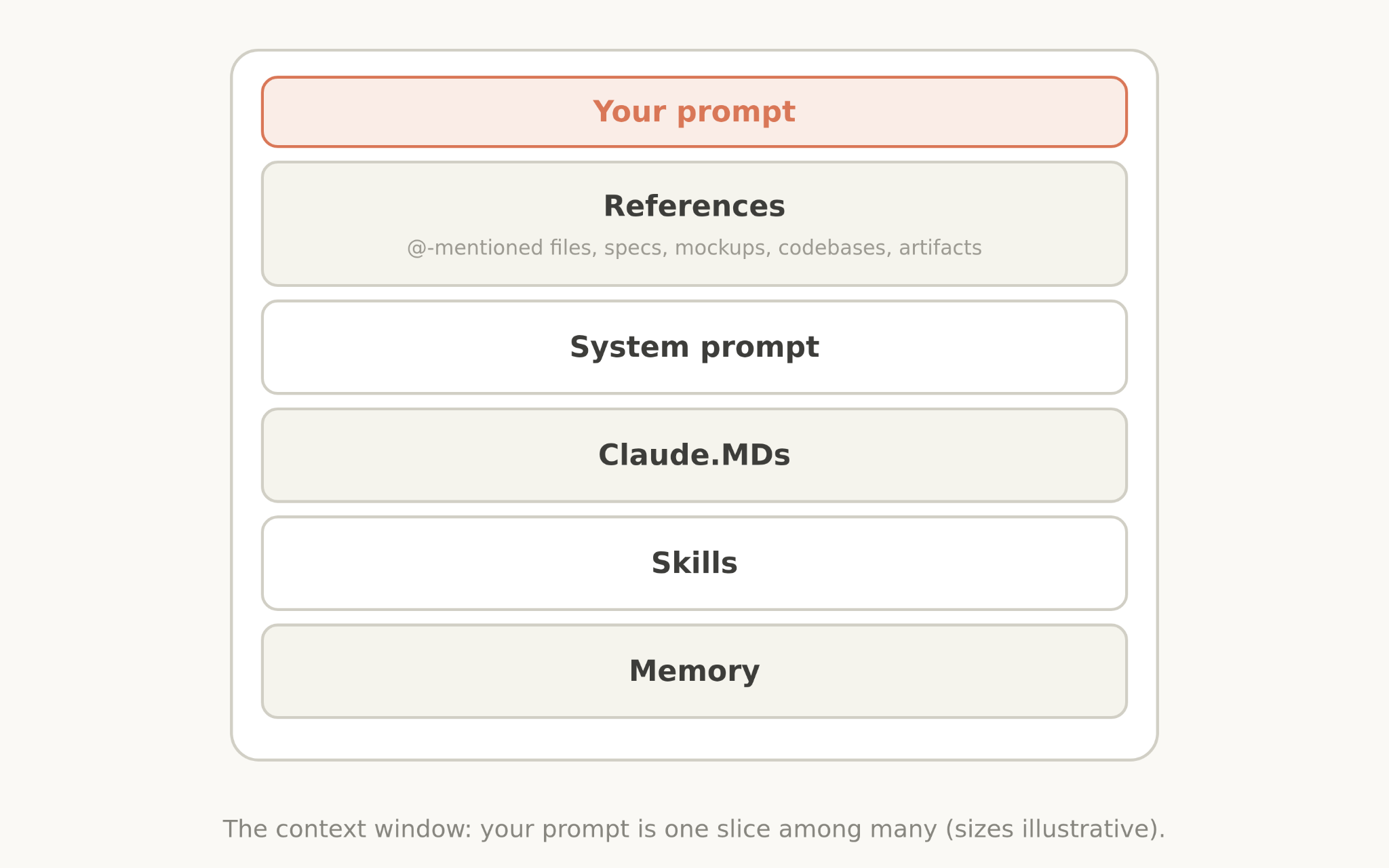
But when you send a message to Claude, the prompt is only a small part of the context it gets. Much of your context is assembled from your system prompt, Skills, CLAUDE.md files, memory, and other sources. We call this context engineering:https://www.anthropic.com/engineering/effective-context-engineering-for-ai-agents, and it makes a big impact on the results you generate when using Claude Code or in building your own agents.
Unlike a prompt, context is used generally across many requests, so it cannot be as specific. How do you build these general prompts and guidance for Claude, especially when you don’t know what a user’s prompt might be?
This can be surprisingly difficult as Claude’s own capabilities evolve. Most recently, we noticed a large jump in the way we prompt the newest generation of Claude models. We removed over 80% of Claude Code’s system prompt for models like Claude Opus 5 and Claude Fable 5 with no measurable loss on our coding evaluations.
Here’s what we’ve learned about prompting this new class of models, and how you can utilize it to update your context engineering. We’ve put these best practices in `claude doctor;` use the command /doctor in Claude Code to rightsize your skills, and CLAUDE.md files.
Overall, we found that we were overconstraining Claude Code, both through our system prompt and in our CLAUDE.md files and skills.
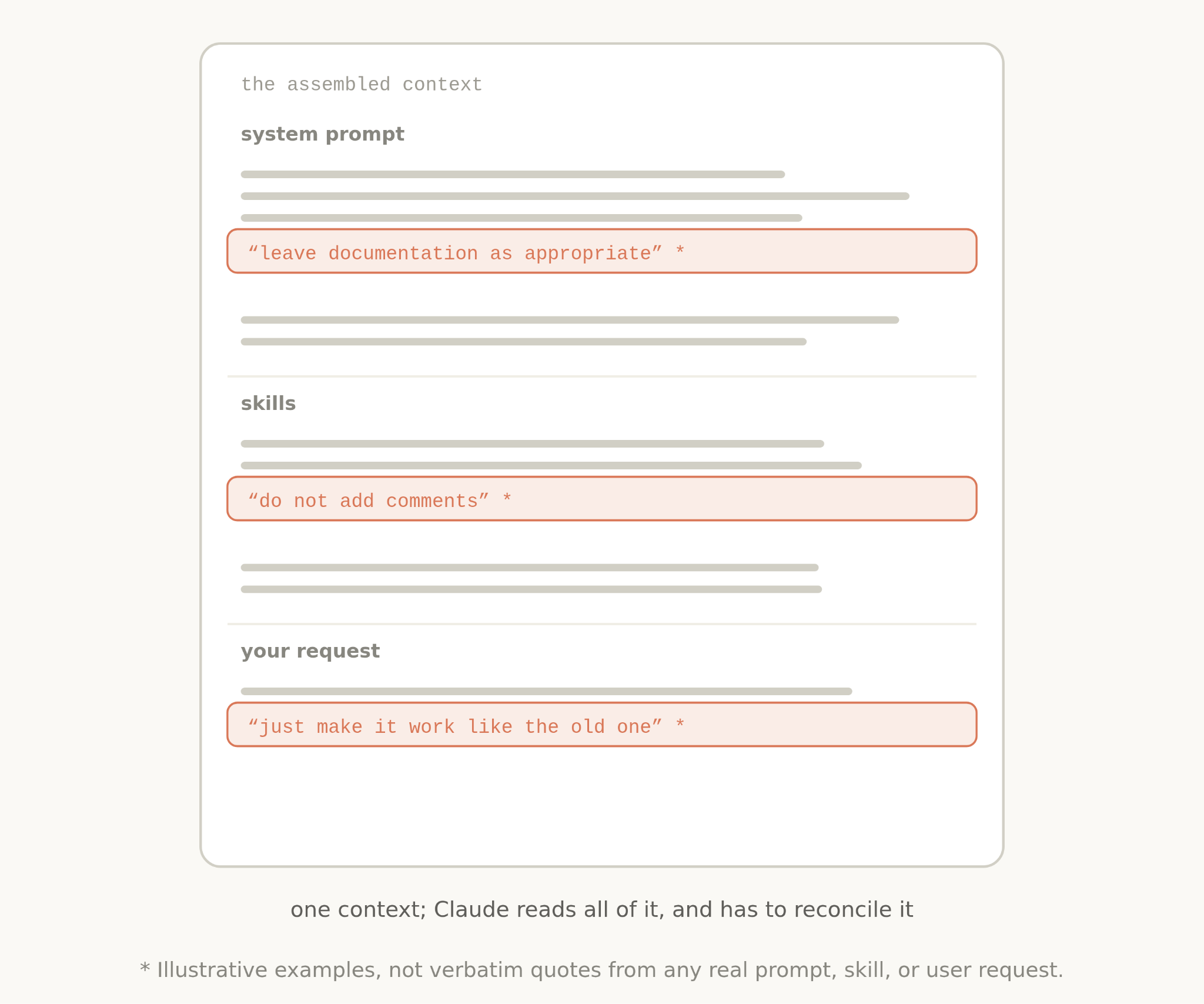
For example, when we read transcripts of our own internal usage of Claude Code, we see several conflicting messages in a single request like “leave documentation as appropriate,” or “DO NOT add comments” as our system prompt, skills, and user requests clash with each other.
Generally, Claude can interpret the user’s intent to get to the right answer, but Claude must think more carefully about these overlapping and conflicting messages before deciding what to do.
And while these constraints were once needed to avoid worst case scenarios, we have since found we can delete many of them and let the model use surrounding context and judgement instead.
Additionally, Claude Code now has many more tools. Claude used to rely on CLAUDE.md as a source of memory, information, and guidance. Now we have memory, artifacts, and skills, which Claude can use to create new ways of loading and sharing context across sessions.
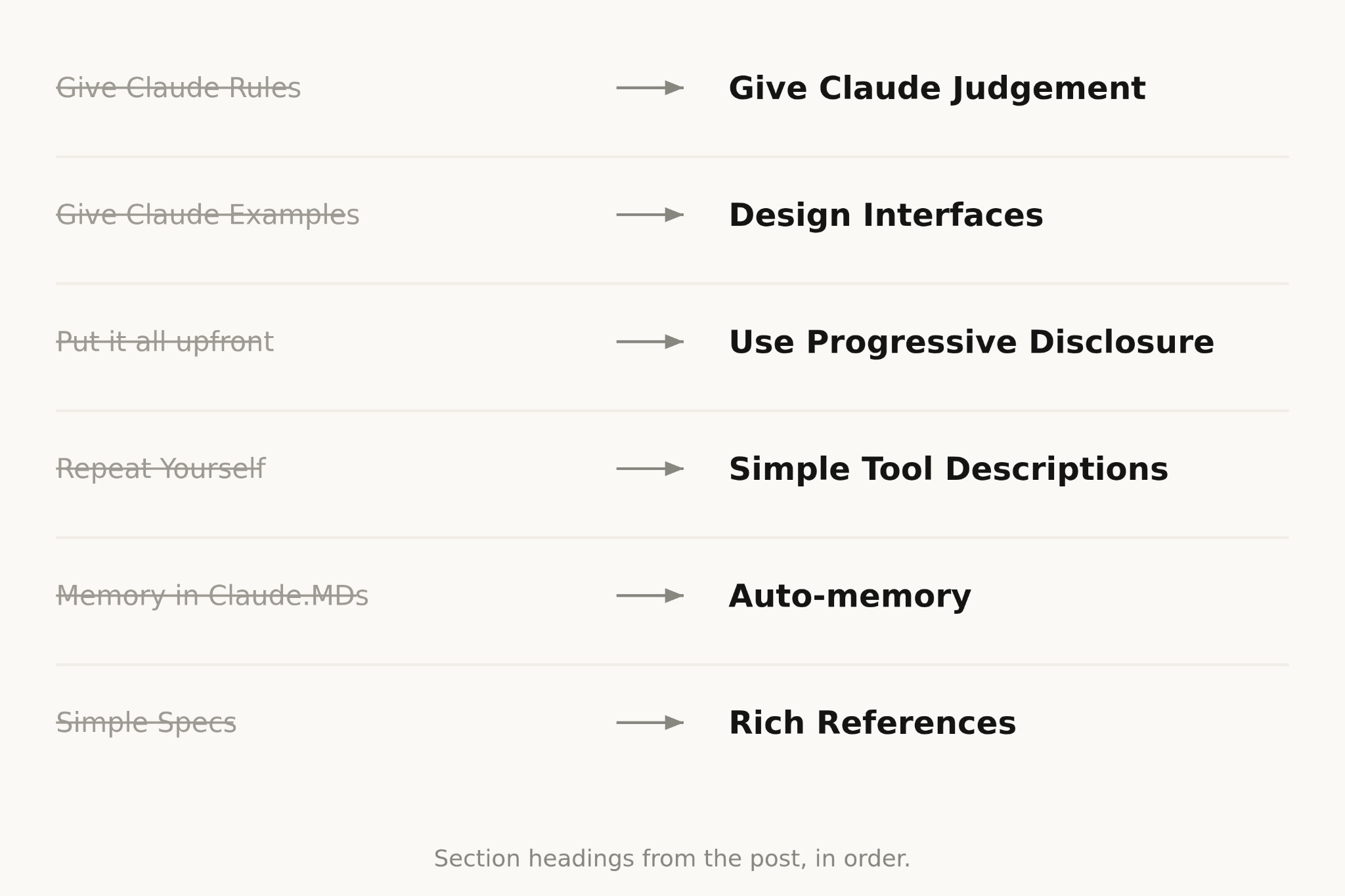
There were a number of previous context engineering best practices that had become myths. Including:.
When we first rolled out Claude Code, we needed to be sure that Claude avoided worst case scenarios, such as deleting files. This meant we would give particularly strong guidance that might not always be true, For example, in the system prompt we used to say:
In code: default to writing no comments. Never write multi-paragraph docstrings or multi-line comment blocks — one short line max. Don't create planning, decision, or analysis documents unless the user asks for them — work from conversation context, not intermediate files.
But for a certain subset of prompts, this guidance would be wrong. In the case of documentation, the user may have their own preferences, or specific parts of very complex code might need multi-line comment blocks.
Still, without these guardrails for older models, the comments Claude wrote would be incorrect in many cases and we had to accept this tradeoff. But newer models have better judgement and can handle these decisions well without explicit rules.
In the new system prompt we say: Write code that reads like the surrounding code: match its comment density, naming, and idiom.
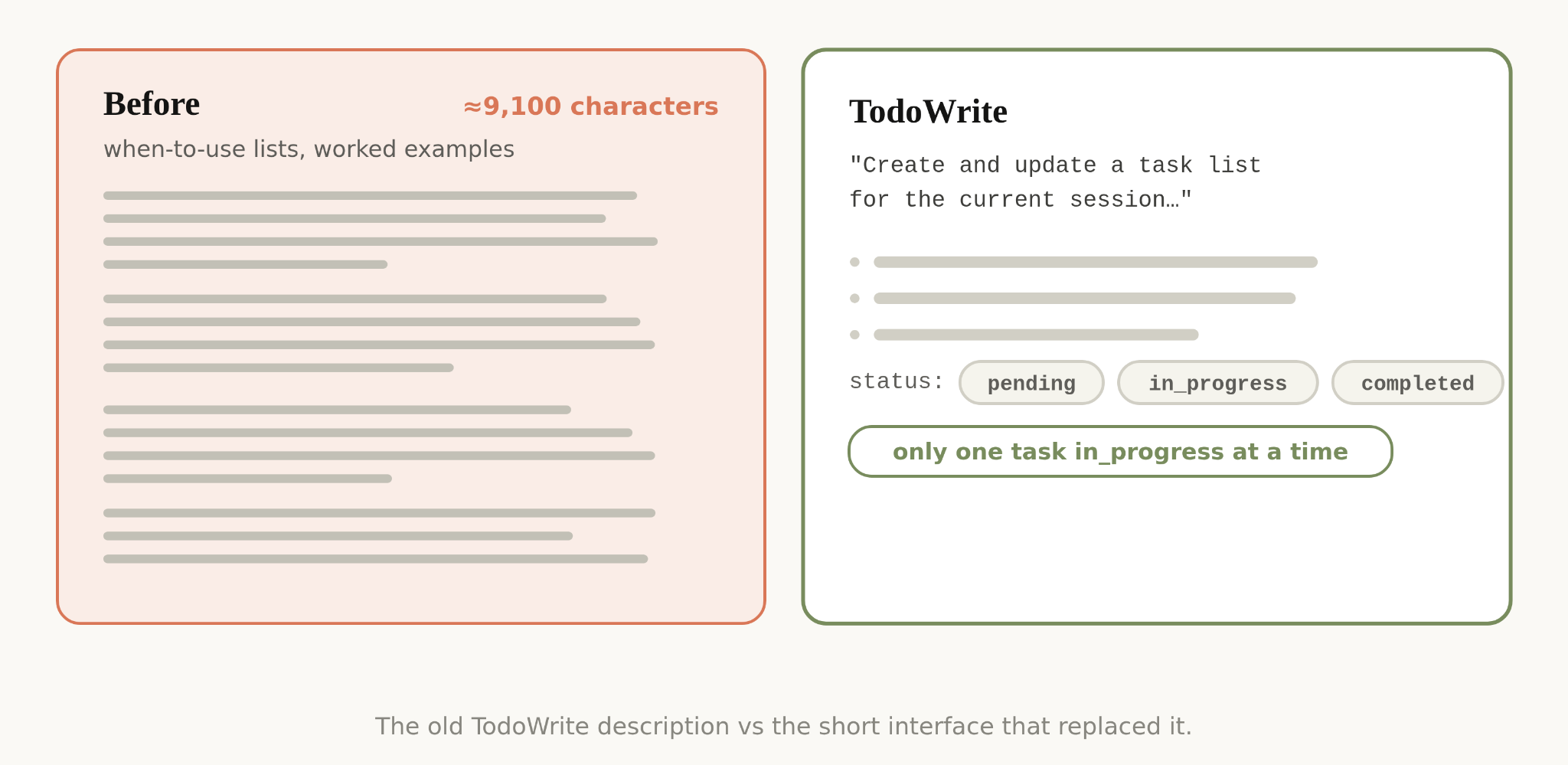
The number one rule for tool usage was to give Claude examples on how to use them. With our newest models, we’ve found that giving examples actually constrains them to a certain exploration space.
Instead of using examples, think more about the design of your tools, scripts and files- what parameters does Claude have and how can they be more expressive?
For example, in the Todo tool example, just listing status as an enumeration between pending, in_progress, and completed, hints to Claude about how to use it. The instruction on keeping one item in_progress helps define our requested behavior.
Because Claude Code was focused on coding, our system prompt included detailed information on how to do code review and verification. These were not always needed, but when they were, it was crucial information.
Since then, Claude Code has gotten very competent at using progressive disclosure- loading the right context at the right times. For example, we moved verification and code review into their own skills that Claude Code could selectively call.
But progressive disclosure is not just for skills, we also use it for tools. Some of our tools are ‘deferred loading,’ which means the agent must search for their full definitions using ToolSearch before using them. This allows us to have more tools (such as our Task tools) that don’t take up context until they’re needed.
The same can be applied to your own CLAUDE.md and Skill.md files. A common myth is that you want to make these a central repository for every known practice that you might run into, because Claude would not find it otherwise. Instead, consider having a tree of files that can be loaded at the right time:https://claude.com/blog/a-harness-for-every-task-dynamic-workflows-in-claude-code.
Earlier Claude models could sometimes need repeated instructions or be more likely to listen to instructions at the end of their context window than at the start. This meant our system prompt would sometimes have references to tools in the main system prompt as well as instructions in the tool description.
We found we could delete these repeat examples and put instructions on how to use tools in the tool descriptions rather than the system prompt.
We used to encourage users to save things to Claude’s memory, by using the # hotkey to write to their CLAUDE.md:http://claude.md automatically. Instead, Claude now automatically saves memories that are relevant to the work and to you.
In plan mode, Claude Code has heavily relied on markdown files with plans. Storing these files as plans helped Claude refer to them when needed. Another similar best practice was to store specs in the codebase for Claude to refer to while working across longer projects.
But we’ve found that Claude can handle increasingly more complicated references. Instead of simple markdown files, Claude can reference HTML artifacts created by our new artifacts feature.
You may also give Claude references in the form of code. A spec may also be a detailed test suite, or a function in a different codebase that Claude might port.
Rubrics are another form of references. Rubrics allow Claude to try and verify your taste in a particular field (e.g. what does a good API design look like) by using dynamic workflows:https://claude.com/blog/a-harness-for-every-task-dynamic-workflows-in-claude-code and spinning up verifier agents with those rubrics.
Pulling this all together, what does this look like when you assemble your context?
A system prompt is heavily tied to the product context. It tells Claude what product it’s operating in and what it’s doing. For Claude Code, you will likely never modify this, but if you are building your own agent harness, this is where you should spend a lot of time.
Keep your CLAUDE.md lightweight and briefly describe what your repo is for, but spend most of the tokens on gotchas inside of the codebase. For example, you may organize your code to keep types in one monolithic file and nowhere else. Avoid stating ‘the obvious’ things Claude should know by looking at your file system or your repo.
Use progressive disclosure heavily, for example if you have several unique instructions on how to verify your work, create a verification skill and reference it from your CLAUDE.md.
Think of skills as lightweight guides to let Claude find information when needed. Avoid making them overconstrained, except in highly important areas.
For long skills, try and use progressive disclosure as much as possible- divide it into many files and split them out.
It’s best when skills encode particular opinions, knowledge, or best practices that are particular to you, your team, or product.
You can @ mention files to include them as references. References allow Claude to refer to in-depth information about the current plan.
This might be in specs files, mockups, or even entire codebases. Generally you should prefer files that are in code as it provides clear, high-fidelity instructions to Claude in a language it knows very well. For example, a HTML mockup of a design will generally produce better results than a description of the design or a screenshot.
Across your system prompt, skills, and CLAUDE.md files, you may need to simplify just like we did. We rolled out a new command called `claude doctor,` which will help you do this automatically as well. For more details on prompting more advanced models specifically, check out our Fable field guide:https://claude.com/blog/a-field-guide-to-claude-fable-finding-your-unknowns.
This article was written by Thariq Shihipar, member of technical staff, Anthropic.
Explore more product news and best practices for teams building with Claude.
Product updates, how-tos, community spotlights, and more. Delivered monthly to your inbox.
Hi Claude! Could you help me develop a unique voice for an audience? If you need more information from me, ask me 1-2 key questions right away. If you think I should upload any documents that would help you do a better job, let me know. You can use the tools you have access to— like Google Drive, web search, etc.—if they’ll help you better accomplish this task. Do not use analysis tool. Please keep your responses friendly, brief and conversational. Please execute the task as soon as you can—an artifact would be great if it makes sense. If using an artifact, consider what kind of artifact (interactive, visual, checklist, etc.) might be most helpful for this specific task. Thanks for your help!
Hi Claude! Could you improve my writing style? If you need more information from me, ask me 1-2 key questions right away. If you think I should upload any documents that would help you do a better job, let me know. You can use the tools you have access to— like Google Drive, web search, etc.—if they’ll help you better accomplish this task. Do not use analysis tool. Please keep your responses friendly, brief and conversational. Please execute the task as soon as you can—an artifact would be great if it makes sense. If using an artifact, consider what kind of artifact (interactive, visual, checklist, etc.) might be most helpful for this specific task. Thanks for your help!
Hi Claude! Could you brainstorm creative ideas? If you need more information from me, ask me 1-2 key questions right away. If you think I should upload any documents that would help you do a better job, let me know. You can use the tools you have access to— like Google Drive, web search, etc.—if they’ll help you better accomplish this task. Do not use analysis tool. Please keep your responses friendly, brief and conversational. Please execute the task as soon as you can—an artifact would be great if it makes sense. If using an artifact, consider what kind of artifact (interactive, visual, checklist, etc.) might be most helpful for this specific task. Thanks for your help!
Hi Claude! Could you explain a complex topic simply? If you need more information from me, ask me 1-2 key questions right away. If you think I should upload any documents that would help you do a better job, let me know. You can use the tools you have access to— like Google Drive, web search, etc.—if they’ll help you better accomplish this task. Do not use analysis tool. Please keep your responses friendly, brief and conversational. Please execute the task as soon as you can—an artifact would be great if it makes sense. If using an artifact, consider what kind of artifact (interactive, visual, checklist, etc.) might be most helpful for this specific task. Thanks for your help!
Hi Claude! Could you help me make sense of these ideas? If you need more information from me, ask me 1-2 key questions right away. If you think I should upload any documents that would help you do a better job, let me know. You can use the tools you have access to— like Google Drive, web search, etc.—if they’ll help you better accomplish this task. Do not use analysis tool. Please keep your responses friendly, brief and conversational. Please execute the task as soon as you can—an artifact would be great if it makes sense. If using an artifact, consider what kind of artifact (interactive, visual, checklist, etc.) might be most helpful for this specific task. Thanks for your help!
Hi Claude! Could you prepare for an exam or interview? If you need more information from me, ask me 1-2 key questions right away. If you think I should upload any documents that would help you do a better job, let me know. You can use the tools you have access to— like Google Drive, web search, etc.—if they’ll help you better accomplish this task. Do not use analysis tool. Please keep your responses friendly, brief and conversational. Please execute the task as soon as you can—an artifact would be great if it makes sense. If using an artifact, consider what kind of artifact (interactive, visual, checklist, etc.) might be most helpful for this specific task. Thanks for your help!
Hi Claude! Could you explain a programming concept? If you need more information from me, ask me 1-2 key questions right away. If you think I should upload any documents that would help you do a better job, let me know. You can use the tools you have access to— like Google Drive, web search, etc.—if they’ll help you better accomplish this task. Do not use analysis tool. Please keep your responses friendly, brief and conversational. Please execute the task as soon as you can—an artifact would be great if it makes sense. If using an artifact, consider what kind of artifact (interactive, visual, checklist, etc.) might be most helpful for this specific task. Thanks for your help!
Hi Claude! Could you look over my code and give me tips? If you need more information from me, ask me 1-2 key questions right away. If you think I should upload any documents that would help you do a better job, let me know. You can use the tools you have access to— like Google Drive, web search, etc.—if they’ll help you better accomplish this task. Do not use analysis tool. Please keep your responses friendly, brief and conversational. Please execute the task as soon as you can—an artifact would be great if it makes sense. If using an artifact, consider what kind of artifact (interactive, visual, checklist, etc.) might be most helpful for this specific task. Thanks for your help!
Hi Claude! Could you vibe code with me? If you need more information from me, ask me 1-2 key questions right away. If you think I should upload any documents that would help you do a better job, let me know. You can use the tools you have access to— like Google Drive, web search, etc.—if they’ll help you better accomplish this task. Do not use analysis tool. Please keep your responses friendly, brief and conversational. Please execute the task as soon as you can—an artifact would be great if it makes sense. If using an artifact, consider what kind of artifact (interactive, visual, checklist, etc.) might be most helpful for this specific task. Thanks for your help!
Hi Claude! Could you write grant proposals? If you need more information from me, ask me 1-2 key questions right away. If you think I should upload any documents that would help you do a better job, let me know. You can use the tools you have access to — like Google Drive, web search, etc. — if they’ll help you better accomplish this task. Do not use analysis tool. Please keep your responses friendly, brief and conversational. Please execute the task as soon as you can - an artifact would be great if it makes sense. If using an artifact, consider what kind of artifact (interactive, visual, checklist, etc.) might be most helpful for this specific task. Thanks for your help!
情报判断
Aioga 编辑摘要
Anthropic 表示,面向 Claude Opus 5、Claude Fable 5 等新一代模型,Claude Code 删除了超过 80% 的系统提示词,并称其编码评测没有可测量的损失。

 扫码直达文章详情