The Decoder:AI News(RSS)Aioga 编辑团队2026-07-25T09:31:00.000Z热度 63
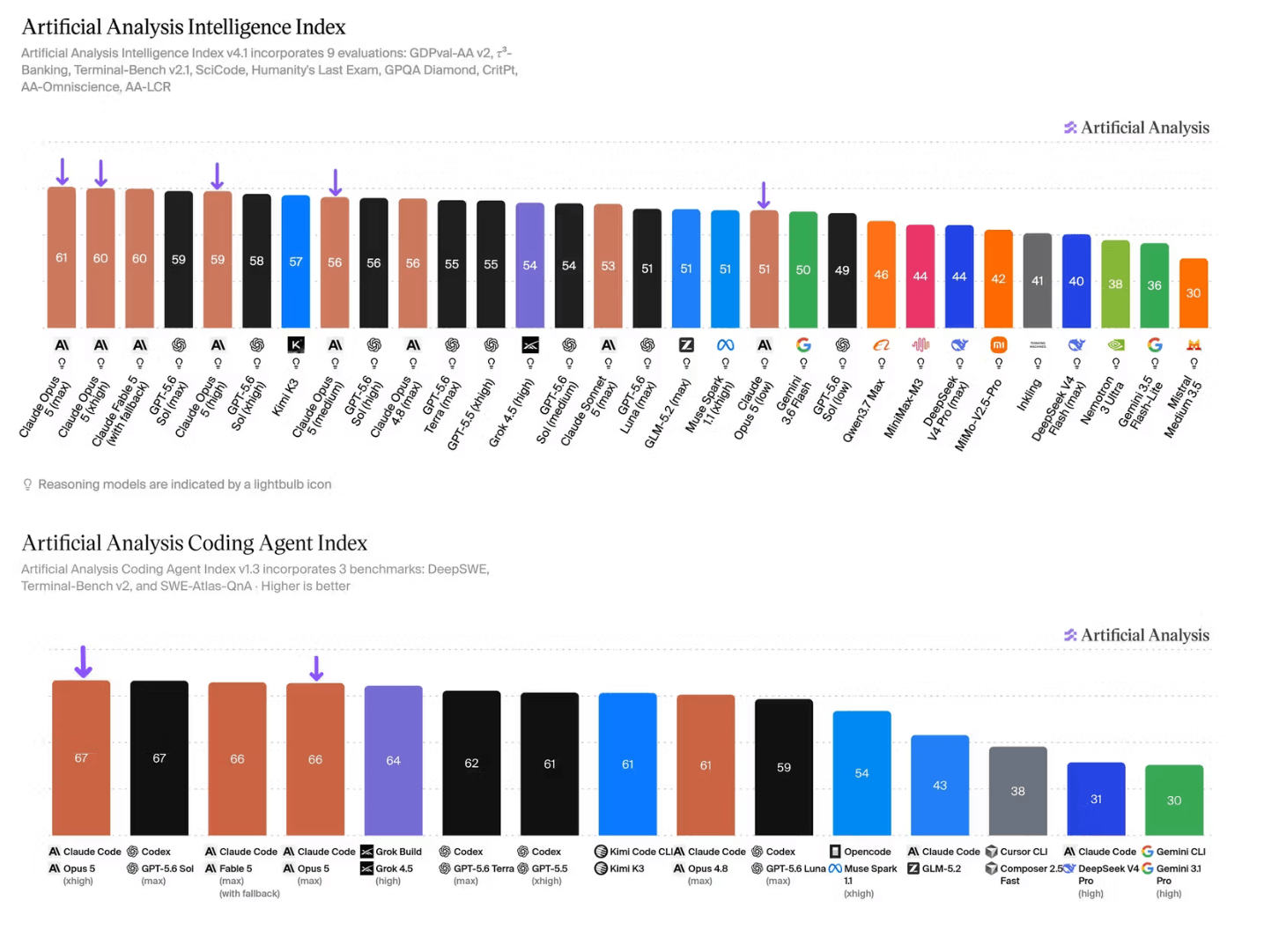
Anthropic 的 Claude Opus 5 在 Artificial Analysis 智能指数上以 61 分位居第一,领先 Fable 5(60 分)和 GPT-5....
技巧观点The Decoder:AI News(RSS)
今日 AI 情报摘要
Anthropic 的 Claude Opus 5 在 Artificial Analysis 智能指数上以 61 分位居第一,领先 Fable 5(60 分)和 GPT-5.6 Sol(59 分)。
其平均智能任务成本仅 $2.03,低于 Fable 5 的 $2.75,但幻觉率升至 50%。
中文正文 · AI 翻译
根据多个基准测试,Anthropic 的 Claude Opus 5 是目前最强大的 AI 模型,性能超过 Fable 5,同时成本更低。
Opus 5 在人工分析智能指数(Artificial Analysis Intelligence Index:https://artificialanalysis.ai/)中得分为 61,该指数结合了涵盖知识工作、编码、科学推理和事实准确性的九项测试。这使其略高于 Claude Fable 5(60)、GPT-5.6 Sol(59)、Kimi K3(57)和 Claude Opus 4.8(56)。人工分析与 Anthropic 合作,在模型公开发布前对其进行了测试。
在编码方面,Claude Opus 5 在“xhigh”模式下与 Claude Code 配合,在人工分析编码指数上并列第一,该指数衡量 AI 模型独立处理编程任务的能力,包括发现和修复漏洞。在 Terminal-Bench v2.1 测试中,该测试评估代理在真正终端环境中作为自主工程师的表现,Opus 5 在“max”模式下得分 89%,与之前的领先者 GPT-5.6 Sol 持平。
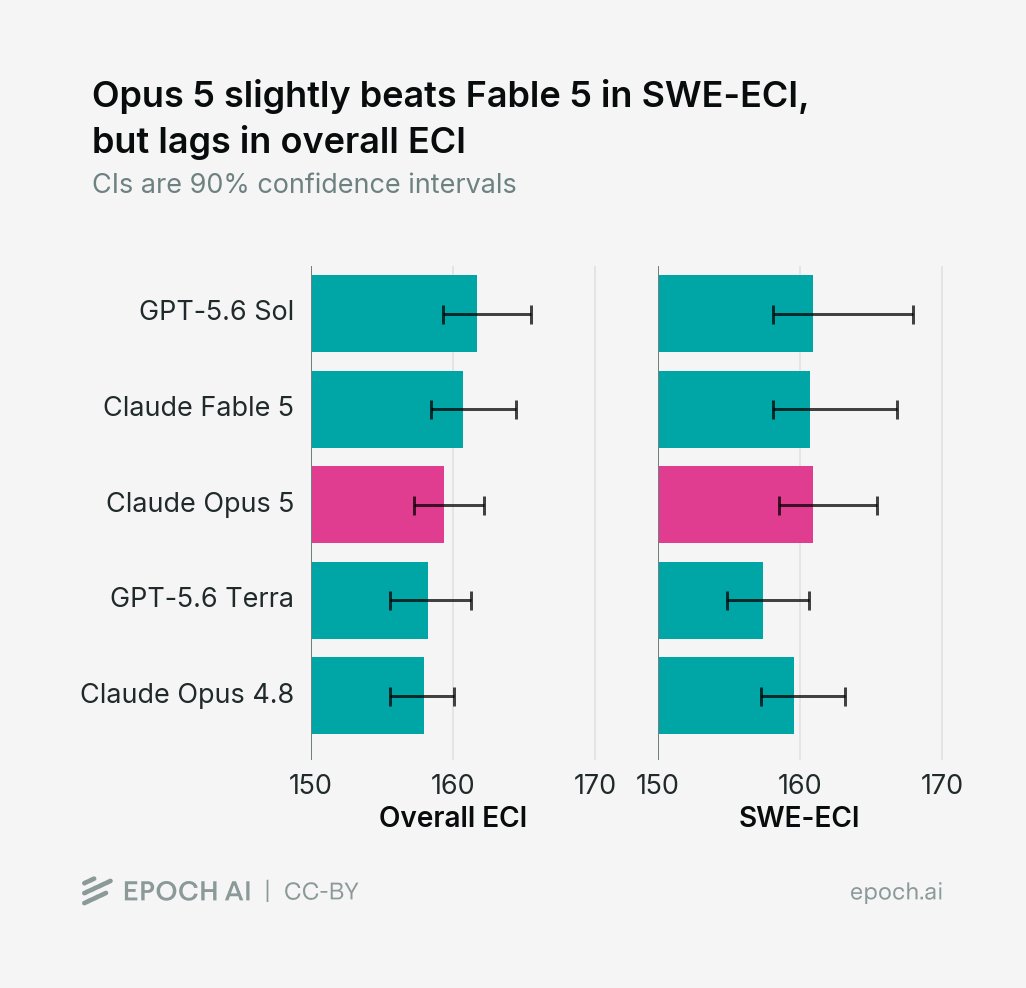
Epoch AI(https://epoch.ai/benchmarks/eci?subset-view=graph&subset-tab=Software+engineering&view=graph&tab=release-date)也对 Claude Opus 5 进行了测试。该研究机构给它的整体 Epoch 能力指数评分为 159,略低于 Fable 5 的 161。然而,仅在软件工程基准(SWE-ECI)中,Opus 5 与 Fable 5 并列 161,表现优于 GPT-5.6 Terra 和 Claude Opus 4.8。GPT-5.6 Sol 在两个类别中均领先。
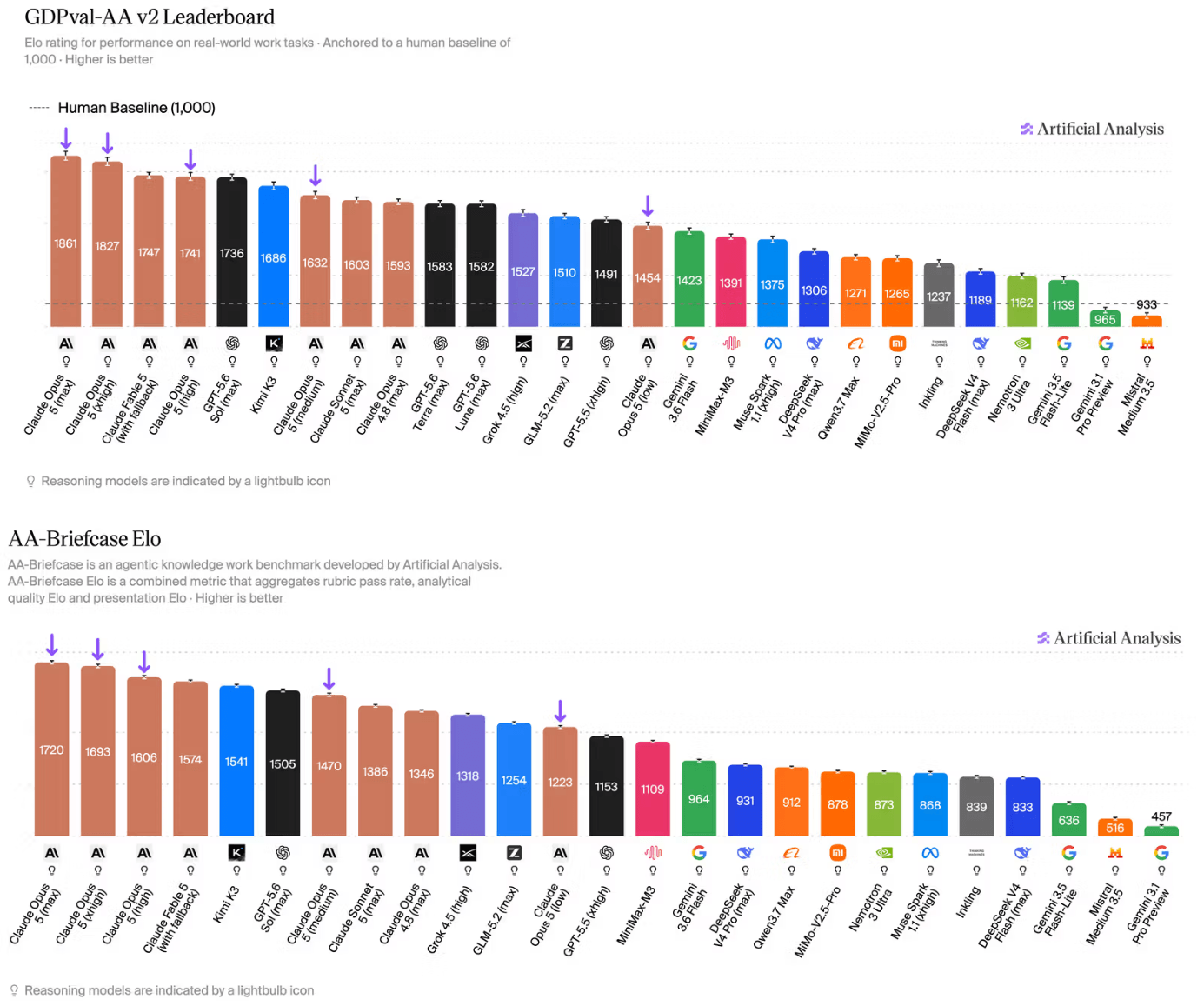
Opus 5在AA-Briefcase:https://artificialanalysis.ai/evaluations/aa-briefcase 基准测试中表现尤为出色,该基准评估AI模型处理典型办公任务的能力,如撰写研究报告、制作演示文稿以及基于数千个输入文件分析电子表格。性能从正确性、分析质量和演示质量进行评分,然后汇总为类似于国际象棋排名的Elo评分。
在最高推理水平下,Opus 5 的 Elo 达到 1720,比 Claude Fable 5(1574)高出整整 146 分。它的三个最高等级(max、xhigh、high)占据前三名。结合 Fable 5、Sonnet 5 和 Opus 4.8,Anthropic 现在掌握了前十名的大部分位置。
Anthropic's Claude Opus 5 is the most capable AI model available today, according to several benchmarks, outperforming Fable 5 while costing less.
Opus 5 scored 61 on the Artificial Analysis Intelligence Index:https://artificialanalysis.ai/, which combines nine tests covering knowledge work, coding, scientific reasoning, and factual accuracy. That puts it just ahead of Claude Fable 5 (60), GPT-5.6 Sol (59), Kimi K3 (57), and Claude Opus 4.8 (56). Artificial Analysis worked with Anthropic to test the model before its public release.
In coding, Claude Opus 5 at "xhigh" paired with Claude Code shares first place on the Artificial Analysis Coding Index, which measures how well AI models handle programming tasks on their own, including finding and fixing bugs. On Terminal-Bench v2.1, which tests agents as autonomous engineers in real terminal environments, Opus 5 scored 89 percent at "max," matching the previous leader GPT-5.6 Sol. Ad
For scientific reasoning, Opus 5 scored 53 percent on Humanity's Last Exam, a very difficult knowledge test covering many academic fields. That ties it with Fable 5. On CritPt, a physics benchmark from researchers at Argonne National Laboratory and UIUC, it again matches Fable 5 but trails GPT-5.6 Sol, GPT-5.5 Pro, and GPT-5.6 Terra. Ad DEC_D_Incontent-1
Factual accuracy remains a weak spot: On AA-Omniscience, which tests the accuracy of a model's knowledge claims, Opus 5 improved by 7 points over Opus 4.8 but still trails Fable 5. Opus 5 also answers more often when it's uncertain, pushing its hallucination rate up 14 points to 50 percent.
Epoch AI:https://epoch.ai/benchmarks/eci?subset-view=graph&subset-tab=Software+engineering&view=graph&tab=release-date has also tested Claude Opus 5. The research institute gave it an overall Epoch Capability Index score of 159, just below Fable 5 at 161. When looking solely at the software engineering benchmarks (SWE-ECI), though, Opus 5 ties with Fable 5 at 161, outperforming GPT-5.6 Terra and Claude Opus 4.8. GPT-5.6 Sol leads in both categories. Ad
Overall, this confirms that the race among frontier models is tight. No single model can pull away or claim a clear advantage. That lends weight to the argument that AI models will eventually become commoditized:https://the-decoder.com/microsoft-ceo-satya-nadella-says-ai-models-are-getting-commoditized/.
The average Intelligence Index task costs $2.03 with Opus 5, less than Claude Fable 5 with fallback at $2.75. It costs more than Opus 4.8 at $1.80 and Sonnet 5 at $1.53. At the "high" and "xhigh" tiers, however, Opus 5 beats both Opus 4.8 and Sonnet 5 while costing less. Ad DEC_D_Incontent-2
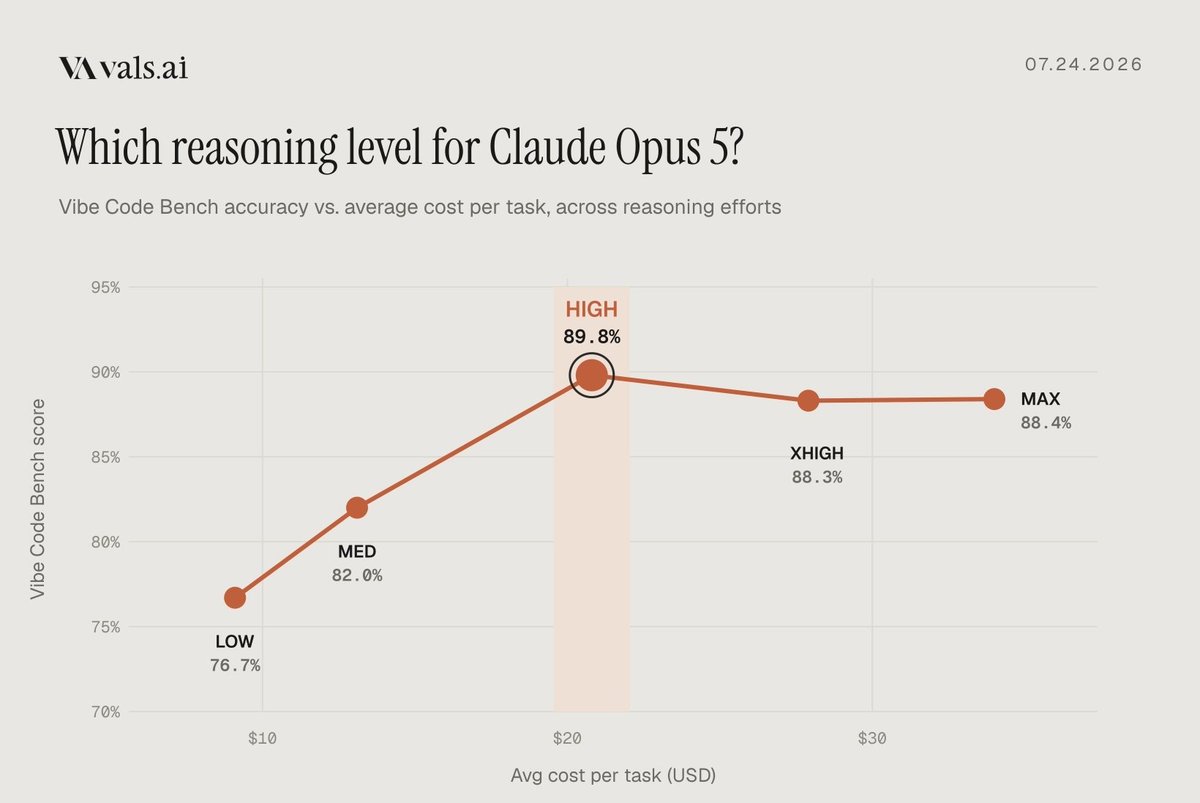
Vals.ai:https://vals.ai/ tested Claude Opus 5 across all five reasoning tiers using Vibe Code Bench, a benchmark for programming tasks. Scores climb from 76.7 percent at "low" to 82 percent at "medium" and 89.8 percent at "high." Performance dips at the two highest tiers, with "xhigh" scoring 88.3 percent and "max" scoring 88.4 percent despite much higher costs. Ad
Vals.ai found that the highest tiers tend to produce more complex solutions that contain errors more often. The "high" tier produces simpler solutions that meet the requirements more reliably.
Terminal-Bench 2.1:https://x.com/ValsAI/status/2080817015871451500 shows a similar pattern. The "high" tier beats "max" because the model spends more time on each attempt at the top tier, leaving fewer attempts within the time limit. That matches Anthropic's guidance, with "high" set as the default tier in both the API and Claude Code.
Token pricing stays at $5 per million input tokens and $25 per million output tokens. Cache writes cost $6.25 per million tokens with a five-minute lifetime, while cache hits run just $0.50 per million tokens.
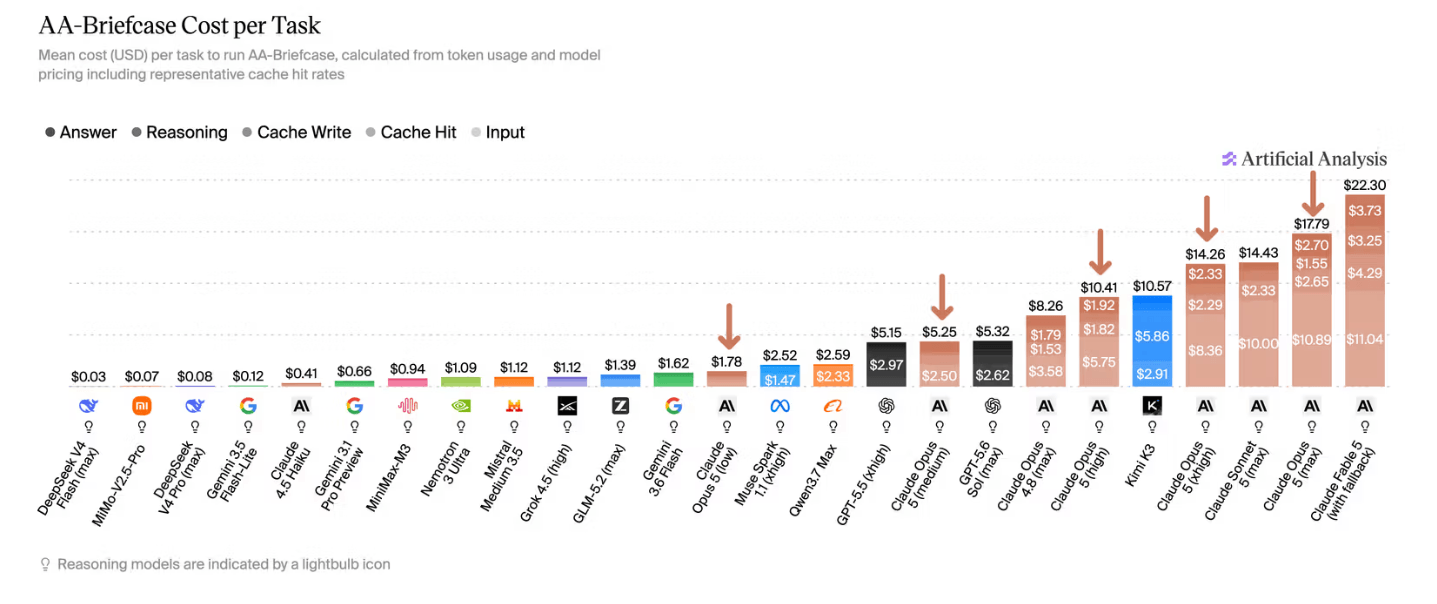
Opus 5 performs especially well on the AA-Briefcase:https://artificialanalysis.ai/evaluations/aa-briefcase benchmark, which measures how well AI models handle typical office tasks like writing research reports, building presentations, and analyzing spreadsheets based on thousands of input files. Performance is scored across correctness, analytical quality, and presentation quality, then rolled into an Elo rating similar to chess rankings.
At max reasoning, Opus 5 reaches an Elo of 1720, a full 146 points ahead of Claude Fable 5 (1574). Its three highest tiers (max, xhigh, high) sweep the top three spots. Combined with Fable 5, Sonnet 5, and Opus 4.8, Anthropic now holds the vast majority of top-10 positions.
Cost per task dropped 20 percent to $17.79, down from $22.30 for Fable 5. The "xhigh" variant costs $14.26, and "high" comes in at just $10.41, less than half of Fable 5. Both still beat Fable 5 in the Elo ranking. At medium performance, Opus 5 hits an Elo of 1470, just behind GPT-5.6 Sol (max, 1505). At low performance, it lands at 1223 Elo, slightly below GLM-5.2 (max, 1254).
Opus 5's biggest gains show up in analytical quality. At "max," it reaches an Analytical Quality Elo of 2016, almost 300 points ahead of Fable 5. Its Rubric Pass Rate, which tracks how often the model meets predefined quality standards, sits at 58 percent ("max"), 57.2 percent ("xhigh"), and 56 percent ("high"). Presentation quality is a different story. Opus 5 scores a Presentation Elo of 1628, about 40 points behind GPT-5.6 Sol at "max" (1666).
More performance takes more time: At "max," Opus 5 needs over 36 minutes per task and averages 103 passes, about 50 percent longer than Opus 4.8 at 24 minutes and 55 passes.
Stay in the loop on AI. Clear, useful, no fluff.
Follow The Decoder for AI news, background stories and expert analyses.
The Decoder:https://the-decoder.com/
情报判断
Aioga 编辑摘要
Aioga 编辑摘要:Anthropic 的 Claude Opus 5 在 Artificial Analysis 智能指数上以 61 分位居第一,领先 Fable 5(60 分)和 GPT-5.6 Sol(59 分)。 Aioga 将其归入「技巧观点」方向,重点关注它对真实使用和行业竞争的影响。

 扫码直达文章详情